

I started reading a new book this past week: A Liberation Theology of the Brain: Neuroscience, Theology, and Decolonizing Emotions by Carmelo Santos-Rolón. A daunting title, for sure, but it touches base with many of my interests both personal and professional, so I thought I’d give it a shot. Probably a bad idea the week before the new semester starts.
After a compelling introduction, here is the book’s first paragraph:
The mind is a storyteller, a creator of worlds, not a mere mirror or camera reflecting back reality as it actually is. Using information collected by the senses, and combining it with memories, feelings, and expectations, the mind weaves into being the universe that constitutes our reality. That does not mean that there is no objective reality out there. It simply means that our minds are part of that reality, we are part of that reality, and the only access we have to that reality is through our embodied minds.
I have never read a clearer, more compelling description of how the world “out there” and our minds “in here” co-create our reality. We know that there is an “as it actually is” to reality, but we have no direct access to it. Each of us inhabits a world of our own making where the facts we encounter are dressed in the clothing of stories woven from experiences, expectations, beliefs, and words. Here’s an example of how that works from my own life over the past ten days.
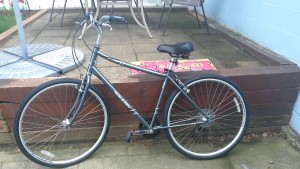 The Facts: Around 10:00 AM on Saturday, August 23, I had a serious bicycle crash. I was going down a hill at about 20 miles per hour. After an ambulance ride to the hospital, it was determined through appropriate scans and treatment that I had no broken bones or severe internal damage. What I did have was a cut over my right eye that took ten stitches, significant road rash literally from head to toe, a painfully jammed right shoulder, and a possible concussion. Ten days later, I am slowly but surely recovering.
The Story: As I was riding down a hill on a street that passes Brown University’s hockey arena, I swerved to avoid something in the road and went over the handlebars, crashing head and right shoulder first into a short stone wall dividing the sidewalk from someone’s front yard, then sliding on my right side down the sidewalk. A local Good Samaritan/guardian angel named John who was finishing his morning walk saw the violent (his word) crash and, after a moment’s shock, rushed to the scene, called 911, and stayed with me until the EMTs in the ambulance arrived.
As we waited for the ambulance, I told John that I had ridden from the Providence College area. “You look like a professor,” he said, and I confirmed that I am. But when the EMTs arrived, I was unable to answer basic questions like, What is your name? What is the date? and Who is the US president? As I was being put into the ambulance, John asked me if I could remember the phone number of anyone he should call—I gave him Jeanne’s number.
I don’t remember any of the above, including the crash itself. Everything above is cobbled together from what John told me on the phone, then in person, the next day. I recall beginning to descend the hill on Lloyd Ave. on the east side of Providence on my way to Blackstone Blvd., a favorite city bicycling destination. The next thing I remember is being transferred by four medical personnel from the ambulance stretcher to a gurney in the emergency room, probably about thirty minutes after the crash. I didn’t slowly emerge from consciousness; rather, it was like a switch was flipped from completely off to fully on.
I left a phone message for Jeanne saying what had happened and where I was—she was at the gym and didn’t get the message until she got home, along with a text from John that he had my bicycle and helmet. Shortly after the medical personnel moved me from the ER to a cubicle, she arrived. By this time I had been through several scans and tests that showed, miraculously, no fractures or significant internal damage. But I did have numerous bruises, scrapes, and a cut over my right eye that a plastic surgery resident took a look at before giving a thumbs up to ten stitches that “will definitely leave a scar.”
After I was stitched up (as Jeanne took pictures to send to the boys), the nurse responsible for taking care of me prepared to work on the worst of the road rash, focusing mainly on both of my knees and my right elbow. After three or four hours in the hospital, Jeanne and I returned home. That evening I had phone conversations with both sons, neither of whom suggested that I should never ride a bicycle again (that would be my brother’s suggestion the next day) but both of whom were clearly relieved when I said that my bicycling for this season is clearly done.
After leaving a message on his phone Saturday evening, I spoke with John for the first time on the phone Sunday morning. Everything in the first two paragraphs of my story above comes from his report of the accident and its aftermath. He expressed surprise several times about how good I sounded given what had happened less than twenty-four hours earlier, as well as my reporting neither broken bones nor obvious concussion symptoms. “You clearly ride a lot,” he said. “You would have been hurt a lot more seriously if you weren’t in such good shape.” As Jeanne has commented a few times when seeing my scraped and bruised body over the past ten days, “all of this in pursuit of being fit!”
After putting the bike rack on the car, Jeanne and I rode to John’s house later Sunday morning to retrieve my bike and helmet. John lives no more than a block from where I crashed. He expressed in person once again his amazement that I was standing in front of him rather than being in the hospital in traction given the violence of the accident; I expressed my eternal gratitude for being a Good Samaritan the previous day. We learned in further conversation that John and his wife have four children who attended and graduated from four different southern New England colleges—one of them, Patrick, is a 2017 graduate of Providence College. Patrick never had me in class but reported to his father, upon hearing about the accident, that “Dr. Morgan is a legend at PC!” 🙂 You get to be a legend when you’ve been teaching at the same place for more than thirty years.
As I slowly and painfully got back in the car after a fifteen minute or so conversation, I promised John that after I healed up a bit I would be in touch to schedule taking him out for a beer (or two or three). Just when Jeanne and I pulled into our driveway ten minutes or so later, her phone sounded with her ringtone, John Legend’s “Happy.” It was John. “Jeanne, you’re not going to believe this! Do you remember a number of years ago when you agreed to let a couple of PC students park their car in your driveway for a semester because there was no parking room on campus?” John asked (Jeanne and I live only four blocks from campus). ”Those two guys were my son Patrick and his friend! I just found this out!” “I always wondered what happened to those guys!” Jeanne said. Small world. You can’t make this shit up. What are the chances? All of the cliches fit.
In this interest of keeping my story within blog post word limitations, I’m leaving out describing my first experience with fentanyl at the hospital, with decidedly mixed results. That the care I received at the hospital, particularly from lead nurse Tina, was stellar. That the sunglasses I was wearing that Saturday “shattered” (John’s word) scraping a good chunk out the left side of my nose but missing my eye by less than an inch. That when I saw my own general practitioner physician (who has been my primary doctor for more than thirty years) the following Wednesday for a follow-up appointment he was stunned and shocked that I had broken no bones, had no concussion symptoms, and was completely intact with nothing but painful but surface-level cuts, bruises, and muscle aches. Apparently in his experience 69-year old guys who go bouncing down a sidewalk at twenty miles per hour like a late-middle-aged basketball receive far more serious injuries than mine.
Weaving throughout my story is an important thread that looks a lot like  Big Bird. I was like the proverbial sparrow in the gospels that God takes note of but whose fall God doesn’t prevent. John is no random guy in this story. He was a gift whose life intersected with mine at exactly the right time. A storyteller with different commitments than mine might weave a tale full of coincidences and random connections out of the same facts—mine is full of appreciation for divine concern and the beauty of intersecting lives even on a day that, on the surface, was a very bad one. Theologian Marcus Borg once wrote that faith begins with the sneaking suspicion that there’s a lot more going on in our reality than meets the eye. That’s my story, and I’m sticking to it.










 Ad-Free & Subscriber Log-In