

It’s New Year’s Day, a day which for many is a day of anticipation, of resolutions, of leaving the past behind, and of wondering “What’s next?” This energy brings the main character of one of the greatest television series ever to mind. I love all of the ten or so main characters from “The West Wing,” none more than President Josiah Bartlet himself. “The West Wing” premiered in September of 1999,  just a few weeks before the presidential election that eventually brought George W. Bush to the White House. The show helped keep me sane during the W years. During the two terms of the Bush presidency Jeanne and I had a Don’t blame me—I voted for Bartlet bumper sticker on our car. President Bartlet had Bill Clinton’s charisma and political savvy joined with the moral fiber of Jimmy Carter—what was not to like (especially for liberals and idealists)?
A typical episode portrayed the controlled chaos of a day or a few days in the White House, with several scenes each week taking place in the Oval Office itself. As Bartlet and his ever-present entourage move swiftly from issue to issue and one impending disaster to another, they multi-task with endless energy and Olympian ability. As one brush fire appears to have been temporarily stamped out and another awaits attention, there is no time to take a few extra breaths or reflect before pressing forward. 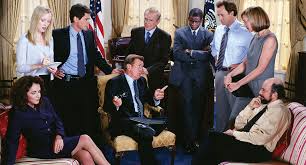 “What’s next?” the president typically would ask Leo, Toby, Sam, Josh, C.J., Charlie, Donna, General Fitzwallace, Mrs. Landingham, or whomever happened to be standing next to him. No time for savoring victories or regretting failures—there’s always more shit to get done.
I completely understand the energy of “What’s Next?” and was plugged into it for just about all of the eight years (2004-08, 20011-15) that I was an administrator on campus, first as chair of my department, then as director of a large interdisciplinary program required of all freshmen and sophomores. Teaching four classes per semester, usually with three separate preparations, is more than a full-time job in itself; adding the administrative tasks on top frequently pushed me close to the point of “I can’t do this.” 
But I did, in large part because I learned to be ultra-organized, looking at my calendar each morning to prioritize each of the dozen Whack-a-Moles that promised to pop up over the following hours, and seldom diverging from that prioritization. In service to my overall “What’s Next?” attitude I had a three page, single-spaced “Important Dates” document for the semester taped on the wall next to my computer just to remind me that things keep coming and disaster awaits those who don’t keep up. Rigorous organization, energy always directed forward, never looking back—these are necessary features of the “get it done” attitude of American success. And it’s no way to live a life.
I learned during my Spring 2009 sabbatical semester that focus, centeredness and peace are available in the midst of the most manic schedule because I carry a space in which those welcome things live everywhere I go. I identified this space as the place where the divine in me hangs out, agreeing with Catherine of Genoa that “my deepest me is God.” I also began to learn how to access that space deliberately by directing my attention properly. This new awareness and skill served me well during my four years as program director that began a year later—when I remembered to pay attention and make use of it. My mantra coming out of sabbatical was from Psalm 131—“Truly I have set my soul in silence and peace”—something I intended to use as the screen saver on my computer and to frame on my office wall when I returned to campus.
But I did neither one; I was on my computer so much that it wouldn’t have mattered what I had on my screen saver. I established the practice of reading the Psalms from the daily lectionary every morning, a habit that served me well in terms of starting the day off in the right place. But the vortex of “What’s Next?” and “Get It Done” frequently sucked me in by the middle of the morning, swamping my space of intentionality and attention before I was aware of what had happened.
Away from work, I have done a better job over the past few several yeas of avoiding the “What’s Next?” syndrome, but I still have to be very conscious and attentive to escape the guilt that often is paired with “doing nothing.” The key is to reject the nagging idea that one’s value and space on this planet has to be earned on a daily basis by what one does. We were talking about this not long ago in the “Living Stones” discussion group that I lead at church; one of the participants observed that there is not just a point about human psychology to be made here. It is not only good for a person’s mental and emotional well-being to find internal spaces of peace and quietness as resources for addressing a world that is anything but peaceful and quiet, but these also appear to be the very spaces where direct connections to what is greater than us are made.
There are all sorts of theological reasons to conclude that what I do, my “works,” are not the key to a healthy relationship with the divine, but the authors of scripture have something deeper than right belief in mind when they continually emphasize the importance of stillness and quietness when seeking God. The divine is born in us as a tiny seed that is nurtured not by manic activity, but by patience, daily attention, and perpetual care. It is very challenging to be still when everything around us screams that time is of the essence and must not be wasted. God is said not to be a respecter of persons; God is most definitely not a respecter of our schedules.
My New Year’s resolution is to recommit myself to the retooling and honing of my practices of attentiveness, silence and peace. I find that in spite of my regular failure to access my core of centeredness over the years since I first became aware of its existence, my inner attunement to it has become stronger without my even being aware.  It takes less time to get there than it used to—like water seeping through a rock, the wall between outer demands and inner strength has become one of those “thin places” that various writers love to ruminate about. Or at least thinner—it’s always a work in progress. My hope for the New Year is that each of you find your own thin places. The places where the divine is always waiting to say “hello.”












 Ad-Free & Subscriber Log-In