


Christ wants us to receive the Holy Spirit, not for the sake to have the Spirit merely reside in us, giving us an impersonal form of inspiration, but rather, so that we can turn inward and encounter the Spirit within ourselves. If we do that, we will find the Spirit gives us a way to participate in God’s own holiness, a holiness which, if embraced, will allow us to become as holy as God wants us to be. That is, we are expected to engage the Spirit, and not just sit back and do nothing, thinking the mere presence of the Spirit in us is enough to make us holy. Just like Christ (in his humanity) grew in wisdom and holiness, we are open ourselves to the Spirit, let the Spirit enlighten us, and give us the wisdom we need to act as God wants us to act in our lives. The Holy Spirit, indeed, can be said to overshadow us in a way similar to the way the Spirit overshadowed Mary; Pope St. Leo explained this parallel by saying:
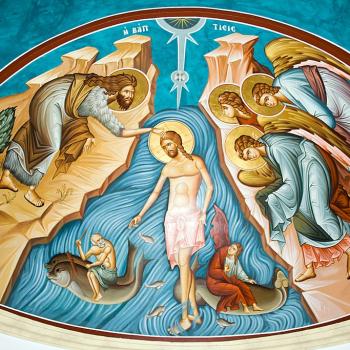
To every human being who is “reborn,” the water of Baptism is an image of the Virgin’s womb – as the same Holy Spirit fills the font who also filled the Virgin, so that the mystical washing cancels in our case the sin which the holy Conception lacked entirely in theirs. [1]
We should consider the implications of our actions, keeping in mind both our temporal existence, and the good we should be doing, and what our eternal life will be like. That is, we are to consider our physical death, and what lies beyond it, using that to encourage us to do what we can to “acquire the Spirit,” that is, activate the Spirit and all her graces in our life so that we can, at the time of our death, be ready for eternal life. St. Isaac the Syrian said we are blessed if we remember this:
Blessed is the man who remembers his departure from this life and severs his ties with this world’s delights, for many times over he will receive blessedness at his departure and this blessedness will not fail him. This is the man who is born of God and whose Nurse is the Holy Spirit; he suckles the life-giving nourishment from the Spirit’s breast and delights in the odor of His fragrance. [2]
Thus, as we can say we are given birth in and through the Spirit, the graces she offers us to help us grow can be seen as our spiritual milk. The Spirit is everywhere present, filling all things, giving all the seeds of grace needed so that they can share in her holiness. This is why she can be said to give those graces not only to those within the “institutional church,” but to those outside of it: she goes where she wills, without restriction. Bede hints at this when he said this is one of the lessons we should learn from the story of St. Cornelius:
We must not doubt that the Holy Spirit, with whom he was filled, absolved him from all sin. It is the truly spoken opinion of the Fathers that the gift of the Holy Spirit is not bound by any legal restrictions. For this reason [the one who] consecrated Cornelius and his household by his grace before their reception of baptism was surely the very one who infused John with the gift of the same grace, not only before his circumcision, but even before his birth.[3]
The seeds of grace are found everywhere; everyone has the potential for holiness, for salvation, and for deification. There is no one, indeed, nothing which cannot be touched by the Spirit and elevated by grace. This is not to say she will force herself upon us: we can resist the Spirit, and if we do that infinitely, we reject the holiness we need for our perfection and beatification, and so find ourselves bound to the blasphemy of the Holy Spirit; but if we ever open ourselves up to her promptings, all that we have done wrong can be and will be transcended. She will give us the grace we need for our spiritual healing. And, it is important to realize, she gives each of us the graces we need in unique ways; we should not expect her to lead us all in the same direction, to engage the same walks of life, as we are all different. This means, we should not expect all that the Spirit does today will merely repeat what she did in the past; she is always open to and will lead us to something new if we let her:
St. Paul reminds us that one and the same Holy Spirit inheres and energizes in the Church considered in her members, but the Spirit does not work in the same way in all members but suits his action to the gifts and requirements of each: so it is when the Church is considered in the passing of time and succession of generations; the same Spirit, eternally resident in her, manifests his presence in degree and by ways that differ according to the history state and needs of the age. Therefore the permanence of the Church does not require the new to be in conformity with the old because it is old but because all, old and new, is the work and expression of the Holy Spirit who cannot contradict himself. [4]
Not only are we called to open ourselves to the Spirit, not only are we called to follow the prompting of the Spirit, we are always to make sure we do not impose upon the her even as she does not needlessly impose upon us. The Spirit, again, blows as she will, and so if we are to live in and with the Spirit, will find ourselves engaging in new situations and contexts, each which will be necessary for our own spiritual growth, that is, for our own growth in the new life which we have received. Let us hope we will always be ready to do so.
[1] St Leo the Great, Sermons. Trans. Jane Patricia Freeland CSJB and Agnes Josephine Conway SSJ (Washington, DC: CUA Press, 1996), 95 [Sermon 24].
[2] Saint Isaac the Syrian, The Ascetical Homilies of Saint Isaac the Syrian. Trans. Monks of the Holy Transfiguration Monastery. Rev. 2nd ed (Boston, MA: Holy Transfiguration Monastery, 2011), 205-6 [Homily 15].
[3] Bede the Venerable, Homilies on the Gospels. Book Two: Lent to the Dedication of the Church. Trans Lawrence T. Martin and David Hurst OSB (Kalamazoo, MI: Cistercian Publications, 1991), 198 [Hom. II.19].
[4] Vladimir Solovyey, God, Man & The Church. The Spiritual Foundations Of Life. Trans. Donald Attwater (Cambridge: James Clarke & Co., 2016), 96.
Stay in touch! Like A Little Bit of Nothing on Facebook.
If you liked what you read, please consider sharing it with your friends and family!
N.B.: While I read comments to moderate them, I rarely respond to them. If I don’t respond to your comment directly, don’t assume I am unthankful for it. I appreciate it. But I want readers to feel free to ask questions, and hopefully, dialogue with each other. I have shared what I wanted to say, though some responses will get a brief reply by me, or, if I find it interesting and something I can engage fully, as the foundation for another post. I have had many posts inspired or improved upon thanks to my readers.









 Ad-Free & Subscriber Log-In