


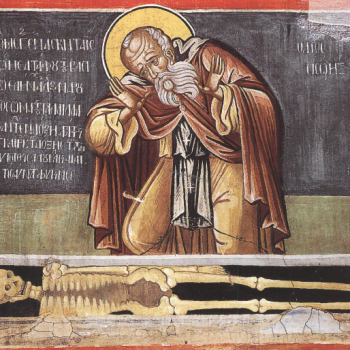
Reading through various spiritual texts, such as those of ascetics like the Desert Fathers and Mothers, we are told about the gift of tears. Sometimes, someone would have such an emotional reaction during a liturgical celebration and tears will flow from their eyes. At other times, tears will emerge during some private devotion. Spiritual writings confirm that such tears should be seen as a gift, and as such, we should not try to stop them when they we have them. They also suggested most, if not all of us, will have such tears during our spiritual journey. Nonetheless, we must be careful, and not turn the gift into some sort of show. We must not force ourselves to cry, making it as if we are holy and pious in front of others. Our tears should come from the heart. The more we let our hearts grow full of love, the more likely tears will emerge, as we will be more in tune with our own emotions. We will know we should not try to suppress them. And this is why, as George Maloney said, the gift of tears is about more than the tears; they are a sign of God’s work in and with us, and the way God is making us better in our relationships with others:
What the desert Fathers universally experienced through the gift of tears was a cosmic oneness in love and mercy not only toward all other human beings but toward animals, plants and all inanimate creation. God’s loving presence shines through all of creation as a self-giving love that can only engender in the heart of the purified contemplative a like response of love and mercy toward the whole world. Such a heart, freed from all taint of narcissism through tears, can look upon all human beings with the eyes of the compassionate God. [1]
When we examine ourselves, when we see the way we have hurt others (as well as ourselves), and feel ashamed of it all, we are ready. We will experience metanoia, and with that metanoia, we will be ready to receive the grace we need for spiritual transformation. It is at this time we find the gift of tears often manifests itself, showing not only the remorse we have for what we have done, but the joy we experience thanks to the freedom from our past that God has given to us.
Thus, there is nothing to be ashamed about when we cry. Tears are a sign that we still have feelings, that we still have a heart, that we can and will feel both sorrow and joy. We should realize it is a good thing that we can feel. Feelings are not, in and of themselves, something bad; they are a part of us and our natural makeup. That means, there is something good about them, a good which we see Jesus experienced when we read the Gospels (such as when he cried at the death of Lazarus).
We are not meant to be emotionless automatons, even as we are not to let emotions take absolute control over ourselves and our lives. We need to balance ourselves, engaging emotion and reason together. We need to learn how to be merciful to ourselves, even as we should learn how to be merciful to others. We will all make all kinds of mistakes in our lives. Our emotional response to those mistakes will tell us much about ourselves. What we do after we realize what we have done is very important. It is in this light we can read of a discussion two monastic elders had concerning the arrogance of youth, with one showing they have learned the wisdom to understand where it comes from and what we can gain from it:
An elder said: “I hated the arrogance of the young because they toil away and have no reward, looking towards human distinctions.” Another elder, one of the greatest knowledge, said to him: “For my part I entirely approve of them. It is advantageous for a younger person to be arrogant and not neglectful; for indeed he who is arrogant must be in control of himself, must watch and exercise; acquire love and endure affliction [in order to acquire] praise. After he has lived like this, the grace of God comes to him, saying to him: ‘Why do you not toil for me, but for men?’ Then he is persuaded not to pay heed to human distinction, but to that of God.” And having heard, they said: “Indeed, it is so.” [2]
We are to engage others with empathy. We must accept everyone will make mistakes, and, once they have been made, accept that everyone can move on from them. We need to learn this and apply this wisdom to our own lives. We are to engage others, and ourselves, with empathy, sometimes with sympathy, but always with compassion. With grace, even mistakes can be redirected and used for some greater good. Those who have experienced tears will be able to understand this, as they will have experienced the mercy, grace, and healing that God has brought into their lives. It is also an understanding we can attain in other ways. Not everyone has the same kind of emotional response, not everyone cries. The tears, themselves, are not important, except that they can serve as a sign of spiritual transformation. This is what we should be concerned about. And, as George Maloney explained, what we should seek after is a purified heart, one which is able to love and be loved, loving everyone and everything like God, that is, loving all things for the good which is found in them.
[1] George Maloney, SJ, Prayer of the Heart (Notre Dame, IN: Ave Maria Press, 1981), 90.
[2] John Wortley, trans., The Anonymous Sayings Of The Desert Fathers: A Select Edition And Complete English Translation (Cambridge: Cambridge University Press, 2013), 495 [N 616].
Stay in touch! Like A Little Bit of Nothing on Facebook.
If you liked what you read, please consider sharing it with your friends and family!
N.B.: While I read comments to moderate them, I rarely respond to them. If I don’t respond to your comment directly, don’t assume I am unthankful for it. I appreciate it. But I want readers to feel free to ask questions, and hopefully, dialogue with each other. I have shared what I wanted to say, though some responses will get a brief reply by me, or, if I find it interesting and something I can engage fully, as the foundation for another post. I have had many posts inspired or improved upon thanks to my readers.













 Ad-Free & Subscriber Log-In