2018-10-02T08:40:45-05:00

Lactantius, an educated convert to the Christian faith around 300 CE, made such a great name for himself that Constantine chose him to be the tutor of Crispus, his son. It under such auspices that he wrote his major work, The Divine Institutes, dedicating it in part to Constantine and his family. The work can be seen both as the accumulation of the Christian Latin apologetic tradition as well as the formation of a systematic theology which could be used... Read more

2018-10-01T03:06:00-05:00

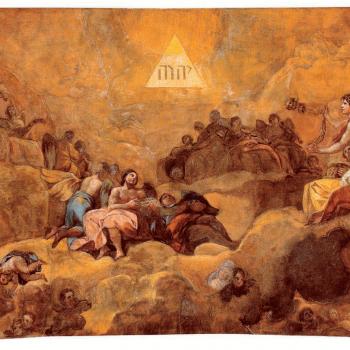
The Trinity, Father, Son and Holy Spirit, represent three relative relations in God; they do not indicate absolute or substantial distinctions within God. Thus, Peter Lombard in the Sentences explained: These properties are designated by the names of the persons, namely, Father, Son, Holy Spirit, which are relative and are used in relation to each other because they denote relations. They are not accidental to God, but are immutable in the persons themselves from eternity, so that these titles are... Read more

2018-09-28T03:32:36-05:00

Baruch ben Neriah, the friend and secretary of the prophet Jeremiah, found his prophetic mission to be completely intertwined with that of Jeremiah. When Jeremiah was barred from the Temple, Baruch was sent to the Temple to read the Lord’s condemnation of Israel’s sins:  Then Jeremiah called Baruch the son of Neriah, and Baruch wrote upon a scroll at the dictation of Jeremiah all the words of the LORD which he had spoken to him. And Jeremiah ordered Baruch, saying,... Read more

2018-09-26T04:04:43-05:00

One of the appalling factors in modern Christian life, Catholic or otherwise, is the great disconnect between faith and action. Christian leaders find all kinds of reason to excuse themselves, and their friends or political allies, from the mode of conduct which they demand from others. The words of St. Salvian the Presbyter, written during a time of upheaval and the collapse of the Roman Empire, could be said today.  Christians, not non-Christians, are creating terrible scandals which serve as... Read more

2018-09-24T03:04:01-05:00

One of the preeminent names for God is “Goodness” or “The Good,” indicating by such an appellation the greatness of God’s providence.  “Every good endowment and every perfect gift is from above, coming down from the Father of lights with whom there is no variation or shadow due to change” (James 1:17 RSV). Everything which is good has as its root God’s creative activity behind it; indeed, insofar as they exist, all things are said to be good because they... Read more

2018-09-20T03:54:34-05:00

Because of the incomprehensible nature of God, our talk about God, even when relying upon revelation and the best theological sources, will never properly reflect who God is in his nature. Human language reflects the human mind, the modalities of human thought, which though significant, is incredibility limited in nature. Our conventions, our words, our expressions of the truth will come out of our experience with it, but will be clothed in conventional representations which, by the nature of our... Read more

2018-09-18T06:39:36-05:00

On Monday the 17th, the Trump Administration announced that they would be drastically reducing the number of refugees allowed to settle in the United States in 2019. Reporting on this in the New York Times, Julie Davis wrote: President Trump plans to cap the number of refugees that can be resettled in the United States next year at 30,000, his administration announced on Monday, further cutting an already drastically scaled-back program that offers protection to foreigners fleeing violence and persecution.[1]... Read more

2018-09-17T03:05:08-05:00

The First Cause, the Creator of all, transcends all names and titles which we use to discuss it. This is because of such names and titles come from and employ conventions which would otherwise limit and impose upon the First Cause all kinds of meanings which cannot appropriately be applied to him. Having gone through several important attributes which are often used to name God throughout the fifth chapter of the Mystical Theology, Dionysius extended his apophatic analysis to the... Read more

2018-09-13T05:38:18-05:00

Know thyself. This philosophical wisdom, declared by the Oracle at Delphi and continued by Socrates in his promotion of living the examined life remains one of the key disciplines which we should all engage if we want to know God. For when we truly come to know ourselves, we come to know God, as St. Antony the Great told his followers: The rational man who has prepared himself to be set free through the advent of Jesus, knows himself in... Read more

2018-09-11T07:02:52-05:00

Since the sexual abuse crisis in the Catholic Church has once again made its way into the news, Catholics have felt great shame because of what they have heard has happened within the church. This is a natural reaction of those who desire and seek for what is good. When it is shown that those who should be working for good have been doing evil, there will be grief. There will be confusion.  What are we do to about it?... Read more

Follow Us!


TAKE THE
Religious Wisdom Quiz

Who said, "The fear of the Lord is the beginning of knowledge"?

Select your answer to see how you score.


Browse Our Archives