
 Holy Rover
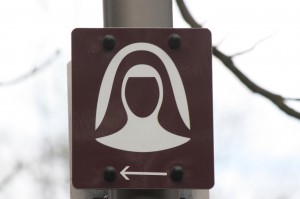
I love this sign, don’t you? I’ve traveled to a lot of holy places, but Bingen, Germany, is the only place where the pilgrimage route is marked by a nun sign. Hildegard is their most famous resident, and they want to make it easy for pilgrims to follow in her footsteps.
And more people are doing just that, for Hildegard of Bingen is enjoying a surprising career resurgence for someone who’s been dead for nine centuries. Her fan club is certainly diverse: feminists hail her as a foremother, environmentalists praise her views on nature, New Age enthusiasts recognize her as a kindred spirit, and musicians record her chants (the CD A Feather on the Breath of God was a surprise best-seller in 1988). And in 2012 Hildegard was named a Doctor of the Church by Pope Benedict XVI, an honor given to only four women saints.
It’s no wonder they’ve put up nun signs in Bingen.
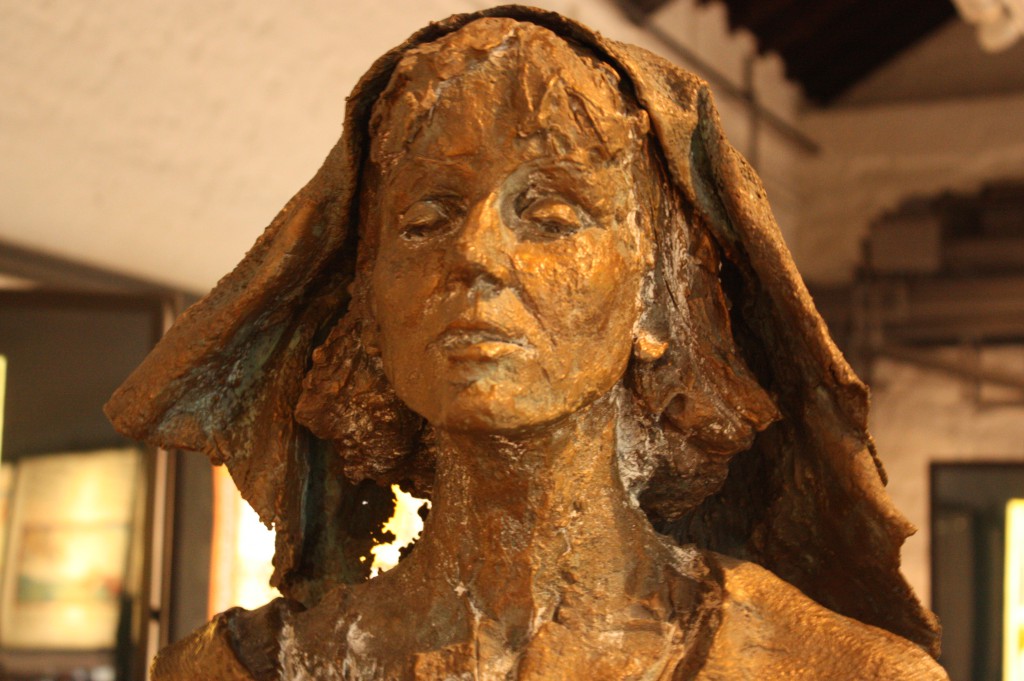
The best place to begin a tour is the Museum am Strom, located on the bank of the Rhine not far from where Hildegard’s abbey once stood. Most of its interior is devoted to an overview of her life and legacy, including models of the monasteries where she lived, information on the daily life of a Benedictine nun during the Middle Ages, exhibits on her many talents and accomplishments, and displays on the ways in which her legacy continues to influence the world. The ethereal, haunting background music, naturally, is by Hildegard herself.
On my visit I got the chance to visit with Dr. Matthias Schmandt, director of the museum, who talked about the challenge of presenting Hildegard’s complex life. “Sometimes it seems as if there is no single Hildegard,” he said. “Because she was so multi-faceted, it’s easy to see just one aspect of her life, as in the story of the blind men and the elephant. Our goal is to present the historical facts of her life and give background on the times in which she lived. Even if people are most interested in her as a religious figure, for example, they should know something about her accomplishments in music and medicine, and vice versa.”
I found the museum’s displays on Hildegard’s medicine particularly interesting. During her day, the art of healing was mostly practiced by Benedictine monks and nuns. As an abbess, Hildegard treated both her fellow nuns and others who came to her with complaints and symptoms. Like her contemporaries, she followed a form of medicine dating back to the ancient Greeks, who believed that four bodily fluids influenced people’s temperament and health: black bile, yellow bile, phlegm and blood.
But Hildegard was also a strong advocate for many of the practices that we have only just re-discovered in Western medicine. She believed in the importance of a healthy diet, the value of moderation and rest, and the necessity of treating the entire person, not just their symptoms. She knew people’s spirituality was closely linked to their physical condition. She wrote extensively about the use of medicinal herbs, some of which are grown in the museum’s garden. (It is Hildegard’s holistic approach to diet and health that draws the most attention in Germany today. Bob and I were amused in Dusseldorf, for example, to dine at a restaurant that had certain entrees on its menu marked with a Hildegard-seal-of-approval.)
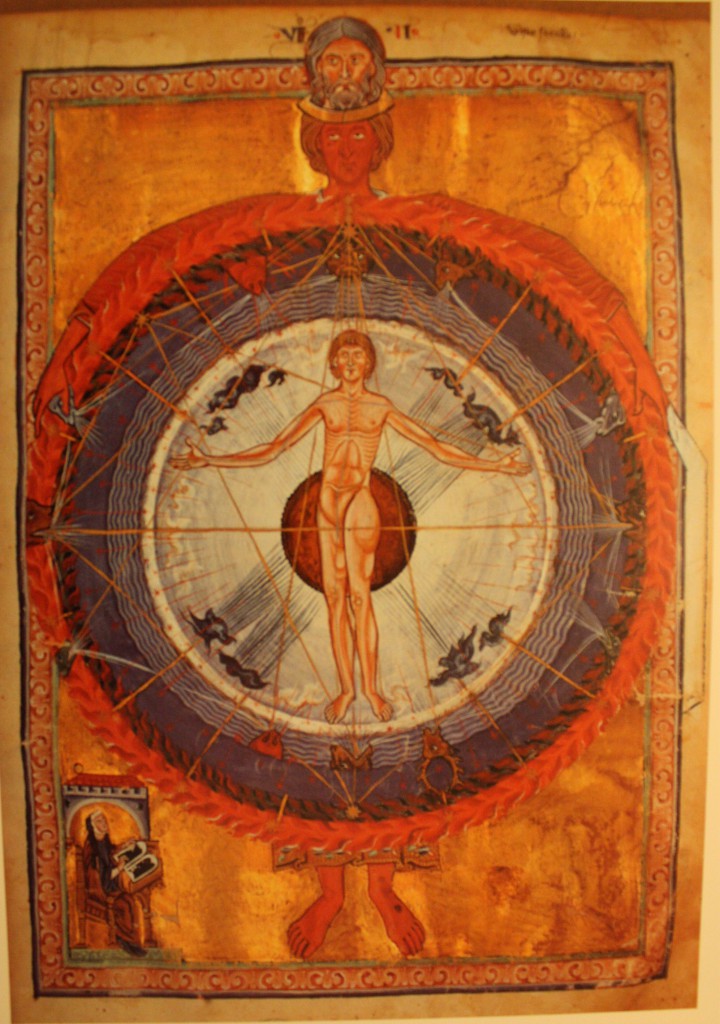
But it was the museum’s upper level that was most fascinating to me, for exhibits there focus on Hildegard’s mystical visions. Enlargements of them are arranged around a statue of Hildegard, each displayed in a lighted panel that allows one to see the small details.
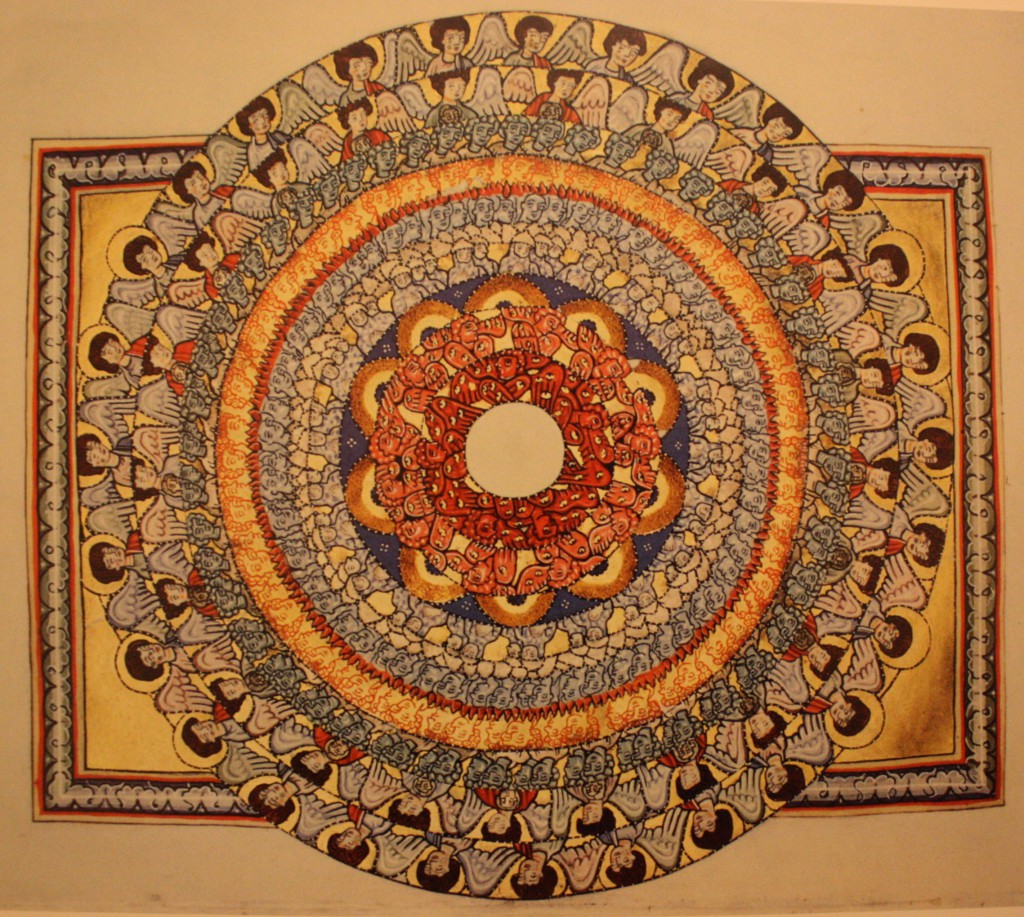
And what an amazing set of visions they are! Some are fiery and apocalyptic; others radiate a sense of serenity and peace. All are highly symbolic, which explains why Hildegard spent many years writing books trying to explain them. Scholars believe that Hildegard did not create these images herself, but rather closely supervised their creation by scribes. They are some of the most remarkable religious visions ever recorded, providing windows into a most-unusual soul. After seeing them, I have even more respect for the church authorities who recognized them as divinely inspired, for these complex and sometimes puzzling images are not easy to understand and would be easy to misinterpret.
“Even in her own time, some people thought her visions came from the devil,” said Dr. Schmandt. “Without papal and church approval, her story would have been very different.”
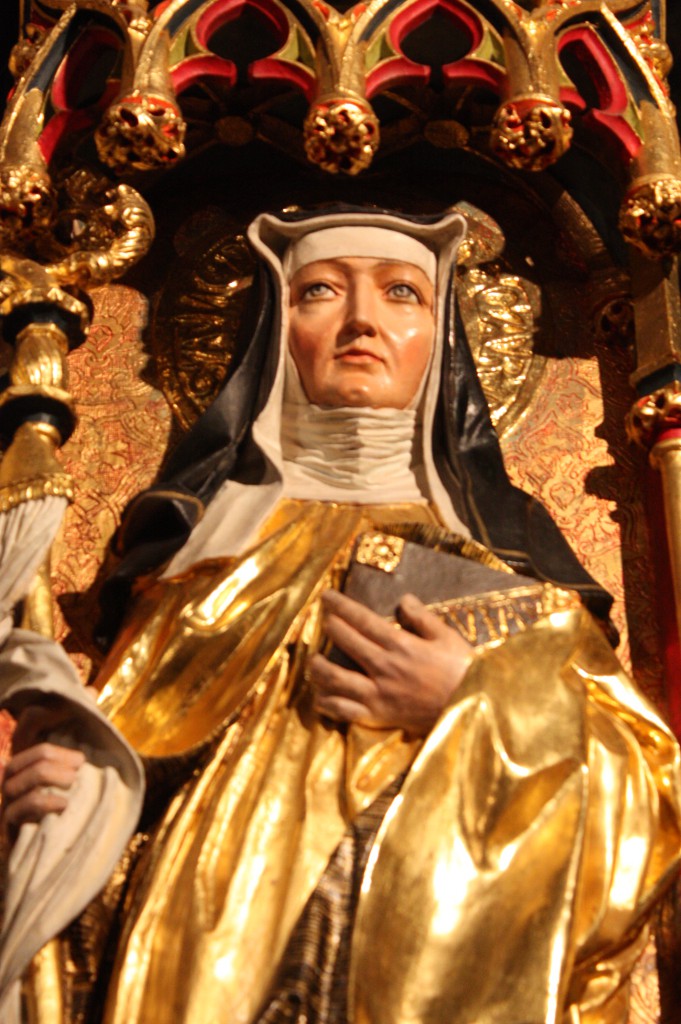
After leaving the museum we headed up the hill to St. Rochus Chapel, another landmark on the Hildegard Trail. This chapel overlooking Bingen became a focus for the veneration of Hildegard in the nineteenth century. Constructed in neo-Gothic style in 1895, its interior includes ornate, gilded panels illustrating scenes from Hildegard’s life as well as a side altar that includes two of her relics.
The church also illustrates the Lazarus-like nature of Hildegard’s reputation. After her death in 1179, her memory was kept alive in this region of Germany but faded in the larger world. Then in the 18th and 19th century the German Romantics discovered her. With their love for the medieval era and close ties to the natural world, these poets and philosophers found a kindred spirit in the German nun. It seems as if each era rediscovers its own Hildegard.
Another aspect of her legacy lives on in the nearby Hildegard Forum, a non-profit institution founded by the Sisters of the Cross that sponsors workshops and classes inspired by Hildegard’s teachings. The forum also serves a daily lunch buffet in a circular dining room whose shape echoes Hildegard’s vision of the wheel of the world. The food is prepared according to Hildegard’s principles, while outside is a medicinal herb garden that (as at the museum) features the plants that Hildegard regarded as having healing properties.
Before leaving Bingen, we finally went to the site where it all began: the spot where Hildegard’s abbey once stood at the junction of the Nahe and Rhine Rivers. Alas, the building was destroyed in 1632 during the Thirty Years War, and today the site is a hodgepodge of modern city streets and buildings. But underneath the surface lies a treasure: stone vaults that date back hundreds of years, perhaps to the time of Hildegard’s abbey.
There I met someone who’s even more of a fan of Hildegard than I am. Dr. Annette Esser is founder and director of the Scivias Institute for Art and Spirituality. After earning a doctorate in feminist theology, she has devoted her life to keeping the legacy of Hildegard alive, including offering conferences, workshops, and pilgrimages.
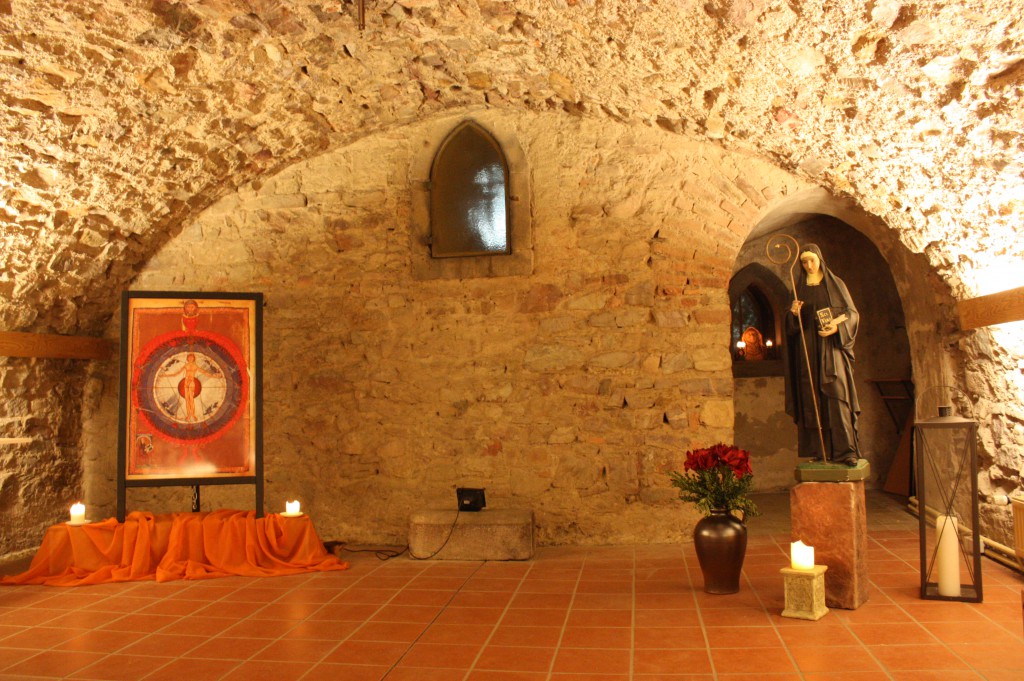
In a serene and low-lit room that has something of the atmosphere of a cloister about it, Dr. Esser spoke of the world’s continuing fascination for the German saint. “Hildegard influences people in a wide variety of ways because she was active in so many fields,” she said. “But I think Hildegard herself viewed her many accomplishments as all being connected and flowing from the same divine source. For her, all of life was one harmonious whole. And speaking personally, I am most fascinated by her experience of what she called the ‘Living Light.’ She took her visions very seriously and considered herself a prophet. I think we are still learning from what she proclaimed.”
Next post: Hildegard’s legacy on the other side of the Rhine River










 Ad-Free & Subscriber Log-In