

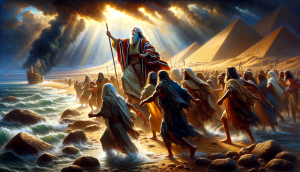
Exploring the Narrative: Exodus as Literature
Next week I will begin teaching from the book of Exodus. This is a Christian school, but when I teach about Exodus in my 10th grade English class, I teach it as literature–as a work of art, as a narrative from the Master Story-teller.
All scripture is art from the greatest creative mind of all, and He, before any renowned author, invented the literary techniques that sell books. Any book of the Bible can be studied as literature. I use Exodus because it neatly fits into our World Literature sequence alongside The Epic of Gilgamesh, The Odyssey, Beowulf, Cid, and The Song of Roland.
Exodus as Epic
For many years now, I have taught World Literature through the epics. By definition, an epic is a long, narrative poem, which, of course, Exodus is not. It does, however, contain some poetic passages. The most obvious is found in Exodus 15:
The Song of Moses and Miriam
Then Moses and the Israelites sang this song to the Lord:
“I will sing to the Lord,
for he is highly exalted.
Both horse and driver
he has hurled into the sea.
“The Lord is my strength and my defense;
he has become my salvation.
He is my God, and I will praise him,
my father’s God, and I will exalt him.
The Lord is a warrior;
the Lord is his name.
Pharaoh’s chariots and his army
he has hurled into the sea.
The best of Pharaoh’s officers
are drowned in the Red Sea.
The deep waters have covered them;
they sank to the depths like a stone.
Your right hand, Lord,
was majestic in power.
Your right hand, Lord,
shattered the enemy.
“In the greatness of your majesty
you threw down those who opposed you.
You unleashed your burning anger;
it consumed them like stubble.
By the blast of your nostrils
the waters piled up.
The surging waters stood up like a wall;
the deep waters congealed in the heart of the sea.
The enemy boasted,
‘I will pursue, I will overtake them.
I will divide the spoils;
I will gorge myself on them.
I will draw my sword
and my hand will destroy them.’
But you blew with your breath,
and the sea covered them.
They sank like lead
in the mighty waters.
Who among the gods
is like you, Lord?
Who is like you—
majestic in holiness,
awesome in glory,
working wonders?
“You stretch out your right hand,
and the earth swallows your enemies.
In your unfailing love you will lead
the people you have redeemed.
In your strength you will guide them
to your holy dwelling.
The nations will hear and tremble;
anguish will grip the people of Philistia.
The chiefs of Edom will be terrified,
the leaders of Moab will be seized with trembling,
the people of Canaan will melt away;
terror and dread will fall on them.
By the power of your arm
they will be as still as a stone—
until your people pass by, Lord,
until the people you bought pass by.
You will bring them in and plant them
on the mountain of your inheritance—
the place, Lord, you made for your dwelling,
the sanctuary, Lord, your hands established.
“The Lord reigns
for ever and ever.”
This is a prime example of Hebrew poetry, which uses parallelism to create rhythm and emphasis.
- Synonymous parallelism: the second line of a couplet restates the thought of the first. For example, “The LORD is my strength and my defence; He has become my salvation.”
- Chiastic parallelism: word order is inverted in successive lines. One example is: A (The waters) / B (covered them) // B’ (they sank) / A’ (to the depths) like a stone.
Aside from the poetry, an epic has an epic hero who is larger-than-life, has supernatural help, goes through an underworld experience, and influences many people. I’d say Moses fits that definition really well.
An epic also defines a culture of a people group existing in a particular place and time, asks important life questions, and takes place over a long period of time. Check. Check. And check.
Themes in Exodus
There are seven main themes in Exodus:
- God reveals Himself: He reveals His Name, His attributes, His redemption plan.
- God reveals His nature: His glory, justice, truthfulness, reliability, mercy, faithfulness, and holiness
- God reveals Himself as the Lord of history: the covenant established with Abraham is not thwarted by other cultures or gods
- God remembers and is concerned about His people: He hears their cries and sends a deliverer (a theme that runs throughout the entire Bible)
- Salvation: redemption by the sacrifice of the Lamb as introduced by the Passover
- Biblical ethics and morality: the Ten Commandments
- Worship: He gives directions for the construction and duties of the tabernacle
Conflict in Exodus
Every good story needs conflict, and there is certainly conflict. There is man against man: Moses goes head-to-head with Pharoah. He must also face the wrath of his own people on several occasions. There is man against nature: He braves the wilderness alone. There is man against himself: Moses is far from sure of his ability to pull off the extraordinary instructions given by God.
Plot in Exodus
There is a plot: Ask Cecil B. DeMille, Philip LaZebnik, or even Stephen Spielberg.
Exposition
- Setting: The book opens approximately 400 years after Genesis, in Egypt. The Israelite descendants of Jacob have grown into a large population, living as guests of Egypt.
- Initial situation: A new pharaoh, who does not remember Joseph, comes to power. He fears the Israelites’ growing numbers and enslaves them, forcing them into brutal labor.
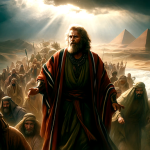
- Protagonist introduced: Moses is born during this time and, to escape Pharaoh’s edict to kill all male Israelite infants, is placed in a basket in the Nile. He is discovered by Pharaoh’s daughter and raised in the Egyptian palace.
Rising action
- Moses’s call: As an adult, Moses witnesses an Egyptian beating a Hebrew slave and kills the Egyptian, forcing him to flee into the wilderness. There, God appears to him in a burning bush and commands him to return to Egypt to lead his people out of slavery.
- The plagues: Moses and his brother Aaron repeatedly demand Pharaoh release the Israelites. Pharaoh refuses, leading God to unleash ten devastating plagues upon Egypt, including turning water to blood, hail, and darkness.
- The Passover: The final plague is the death of the firstborn son in every Egyptian household. The Israelites are spared by marking their doorposts with the blood of a lamb, an event commemorated as Passover.
- The escape: After this final plague, Pharaoh relents and sends the Israelites away.
Climax
The climax involves Pharaoh’s change of heart and the subsequent confrontation at the Red Sea.
- The pursuit: Pharaoh and his army chase the fleeing Israelites, trapping them between the Red Sea and the Egyptian army.
- The crossing: God commands Moses to stretch out his staff over the water, which parts the sea to allow the Israelites to cross on dry ground.
- Pharaoh’s defeat: As the Egyptian army pursues them, the waters crash down, destroying Pharaoh and his forces. This miraculous victory proves God’s power and solidifies the Israelites’ trust in him.
Falling action
- The wilderness journey: Freed from Egypt, the Israelites begin their journey through the wilderness. During this time, they experience hardship, complain, and repeatedly test God’s patience.
- The covenant at Sinai: The people arrive at Mount Sinai, where God enters into a covenant with them, presenting the Ten Commandments and other laws. The Israelites agree to follow God’s laws and become his chosen people.
- The golden calf: While Moses is on the mountain receiving the law, the people grow impatient and construct a golden calf to worship. God is angered by this breach of the covenant, but Moses intercedes on their behalf, and God forgives the nation.
- The Tabernacle instructions: God gives Moses detailed blueprints for the construction of a sacred tent, the Tabernacle, where God’s presence will dwell among the people.
Resolution
The book of Exodus ends with the successful completion of the Tabernacle.
- The Tabernacle is built: The Israelites construct the Tabernacle according to God’s instructions.
- God’s presence descends: When the work is finished, the glory of the Lord descends and fills the Tabernacle, symbolizing God’s presence among his people
Motif in Exodus
The motif in Exodus is one that runs through the entire Bible, helping to make it one cohesive work. That motif is enslavement, redemption, and promotion. We see it from Genesis through Revelation. We see it in the stories of Joseph, Daniel, Jesus, and the Church. It is the very hopeful message that is intentionally taught.
Parallel Structure in Exodus
There is parallel structure: The ten plagues are the most obvious occurrence this device. The ten plagues are organized into three cycles, each escalating in intensity. This structure builds suspense and emphasizes God’s increasing power over Pharaoh and the Egyptian gods.
- Cycle 1 (Plagues 1–3): Blood, frogs, lice (ends with the Egyptian magicians unable to duplicate the situation)
- Cycle 2 (Plagues 4–6): Swarms of insects, pestilence, and boils (grossly inconvenient, but not deadly)
- Cycle 3 (Plagues 7–9): Hail, locusts, darkness (affected the environment’s ability to sustain life and ended the conversation between Moses and Pharaoh)
- The finale (Plague 10): The death of the firstborn is the climax, providing the final and most devastating contrast between Israel and Egypt
The example of the Passover lamb, of course, parallels the sacrifice of Jesus, the Lamb of God, slain for the redemption of His people.
There are also 10 Commandments. There is a symbolic connection between the two. The ten plagues represent God’s supremacy over the Egyptian gods and His divine judgement over Pharaoh, who believed in his own authority and divinity over the God of the Hebrews. The 10 Commandments issued the moral code for those who would recognize God’s authority over all other gods. Both sets of ten serve to reveal God’s nature and His will for humanity, one through his power and the other through His law.
According to the article “The Meaning in the Order” by Stacy Goldman, “The Talmud explains that the first five commandments reflect our obligations to G‑d, while the last five instruct us regarding our relationships with other people. The medieval commentator Abraham Ibn Ezra further explains that all the commandments can be put in one of three categories: emotion, speech and action. While the Ibn Ezra does not tell us which commandment fits into which grouping, Nechama Leibowitz, a brilliant 20th-century Israeli biblical scholar and commentator, provides us with a fascinating theory on the order of the Ten Commandments.” [She writes] that the commandments follow a “triple chiastic using the three elements of emotion, speech and action.”
“The first two commandments, 1) Belief in G‑d and 2) Not worshipping other gods, both have to do with what is in our hearts, what we feel to be true. We are then told not to take G‑d’s name in vain; this is clearly speech. Keeping the Sabbath is all about action.
“What about the fifth commandment, honoring one’s mother and father? Does this continue with action as the structure would suggest? Surprisingly, Jewish law defines respecting parents entirely through our actions toward them. We are not commanded to love our parents, but to honor them. This means behaving towards them in a respectful way: getting them water when they are thirsty, not sitting in their designated chair and standing when they enter a room (they may excuse us from this action). This commandment appears on the side of the tablets which is our obligation to G‑d, for if we disrespect our biological creators, we are in essence dismissing our Divine Creator. This commandment also serves as the perfect bridge to the commandments concerning our fellow human beings.
“Beginning with the top of the second tablet we have: Murder, Adultery and Stealing, which are all sins completely mired in action. Bearing false witness against your neighbor is a transgression through speech. The final commandment, coveting that which belongs to your neighbor, is contained within one’s heart, one’s emotions.
“While the pattern is chiastic in reference to the emotion, speech and action, we can see a parallel structure in regard to level of difficulty. Belief in G‑d seems relatively easy.”
Protagonists and Antagonists
There are protagonists and antagonists in the Book of Exodus. The main protagonists are God, Moses, and the Israelites, while the primary antagonist is Pharaoh, who opposes God’s will and oppresses the Israelites. God is the ultimate protagonist, orchestrating the rescue of His enslaved people, while Moses serves as the human leader commissioned to free them. Pharaoh embodies the wickedness of oppression that must be overcome.
Advantages of Reading Exodus As Literature
One thing about reading Exodus (or any other book of the Bible) as literature instead of as “scripture” is that verses can not be separated from the narrative (except as an interesting, inspiring, or important quotation) or taken out of context. In fact, one of the great benefits of reading the Bible as literature is to understand the context.
According to the Guiness Book of World Records , the Christian Bible is the best-selling book of all time. “It is impossible to know exactly how many copies have been printed in the roughly 1,500 years since its contents were standardized, but research conducted by the British and Foreign Bible Society in 2021 suggests that the total number probably lies between 5 and 7 billion copies.” What it is possible to say is that God Almighty is the greatest author of all time–the number One. He did, after all, create words. I guess it’s not surprising that He knows how to use them.
God bless you; and happy reading!










 Ad-Free & Subscriber Log-In