


Things That Go Bump In the Night
“From ghoulies and ghosties and long-leggedy beasties and things that go bump in the night, Good Lord, deliver us!” The phrase is from a traditional prayer or litany that has been traced to the folk traditions of Cornwall and Scotland and included in George Oliver Onions 1911 collection Widdershins. As the days get shorter and nights get colder and the leaves begin to fall, what is it that draws us to thoughts of “things that go bump in the night”? Is it merely Halloween? As a Christian, what do I do with that? If I participate in anything goose-bumpy, am I guilty of celebrating a pagan holiday?
What Is the Background for Halloween?
For years, the Christian schools where I have taught forbade the acknowledgement of the “H holiday that we don’t mention.” Everyone had some kind of thoughts and theories about why it was so bad. Some had thoroughly researched it and were pretty passionate about where their research took them. Their explanations included key passages like Deuteronomy 12:30–31, which urges Israel to not worship God in the way other nations worship their gods, and Jeremiah 10:2–3, which says the customs of the peoples are worthless, and 1 Corinthians 10:20–21 which warns against participating in pagan sacrifices that are offered to demons. I get it. I do. But I have always wondered if there might not be just an ounce of overreacting to a heap of bad taste in costumes and celebration ideas.
According to one man, Steven Wedgeworth (as published in The Calvinist International, 2018), “The question that often generates the most excitement and interest is also the easiest one to answer. No, Halloween was not originally a pagan holiday, and there is no evidence showing an actual link between current practices and ancient pre-Christian rituals. The supposed pagan predecessor that most people point to is Samhain, an ancient Celtic festival which celebrated the end of Summer and the beginning of Winter. The problem is, we have basically no evidence to teach us about Samhain, and the later Christians communities in Ireland, Scotland, and England were pretty good at stamping it out.
“While Samhain certainly included some typical pagan religious rites, there is no evidence to suggest any overt fixation on death. Ronald Hutton has the most accessible treatment of Samhain in his excellent The Stations of the Sun: A History of the Ritual Year in Britain. He admits that our knowledge of Samhain is minimal and plagued by anachronism: ‘To hazard any guess about the ancient religious significance of Samhain… therefore, we are left completely dependent upon inferences projected backward from folklore collected in the last few centuries…’ (365). He concludes rather modestly that the only things which can be reasonably attributed to Samhain are that it was a seasonal festival with bonfires and that there was some thought that supernatural forces were at work.
“What’s ironic about this is that Samhain was essentially a ‘Fall Festival’ or a ‘Harvest Festival.’ The only cultural activity that we know went on at Samhain was the building of bonfires. So, if you are really nervous about pagan elements in Halloween, you’ll want to steer clear of two things: Fall Festivals and bonfires.” I suppose those could include “things that go bump in the night.”
Halloween and Cosplay
Then there are the costumes.
May I propose that costumes, or cosplay, is a valid form of creative self-expression.
“Most of our forms of self-expression spin out of the innate human desire to grow, coupled with imagination. I have often heard people say, ‘I’m not very creative;’ however, the Bible tells us that we are made in the image and likeness of a very creative, imaginative God. According to C. S. Lewis, ‘I think that all things, in their way, reflect heavenly truth, the imagination not the least.’
“J. R. R. Tolkien produced his theory of sub-creation wherein one reflects the inborn God-nature by creating his own landscapes and creatures. ‘We have come from God, and inevitably the myths woven through us, though they contain error, will also reflect a splintered fragment of the true light, the eternal truth that is God. Indeed only by myth making, only by becoming sub-creator and inventing stories, can Man aspire to the state of perfection that he knew before the fall.’ Within our personal sub-creation experiences, we can evaluate our part in our ideal existence and begin to discern what our own part may be. We can find our ideal, heroic self.”
The Spirit Behind the Spirit Stories
A big part of the traditional holiday activities has always been ghost stories–spirit stories that have become attached to Halloween. You’ve heard them, from the silly to the terrifying. Admittedly, the world has taken tales of horror to an unnecessary level–a satanic level where evil is glorified.
But the spirit story–God Himself is the Master of the spirit genre, just as He is the Master of all things. There are many lessons that can be learned about obedience, trust, and following the right influences in God’s own darker tales. Try this one:
“The hand of the Lord was on me, and he brought me out by the Spirit of the Lord and set me in the middle of a valley; it was full of bones. He led me back and forth among them, and I saw a great many bones on the floor of the valley, bones that were very dry. He asked me, “Son of man, can these bones live?”
I said, “Sovereign Lord, you alone know.”
Then he said to me, “Prophesy to these bones and say to them, ‘Dry bones, hear the word of the Lord! This is what the Sovereign Lord says to these bones: I will make breath enter you, and you will come to life. I will attach tendons to you and make flesh come upon you and cover you with skin; I will put breath in you, and you will come to life. Then you will know that I am the Lord.’”
So I prophesied as I was commanded. And as I was prophesying, there was a noise, a rattling sound, and the bones came together, bone to bone. I looked, and tendons and flesh appeared on them and skin covered them, but there was no breath in them.
Then he said to me, “Prophesy to the breath; prophesy, son of man, and say to it, ‘This is what the Sovereign Lord says: Come, breath, from the four winds and breathe into these slain, that they may live.’” So I prophesied as he commanded me, and breath entered them; they came to life and stood up on their feet—a vast army.
Then he said to me: “Son of man, these bones are the people of Israel. They say, ‘ Our bones are dried up and our hope is gone; we are cut off.’ Therefore prophesy and say to them: ‘This is what the Sovereign Lord says: My people, I am going to open your graves and bring you up from them; I will bring you back to the land of Israel. Then you, my people, will know that I am the Lord, when I open your graves and bring you up from them. I will put my Spirit in you and you will live, and I will settle you in your own land. Then you will know that I the Lord have spoken, and I have done it, declares the Lord’” (Ezekiel 37:1-14).
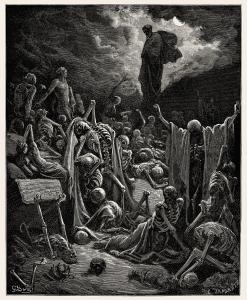
You might picture it … in your nightmares. What about this one:
In those days the Philistines gathered their troops for war in order to fight Israel. Achish said to David, “You should fully understand that you and your men must go with me into the battle.”David replied to Achish, “That being the case, you will come to know what your servant can do!” Achish said to David, “Then I will make you my bodyguard from now on.”
Now Samuel had died, and all Israel had lamented over him and had buried him in Ramah, his hometown. In the meantime Saul had removed the mediums and magicians] from the land. The Philistines assembled; they came and camped at Shunem. Saul mustered all Israel and camped at Gilboa. When Saul saw the camp of the Philistines, he was absolutely terrified. So Saul inquired of the Lord, but the Lord did not answer him—not by dreams nor by Urim nor by the prophets. So Saul instructed his servants, “Find me a woman who is a medium, so that I may go to her and inquire of her.” His servants replied to him, “There is a woman who is a medium in Endor.”
So Saul disguised himself and put on other clothing and left, accompanied by two of his men. They came to the woman at night and said, “Use your ritual pit to conjure up for me the one I tell you.”
But the woman said to him, “Look, you are aware of what Saul has done; he has removed the mediums and magicians from the land! Why are you trapping me so you can put me to death?” But Saul swore an oath to her by the Lord, “As surely as the Lord lives, you will not incur guilt in this matter!” The woman replied, “Who is it that I should bring up for you?” He said, “Bring up for me Samuel.”
When the woman saw Samuel, she cried out loudly. The woman said to Saul, “ Why have you deceived me? You are Saul!” The king said to her, “Don’t be afraid! But what have you seen?” The woman replied to Saul, “I have seen a divine being coming up from the ground!” He said to her, “What about his appearance?” She said, “An old man is coming up! He is wrapped in a robe!”
Then Saul realized it was Samuel, and he bowed his face toward the ground and kneeled down. Samuel said to Saul, “Why have you disturbed me by bringing me up?” Saul replied, “I am terribly troubled! The Philistines are fighting against me and God has turned away from me. He does not answer me anymore—not by the prophets nor by dreams. So I have called on you to tell me what I should do.”
Samuel said, “Why are you asking me, now that the Lord has turned away from you and has become your enemy? The Lord has done exactly as I prophesied! The Lord has torn the kingdom from your hand and has given it to your neighbor David! Since you did not obey the Lord and did not carry out his fierce anger against the Amalekites, the Lord has done this thing to you today. The Lord will hand you and Israel over to the Philistines. Tomorrow both you and your sons will be with me.The Lord will also hand the army of Israel over to the Philistines!”
Saul quickly fell full length on the ground and was very afraid because of Samuel’s words. He was completely drained of energy, having not eaten anything all that day and night. When the woman came to Saul and saw how terrified he was, she said to him, “Your servant has done what you asked.I took my life into my own hands and did what you told me. Now it’s your turn to listen to your servant! Let me set before you a bit of bread so that you can eat. When you regain your strength, you can go on your way.”
But he refused, saying, “I won’t eat!” Both his servants and the woman urged him to eat, so he gave in. He got up from the ground and sat down on the bed. Now the woman had a well-fed calf at her home that she quickly slaughtered. Taking some flour, she kneaded it and baked bread without leaven. She brought it to Saul and his servants, and they ate. Then they arose and left that same night.
Now the Philistines were fighting against Israel. The men of Israel fled from the Philistines and many of them fell dead on Mount Gilboa. The Philistines stayed right on the heels of Saul and his sons. They struck down Saul’s sons Jonathan, Abinadab, and Malki-Shua. Saul himself was in the thick of the battle; the archers spotted him and wounded him severely.
Saul said to his armor-bearer, “Draw your sword and stab me with it! Otherwise these uncircumcised people will come, stab me, and torture me.” But his armor-bearer refused to do it, because he was very afraid. So Saul took his sword and fell on it. When his armor-bearer saw that Saul was dead, he also fell on his own sword and died with him. So Saul, his three sons, his armor-bearer, and all his men died together that day” (1 Samuel 28:1-25, 31:1-6).
And there’s grisly murder:
Now Deborah, a prophet, the wife of Lappidoth, was leading Israel at that time. She held court under the Palm of Deborah between Ramah and Bethel in the hill country of Ephraim, and the Israelites went up to her to have their disputes decided. She sent for Barak son of Abinoam from Kedesh in Naphtali and said to him, “The Lord, the God of Israel, commands you: ‘Go, take with you ten thousand men of Naphtali and Zebulun and lead them up to Mount Tabor. I will lead Sisera, the commander of Jabin’s army, with his chariots and his troops to the Kishon River and give him into your hands.’”
Barak said to her, “If you go with me, I will go; but if you don’t go with me, I won’t go.”
“Certainly I will go with you,” said Deborah. “But because of the course you are taking, the honor will not be yours, for the Lord will deliver Sisera into the hands of a woman.” So Deborah went with Barak to Kedesh. There Barak summoned Zebulun and Naphtali, and ten thousand men went up under his command. Deborah also went up with him.
Now Heber the Kenite had left the other Kenites, the descendants of Hobab, Moses’ brother-in-law, and pitched his tent by the great tree in Zaanannim near Kedesh.
When they told Sisera that Barak son of Abinoam had gone up to Mount Tabor, Sisera summoned from Harosheth Haggoyim to the Kishon River all his men and his nine hundred chariots fitted with iron.
Then Deborah said to Barak, “Go! This is the day the Lord has given Sisera into your hands. Has not the Lord gone ahead of you?” So Barak went down Mount Tabor, with ten thousand men following him. At Barak’s advance, the Lord routed Sisera and all his chariots and army by the sword, and Sisera got down from his chariot and fled on foot.
Barak pursued the chariots and army as far as Harosheth Haggoyim, and all Sisera’s troops fell by the sword; not a man was left. Sisera, meanwhile, fled on foot to the tent of Jael, the wife of Heber the Kenite, because there was an alliance between Jabin king of Hazor and the family of Heber the Kenite.
Jael went out to meet Sisera and said to him, “Come, my lord, come right in. Don’t be afraid.” So he entered her tent, and she covered him with a blanket.
“I’m thirsty,” he said. “Please give me some water.” She opened a skin of milk, gave him a drink, and covered him up.
“Stand in the doorway of the tent,” he told her. “If someone comes by and asks you, ‘Is anyone in there?’ say ‘No.’”
But Jael, Heber’s wife, picked up a tent peg and a hammer and went quietly to him while he lay fast asleep, exhausted. She drove the peg through his temple into the ground, and he died.
Just then Barak came by in pursuit of Sisera, and Jael went out to meet him. “Come,” she said, “I will show you the man you’re looking for.” So he went in with her, and there lay Sisera with the tent peg through his temple—dead.
On that day God subdued Jabin king of Canaan before the Israelites. And the hand of the Israelites pressed harder and harder against Jabin, king of Canaan until they destroyed him (Judges 4:4-23).
Pretty gruesome, don’t you agree? The goose bumps are there. So is God. Of course, He doesn’t just provide the stories for entertainment. There are lessons to be learned. Many authors have followed suit.
Spirit-led Spirit Stories
C S. Lewis did it. The Screwtape Letters is a chilling collection of letters from a demon. I recommend it to any seasoned Christian.
Charles Dickens did it in A Christmas Carol . His ghosts of Christmas Past, Present, and Future are iconic.
Nathaniel Hawthorne did it in many creepy and supernatural tales, often exploring themes of guilt, sin, and the darker side of human nature through allegory and symbolism. Some of his most well-known “creepy” stories include “Young Goodman Brown,” “The Minister’s Black Veil,” “The Birthmark,” and “Dr. Heidegger’s Experiment”.
Edgar Allan Poe, the Brothers Grimm …
To the critics of such literature I say, the stories are fiction. They are written to teach and to entertain. They are not intended to add anything to scripture or to promote demon worship or a belief in ghosts.
My brother and I have always enjoyed sharing tales of mystery and “things that go bump in the night,” so about a decade ago, we set out to write a collection of didactic spirit stories. The resulting book, A Walk in the Dark: A Collection of Spirit Stories, was published in 2018. We even created a name for the genre–redemptive gothic. I haven’t often shared that with my Pentacostal friends. Afraid of being judged, I guess. The Amazon ad says:
“Remember the stories you shared with friends around the campfire on long summer nights? Remember seeing A Christmas Carol for the first time; or hearing tales of the spooky woods; or sitting by your grandparents’ fireplace as wind rattled the window panes on a chilly October twilight? Our tales will take you from the dark, abandoned corridor of a silent airport, to a Civil War Cemetery set in a walnut grove, to the fantastical world of Steampunk, to find not gruesome terror, but spirits who come to help us when we need them.” Some of the characters are spirits who show up to help us.
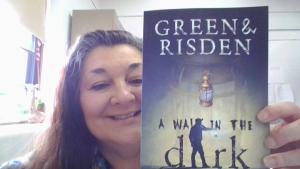
So maybe, whatever you call the genre, once in a while you may enjoy, and even learn from “things that go bump in the night.”
God bless you and keep you educated and entertained during this season.













 Ad-Free & Subscriber Log-In