

We already discussed how to select a good Bible version, but what is the worst Bible version of all? Is it one that you personally own? Maybe. Is it a literal, dynamic, or paraphrased translation? Maybe. The worst Bible of all is the Bible that is never read!* Bible reading is essential for owning a Bible, regardless of the version.
Although I am not fond of paraphrased versions, I would choose such a Bible over one that is never read. In fact, the very first Bible I read from cover to cover was the Living Bible. I moved on from there, of course, to other translations.
Have you read the entire Bible? It is perhaps the most influential book of all time, and so it deserves to be read! Why not add this to your bucket list?
Here are some questions and answers that might help you with reading the Bible:
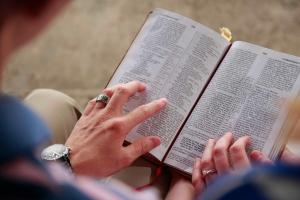
Questions and Answers about Bible Reading
Question 1: There are many translations of the Bible; which one should I read?
If you are new to Bible reading, I recommend the Common English Bible (CEB) or Today’s New International Version (tNIV). If you are not new, I recommend the New American Standard Bible (NASB) or English Standard Version (ESV). For further tips, see my recent post, “Which Bible Should I Read”?
Question 2: I don’t think I understand the Bible. What should I do as I read it?
For starters, I recommend selecting a good study Bible. Here are some decent picks: The NIV Study Bible, the Common English Study Bible, The ESV Study Bible, and the Zondervan NASB Study Bible. For the NRSV, a good one would be the New Oxford Annotated Bible.
What a good study Bible normally does is provide you with background information and footnotes that aid your understanding of the books in the Bible that you are reading. For example, in the ESV Study Bible, almost every verse has a footnote to it explaining what various words or phrases in the verse mean.
Question 3: Is there a particular way that I should read the Bible?
There are three questions I have my students pursue when reading and studying the Bible. They are to ask:
#1: “What does the text say?” Read and observe in detail a select Bible verse, passage, or chapter. What is the text emphasizing, which words are repeated, and which grammatical and literary features does the author use to communicate the text’s message?
#2: “What does the text mean?” Interpret the select Bible verse, or passage, or chapter. What did the passage mean for the original author and audience who first read it?
#3: “What does the text mean to me?” Apply the select Bible verse, passage, or chapter to your own life and culture. How is the text relevant for you personally?
There is a tendency for the contemporary reader to “jump” from point #1 to point #3:
From: “What does the text say?”
To: “What does the text mean to me?”
This leaves out the all-important point #2: What does the biblical text mean for the original writers and recipients of that text? The question is essential since we need to understand at least the basics of what the text meant to the original hearers. Otherwise, we will probably misinterpret and misapply the text to our own lives and culture.
Point #2 prompts us to look at, appreciate, and try to understand the original social, cultural, historical, ideological, and religious contexts of the first readers. The notes and information from a good study Bible should be able to assist with this point.
Question 4: How do I go about reading the Bible completely through? Should I simply start with the first book, Genesis, and read all the way to the end of the last book, Revelation?
That’s one way to do it, though probably not the best way. If you notice, the Bible consists of Old and New Testaments. The NT is more relevant for Christians. Hence, if you have never read through the Bible before, and you trust in Jesus, it might be a good idea to start with the NT (Matthew to Revelation) rather than OT (Genesis to Malachi).
The chapter system is a good way to read the Bible through.
Option 1: In the New Testament there are 27 books consisting of 270 chapters total. This means that if you read simply one chapter a day, you would be finished in 270 days. That’s roughly nine months to read from Matthew ch. 1 to Revelation ch. 22. If you are in no hurry, this would be a good plan.
You could always read more chapters per day. For example, three chapters a day in the NT would take 90 days for you to read it through. After you are finished with the NT, you could then read the OT on the chapter system, though it will take longer since the OT consists of 929 chapters.**
Option 2: Another option is to read from both the NT and OT daily. For example, if you read three chapters per day, two from the OT and one from the NT, you would be finished with the Bible in about a year and one month.
For example, on day one, you would read from two chapters from the OT starting with Genesis chs. 1 and 2. Also, you would read one chapter from NT starting in Matthew ch. 1. The next day, you would read Genesis chs. 3 and 4, and Matthew ch. 2, etc. Once you are finished with the New Testament after 270 days, you would start reading all three chapters from the Old Testament until finished.
Option 3: Select a Bible reading plan recommended by your church or online.
Question 5: What if I want to dig deeper into the Bible?
A quick solution is this—join a small group that reads and discusses the Bible at a local Bible-based church in your neighborhood. Sometimes local churches also offer biblical study courses or Sunday school Bible lessons.
If you are a student, you could probably join such a Bible group on campus, or perhaps take relevant courses at your college or university, if it offers Bible courses.
At home, if you want to dig deeper into Scripture, I would recommend other biblical study tools, including Bible commentaries, Bible Encyclopedias and Dictionaries, Lexicons, and so forth, but details on these are for another blog post.
Bottom line: what you should want to do is develop a daily devotion life that includes reading the Bible regularly, even after you finish reading the entire Bible through.
Notes
* I was not the first to come up with this idea. See “The Three Worst Bibles You Already Own”
** This assumes the Jewish Old Testament canon. Roman Catholic, Eastern Orthodox, and certain Protestant Bibles contain even more books identified as the Apocrypha. These books also could be read through the chapter system.










 Ad-Free & Subscriber Log-In