

What is the origin of Paul’s message of reconciliation and the new creation? We read about his new creation from such texts as Galatians 6:15 and 2 Corinthians 5:17. The latter speaks of anyone who is “in Christ” now becomes and belongs to a new creation. Immediately after this, he speaks of his ministry as one of reconciliation (2 Cor 5:18–20). It follows that this reconciliation characterizes what takes place for those who are in Christ in the new creation. People need to be reconciled to God, and contextually, the Corinthians need to be reconciled from their estrangement from Paul in 2 Corinthians.
This message about reconciliation in the new creation is unique to Paul. Neither Jesus in the Gospels nor other New Testament writers mention it. In the Greek, Paul’s words for reconciliation, καταλλαγή and καταλλάσσω, we find nowhere else in the NT except in 2 Corinthians and in 1 Corinthians 7:11, Romans 5:10–11, and 11:15. His term “new creation” (καινὴ κτίσις) we likewise find nowhere in the NT except in Paul. Where did Paul get this message from? It may stem from his road to Damascus experience and reading of Scripture, as we shall suggest.
What do 2 Corinthians 4:6 and Isaiah 9:1–7 Have in Common?
A number of scholars suggest that in 2 Corinthians 4:6, Paul is recalling his encounter with Jesus on the road to Damascus when he saw the face of Jesus in bright light, according to Acts 9:1–19.* The passage of 2 Cor 4:6 says, “For it is God, the one who said, ‘Light shall shine out of darkness,’ who has shined in our hearts to give the light of the knowledge of his glory in the face of Christ.” When we compare this verse with 2 Cor 3:14–18 and the glory the Torah-follower experiences when he turns to the Lord Jesus, there does seem to be enough overlap with Paul’s Damascus experience to suggest that he might be recalling this event.
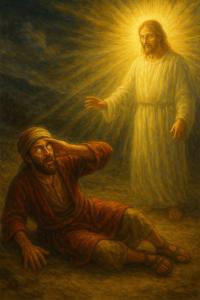
In 2 Cor 4:6, Paul alludes to Isaiah 9 with the light shining out of darkness. In fact, in the Septuagint version of Isaiah 8:22–9:6 (LXX) when compared with 2 Cor 4:6, 8 the same words or cognates appear for “light” (φῶς), “darkness” (σκότος), “shine” (λάμπω), “affliction” (θλῖψις), “distress” (στενοχωρία), and “perplexity/being at loss/despair” (ἀπορία, ἀπορέω, ἐξαπορέω). This number of connections is hardly coincidental! Paul is alluding to the Isaiah passage in 2 Corinthians 4, and also the new creation and reconciliation in 2 Corinthians 5:17–20.**
The Context of Isaiah 9:1–7
In the early verses of Isaiah 9, the birth of the future son of King David (“a child is born to us”: Isa 9:5/LXX 9:6). Incidentally, in both political and religious spheres, the birth of a ruler as good news is the case with David’s posterity here, understood by Paul as the Messiah. Compare with the birthday of Caesar Augustus as good news in the Priene inscription.
Isaiah here echoes the original creation of Genesis 1:3–4, reconfiguring this language into the light of a new dawn that people will see, a restoration, and peaceful time of reconciliation (καταλλαγή in Isa 9:4 LXX). This new dawn characterizes the reign of a royal Davidic son. Paul interprets this light from Isaiah as the light of a new creation in Messiah Jesus emblematic of the salvation, peace, and reconciliation experienced by those who are “in Christ” in his own time (cf. 2 Cor 5:17–19; see Timothy Savage, Power through Weakness, 126).
Galilee, Damascus, and Paul
It so happens that “Galilee of the nations” in Isa 9:1–2, traditionally belonging to the tribe Naphtali, was thought to extend to Damascus, which is where Paul, filtered through 2 Cor 4:4–6, encountered Jesus (cf. Acts 9:1–19)! Like the people who see the light as a harbinger of the messianic son in Isaiah 9, so Paul beheld Jesus in a bright light as the exalted messianic ruler outside Damascus.
Rainer Riesner notices the Damascus connection with Galilee. He suggests the Essenic group’s*** settlement in the land of Damascus become motivated by their belief that the messianic era begins there. For them, the messianic star of Num 24:17 would rise in that region (The Damascus Document [CD] 7:14–18; cf. 6.5, 9; 8.21; 19.34; 20.12).
Both Jewish and Christian traditions see the region as significant for the Messiah, and St. Jerome, for example, claims that Jewish Christians considered the complete realization of Isa 8:23–9:1 happening with Paul’s activity (Commentary in Isaiah, 9:1; Riesner, Paul’s Early Period, 237–39). Riesner likewise affirms that Paul would naturally consider the messianic “root of Jesse” in Isa 11:10, which he cites in Rom 15:12, with the futuristic Davidic ruler in Isa 9:5–6.
Jewish exegesis played on the “rising star” (Num 24:17), “shining light” (Isa 9:1–2) and “sprouting branch” (Isa 11:1) connecting these verses together (cf. Matt 4:14–16; Luke 1:78–79). Hence, “it does not seem far-fetched that Paul came to understand the shining of the messianic light near Damascus as the beginning of the eschatological ingathering of the Gentiles” (Riesner, Paul’s Early Period, 239).
Back to 2 Corinthians 4
The light in 2 Cor 3–5, it seems, originates from the glory of God’s presence and is emitted and reflected by the Spirit and Christ. It also is communicated through the gospel message of Paul as a minister of the new covenant. This gospel prompts reconciliation with God, and its hearers are to turn to the Lord Jesus to be transformed. That transformation marks a new creation in Christ, a transformation that is progressive despite bodily sufferings. The end result is complete conformity to the image of Jesus, the royal son on the future day of bodily resurrection and immortality; this is the aim, the telos, of the new creation (2 Cor 4:6–18).
Paul’s understanding of the context of Isa 9 in relation to his Damascus experience might have taken place at the event. But more probable is that his interpretation of Isa 9 took place later on upon reflection of his experience. Either way, this text shaped his early gospel message that would seem to include Jesus as the exalted messianic son of God, belonging to a new creation in Christ, reconciliation to God, and a good news message that targets not only Jews but gentile nations.
Notes
* See for example, Rob A. Fringer, Paul’s Corporate Christophany (Pickwick, 2019), 31–33; Seyoon Kim, The Origin of Paul’s Gospel (Reprint; Wipf & Stock, 2007), 7–13 (more broadly, 2 Cor 3:16–18 and 4:4–6).
** See more fully, B. J. Oropeza, “Reconciliation in ‘Light’ of Isaiah 8:22–9:6,” in Scripture, Texts, and Tracings in 2 Corinthians and Philippians. Eds. A.A. Das and B. J. Oropeza (Lanham: Fortress Academic/Lexington, 2022), 85–105.
*** A number of scholars regard the Essenes to be the Dead Sea Scrolls sect.










 Ad-Free & Subscriber Log-In