

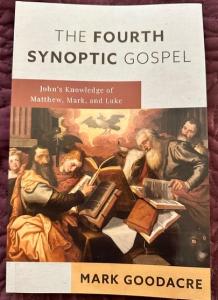
I’m here this week with a special guest—Mark Goodacre, whose new book is entitled, The Fourth Synoptic Gospel: John’s Knowledge of Matthew, Mark, and Luke (Eerdmans, 2025). He is professor of religious studies at Duke University. Among his areas of expertise are Christian origins, the Gospels, and the historical Jesus.
This book, you might say, belongs to a trilogy that Dr. Goodacre has written on the origins of the Gospels. The first is entitled, The Case Against Q, in which he critiques the Q hypothesis and Matthew and Luke’s dependency on it. The second is entitled, Thomas and the Gospels, in which, contrary to certain scholars, he argues that the Gospel of Thomas was not an independent source but drew from the Synoptic Gospels. And in his current book he argues that, despite current disagreements among scholars, John knew the Synoptic Gospels (Matthew, Mark, Luke).
These books, I highly recommend for those who are seriously interested in the Synoptic Problem and relationship between Gospels. I had the privilege to interview Dr. Goodacre regarding The Fourth Synoptic Gospel.
Interview with Mark Goodacre
Oropeza
How did scholars arrive at the view that the author of John’s Gospel did not know the Synoptic Gospels?
Goodacre
It was an innovation in the mid-twentieth century. Although Percival Gardner-Smith is often credited with being the first to argue for John’s independence, in 1938, it took the great C. H. Dodd’s two books on John to persuade people that John was independent.
Both Gardner Smith and Dodd relied very heavily on the idea that John knew oral traditions, and some of these oral traditions were similar to or overlapped with the oral traditions known by the Synoptic authors. This was an era of scholarship in which oral tradition was very popular, and it was given a lot of explanatory power. The difficulty with it, however, is that it does not explain verbatim agreements very well, or parallels in literary structures, and so on.
Oropeza
What would you consider to be some of your primary arguments that point to John’s Gospel knowing the Synoptic Gospels?
Goodacre
I think you have to begin with verbatim agreement, and to draw attention to places where John has striking similarities with the Synoptics. But I would add that the fourth evangelist also has a similar literary structure to Mark. Both have a Passion narrative with an extended introduction, beginning with John’s preaching and the call of the disciples, and reaching the Triumphal Entry at the midpoint of the Gospel.
Moreover, John shares the Synoptic writers’ fundamental literary conceit of writing a book about a hidden Messiah who is only retrospectively fully understood with the benefit of the hermeneutical key provided by the resurrection.
I also argue that Matthew’s and Luke’s redactional fingerprints can be found in John’s Gospel (Chapter 3), and that John frequently presupposes Synoptic narratives that he does not narrate (Chapter 4).
Oropeza
Sounds exciting! Why do you think it matters that John’s Gospel knows the other Gospels?
Goodacre
It matters because history matters, and the development of the Christian tradition is fascinating. We are able to see three of John’s literary sources, and that is significant.
Moreover, if John wrote expecting his readers to know the Synoptics, then he is able to presuppose knowledge of their Gospels, and he is able to build on them in some interesting ways.
For example, I talk in Chapter 5 about the “intertextual dramatic irony” in John, where the Fourth Gospel is able to play with the reader’s knowledge that Jesus was born in Bethlehem (John 7:41–44), which adds a rich texture to John. If you read the same material without knowledge of the Synoptics, readers are in the same position as the crowds, scratching their heads, and wondering what is going on.
It is important, too, for issues like the identity of the Beloved Disciple because readers of the Synoptics have something to say about John’s presentation (Chapter 6). And my book ends by discussing Christology (Chapter 7), and who is not interested in the development of early Christology?
Oropeza
Exactly! I agree with you on John’s knowledge of the other Gospels. So why is it that John seemingly attempts to expand and transform the Synoptic discourses and narratives?
Goodacre
I think a lot of the time John is simply making explicit what he sees as implicit in the Synoptics. He adds life, drama, and panache. He has some new characters to introduce us to, such as Nathanael, Nicodemus, the Samaritan woman, the blind man, and Lazarus. He also has some new stories to tell. He has a fresh perspective on the old story, and he wants to introduce us to key concepts like “eternal life,” which largely replaces the Synoptic “kingdom of God.” And he dispenses with parables in favour of Jesus speaking directly, with seven “I am the . . .” sayings.*
Oropeza
Let’s switch gears a little. A popular view among scholars has been that John’s community, the Johannine community, originated from Palestine or thereabouts, but after expulsion from a synagogue or some other fall out with Judeans, they moved to Ephesus. Irenaeus, Eusebius, and Jerome seem to advocate for John being in Ephesus, too. What is your viewpoint about this?
Goodacre
I’m not a huge believer in the Johannine community, at least as it was reconstructed in scholarship of the second half of the twentieth century. An isolated, sectarian Johannine community is easier to develop if John is isolated as a Gospel, with no contact with the Synoptics.
I was impressed with Hugo Méndez’s new book on John, and he is skeptical of the existence of this kind of Johannine community. Since I don’t really believe in this kind of Johannine community, I find it difficult to be precise about their history or geography. But the difficulty with Palestinian origins is that John uses terms like “200 denarii” and “300 denarii” when he is talking about money, as if the audience knows how much money this is, and we don’t find denarii in Galilee or Judea.
Oropeza
It’s refreshing to hear the son of Zebedee proposed again as the Beloved Disciple. Is the son of Zebedee also the author who wrote John’s Gospel and apparently the Epistles of John? How does “the elder” in the letters, and John the Elder mentioned by Papias factor, or not factor, into this authorship?**
Goodacre
This is probably my most conservative conclusion in the book, but I think John son of Zebedee is the natural candidate for the Beloved Disciple if we read with knowledge of the Synoptics. And John does, I argue, read with knowledge of the Synoptics. Too often this element of the problem is missed.
I don’t think the historical John is the author of the Gospel. It’s an idealized disciple and witness who is based on the historical John. I have no idea if John “the Elder” had anything to do with John’s Gospel, and I doubt it. People in antiquity did not think that the Elder wrote the Gospel in any case.
Oropeza
In your view, who or what identifies the “we” in John 21:24?
Goodacre
The Johannine community?! What I love is the literary inclusion in John—”We beheld his glory” in John 1:14, and now “We know that his testimony is true” in 21:24. It’s clearly a claim to witness that the author and his readers find plausible.
Oropeza
Switching gears again, and I recognize that this is probably not relevant for your book, but who do you think wrote Revelation?
Goodacre
Well, at least Revelation does identify its author as “John”! The easiest answer is that someone called John wrote it, but the author probably wants the reader to identify this character as John, Jesus’s disciple, and that is the way that most of Christian history has read the claim. There are some intriguing links between the Gospel and Revelation, but I don’t think they are authored by the same person.
Oropeza
What’s your next project?
Goodacre
I’ve been spending quite a bit of time working on my podcast, the NT Pod. I started this 16 years ago, but it has taken me until now to develop it into a video podcast. I now have several video episodes out, and dozens of video shorts. I have been enjoying experimenting with these different ways of doing things.
I am also writing on the Gospel of Thomas again, for the CGAT (Coptic Gospels and Associated Texts) series, published by Cambridge University Press. In the longer term I want to write a book on Messianism and Christology.
Oropeza
It’s been a pleasure, Mark, thank you for your research and insights!
Goodacre
Thanks for your interesting questions, and for engaging with my work.
Notes
* For a list of the “I am” sayings in John’s Gospel, see my earlier interview with Brant Pitre.
** John the Elder as the Beloved Disciple is argued, e.g., by Richard Bauckham, Jesus and the Eyewitnesses, 2nd edition, chs. 15-16, 20.













 Ad-Free & Subscriber Log-In