

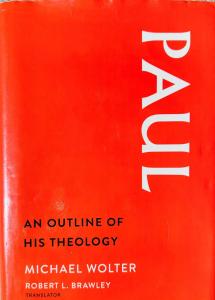
We probably have heard that faith is a gift, but in what sense? Is faith opposed to works and human effort? Helping us sort through questions related to faith is Dr. Michael Wolter, Professor of New Testament at the University of Bonn, Germany. He is also Honorary Professor at the University of Pretoria, South Africa. His book, Paul: An Outline of His Theology (Baylor University Press) is mistitled in my opinion—it is quite a magisterial work at almost 500 pages.*
There are many gems we could draw from this book, but our relevant focus on faith is from Chapter 5 of this work.
Faith and Paul’s Interpreters
Dr. Wolter writes about faith in relation to the gospel. Faith, or trust as I would normally call it, “acquires its particularity from the gospel” as proclaimed by Paul (p. 77).
Wolter bemoans that certain of Paul’s interpreters attempt to place Paul’s words about faith, and gaps of things Paul leaves unsaid, into a “dogmatic doctrinal system” that ends up reading their own theological constraints into Paul. In this milieu, questions are raised regarding whether faith involves a decision, whether it is a “free act of obedience,” “human achievement,” “human work,” etc.
Here is where questions arise regarding, “Can the hearers of Paul’s proclamation accept or reject the gospel ‘in a free decision of the will’ or did Paul reply to the question about the reasons for the acceptance and rejection of the gospel in a ‘predestinarian’ way?” (p. 78).
We might want to raise a similar question in more practical terms: Is faith a gift that is given not only to believers but also to unbelievers so that they can become believers?
Wolter writes, “Where Paul is silent, one is almost compelled to hear only the voices of his interpreters” (pp. 78–79). Some of Paul’s interpreters indeed point to certain passages that affirm faith as a gift, but Wolter’s interpretations of these texts are worth pondering. We will cover ten of them.
10 Passages on faith commonly misunderstood
-
Philippians 1:29
Faith is sometimes understood as a gift to non-believers to believe and be saved in Phil 1:29: “It was granted to you for the sake of Christ not only to believe in him but also to suffer for his sake.” According to Wolter, however, this text is for those who are believers, and the point of the passage is really about suffering. Phil 1:28 suggests that “the statement about believing is associated with the saying about suffering and therefore should help the Philippians accept the theologically challenging notion that the suffering that they experience because they are Christians is a gift from God that is there only for those who believe in Christ. Being Christian consists not only of faith but also of suffering” (p. 79).
I would add that in Phil 1:29, the aorist passive notion of being granted (ἐχαρίσθη) is “simply the action viewed externally, in summary fashion” (as Hellerman, Philippians, 84). As is commonly known in recent years regarding ancient Greek, the aorist tense does not necessarily point to the past so that we must refer to the Philippians’ conversion here. But even if we were to grant that this aorist referred to their past conversion, this belief of the Philippians originated from Paul proclaiming the gospel about Christ to them. This is where their faith first arose (notice Phil 1:27). If so, then in Phil 1:29, the wording appears to be shorthand for Paul saying something to the effect that the message of God’s gospel about Christ was granted to the Philippians through Paul’s preaching, and they believed in it, accepted Christ, and are now saved (cf. 1:28).
In any case, in this text, trust and suffering are granted to the Philippians who are believers, and the present tense infinitive verbs πιστεύειν and πάσχειν attest to this—these are the activities that they as believers presently experience. Their present salvation includes that they are to continue to believe in Christ and keep suffering for his sake (notice the translation of these infinitives in Reumann, Philippians, 271).
-
1 Corinthians 4:7
The text says, according to Wolter, “For who singles you out? What do you have that you did not receive?” This passage is sometimes interpreted to mean that the Corinthians were given faith as a gift. But as Wolter affirms, the topic in this case is not about faith. It is about divisions and being arrogant towards one another. Hence, in 4:7, the “rhetorical questions are to be interpreted in the context of party conflict that split the Corinthian congregation…” (p. 79). To use it as a reference of faith, then, seems to go beyond what Paul intended.
-
1 Corinthians 12:9
Faith is sometimes seen as a work of the Spirt; it is a gift in passages such as 1 Cor 12:9. Wolter correctly explains, however, that faith is a spiritual gift or charisma in this verse. As such, it is not given to everyone but only to certain individual Christians, even as tongues, prophesy, healing, teaching, apostleship, etc., are given only to select Christians. Each believer has his/her own unique gifts. This type of faith is not given to all believers, let alone any unbelievers.
-
Galatians 5:22
Faith is listed as a “fruit” of the Spirit in Gal 5:22. The Spirit here produces and gives “faith,” it seems, as a gift. But as Wolter suggests, faith is not understood as saving faith in this verse but the ethical virtue of “trustworthiness or fidelity” (79).
-
1 Corinthians 2:4–5
Paul can speak about his proclamation of the gospel originally coming to the Corinthians (when they were still apparently unbelievers) as a demonstration of the Spirit and power. For Wolter, this does not refer to the effect of the Spirit on the Corinthians but on Paul as their preacher. This is about his mode of proclamation. Similarly, see 1 Thess 1:5. I would add that in such texts, the gospel mode does not have to be merely verbal proclamation but also Paul’s ability through the Spirit to perform miracles in their midst.
-
Galatians 3:14
Wolter brings out that there is a clear pattern in Pauline Scripture, such as in Gal 3:14 as well as Gal 3:2, 5; 2 Cor 4:13; and other texts. Faith is first evident, and then the Spirt is received, not vice/versa. In other words, it is not the Spirit that first gives faith to non-believers so that they believe. Rather, they believe, and then they receive the Spirit.
-
Romans 5:5
Wolter also notices in Paul that it is the Spirit that is the gift “given” and “received” in Rom 5:5 along with Rom 8:15; 1 Cor 2:12; 6:19; 2 Cor 1:22; 5:5; 11:4; Gal 3:2, 5, 14; and 1 Thess 4:8. Faith is never spoken of in such terms (p. 80).
-
Romans 1:16
The gospel is indeed the power of God for salvation, but this is only “for everyone who believes.” Wolter affirms that “For those who do not believe Paul’s proclamation, it is simply not ‘the power unto salvation,’ because they do not hear it as ‘gospel.’” (80).
-
Romans 9:30–10:21
Paul is clearly aware of unbelief; the gospel about Christ is not heard as gospel to a majority of Israel (Rom 9:30–10:21). Likewise, there are gentiles who also continue in unbelief (2 Cor 4:3–4). For Wolter, unbelief for Israel is “brought about by God,” and for gentiles “by the devil” (p. 81). I would say differently that in both cases, there is personal unbelief that happens first. Then, as a form of divine punishment, hardening and surrendering over to Satan (or one’s own sinfulness) takes place.
-
Ephesians 2:8–9
This passage affirms that, “For by grace you are saved through faith, and this is not from yourselves, it is the gift from God, not as a result of works, so that no one may boast.” Wolter does not address this passage. This is probably because he considers Ephesians “post-Pauline” on account of its disputed authorship (p. 282). Even so, this text does not appear to be contrary to the Pauline passages we already covered.
The neuter “this” (τοῦτο) in Eph 2:8b does not refer back to the feminine “faith” (πίστις) in 2:8a. In other words, “faith” does not appear to be the “gift” in this passage. The neuter “this” may refer to the neuter “gift” (τὸ δῶρον), which may be synonymous with grace in this text. Or perhaps the neuter word for salvation (σωτήριον) is meant, though an ellipsis here. Another alternative is that τοῦτο is adverbial, in which case Wallace (Greek Grammar, 335) may be correct to translate it as: “For by grace you are saved through faith and [you are saved] especially not by your own doing . . .” (emphasis original). All the same, the gift in this text does not center on faith as such but on the gracious salvation in Christ affirmed already in Eph 2:5.
Reflections on Faith/Trust
Although I mostly tend to agree with Wolter’s interpretation of such texts, I should stress that in Paul’s letters, faith/trust is indeed a gift for those who are already in Christ. It is a spiritual gift among many in 1 Corinthians 12. And faith as pistis is also understood as an ethical virtue among others to be exercised in Gal 5. God bestows such gifting through the Holy Spirit.
There is also providential favor granted to certain people—they happen to be at the right place at the right time—for example, those who live in Macedonia in the 50’c CE are able to hear the gospel message of Paul and have faith in Christ, whereas people in Spain at that time would not be able to hear the gospel. This situation of the gospel in Macedonia, then, seems to be an act of grace. Hence, the opportunity for Macedonians to believe the gospel about Christ when it is proclaimed to them may itself be understood as a gift. After all, faith comes alive when people hear the gospel (Rom 10:15–17; cf. Gal 3:2, 5). At least indirectly, then, faith can be a gift to unbelievers.
But…
Does God through the Holy Spirit infuse or otherwise directly give faith to unbelievers so that they might believe?
No doubt, God can harden or soften hearts and remove impediments that might get in the way of understanding the gospel, but this is not quite the same thing as directly giving certain non-believers faith so that they will be saved (and not giving it to others so that they remain unsaved). I must confess, it is not clear to me that this sense of faith is found in Paul’s letters.** Rather, as already mentioned, faith is unleashed through the message of the gospel, the word of truth, and such provides the opportunity for non-believers to have faith in Christ and be saved.
In any case, I do not think that humans are supposed to be entirely passive when it comes to faith. Trust could hardly be something that does not require human responsibility. Faith may stand against “the works of the law” in Paul (e.g., Gal 2:16), but this is not the same thing as works related to faith, which Paul encourages. We notice that Paul commends the Thessalonians for their “work of faith” (1 Thess 1:3; 2 Thess 1:11). He writes in Romans about the “obedience of faith” as something he desires for the nations (Rom 1:5; 16:26). In Galatians he speaks of faith working itself out in love (Gal 5:5). He charges the Philippians to “work out your own salvation” with fear and trembling (Phil 2:12). When the Lukan Paul and Silas respond to the Philippian jailor on how to be saved, they give him a command to exercise faith—“believe on the Lord Jesus Christ and you shall be saved” (Acts 16:31).
Notes
* The original title is, Paulus: Ein Grundriss seiner Theologie (2011). Perhaps the German word Grundriss should have been translated as “basis” or “ground plan” rather than outline.
** Apart from Paul, in the New Testament, we do have early Christian evidence of God opening up the heart of Lydia (Acts 16:11–15). This apparently refers to God removing mental and/or emotional “obstacles” that might have prevented her from being receptive to Paul and/or his message. Again, though, this is not quite the same thing as the Holy Spirit endowing her with faith. Also, Lydia is quite different than an unbelieving pagan idolater. In Acts 16, before even hearing the gospel about Christ, she already is a devout believer in God. She already attends a prayer group (whether as a devout Jew or, perhaps more likely, as a Hellenistic god-fearer). On Acts 13:48, see “Predestination in Acts 13:48?”














 Ad-Free & Subscriber Log-In