


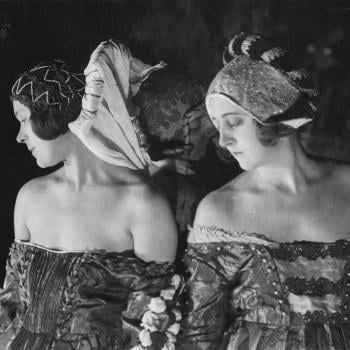
Source: Flickr user trialsanderrors
Public Domain
Douglas Sirk has been called both the king of the 50s “women’s weepies” and a master of social commentary. The two, in fact, go together. Or at least did in his case. As a fan of R.W. Fassbinder and Todd Haynes, Sirk’s greatest heirs, I’ve made it my mission to explore his lush, technicolor oeuvre. The time has come to plunge into his earlier Hollywood work—the black-and-white melodramas.
Thus, I found my way to All I Desire (1953), the story of an early-20th century runaway mother whose dreams of Shakespeare and the marquis leave her on vaudeville, name painted beneath that of the performing dog. Naomi Murdoch (Barba Stanwyck) is aging and regretful. She receives a letter. Her daughter Joyce (Marcia Henderson) will star in the high school play, and she wants her mother to come back to see her star. Of course, Joyce has an ulterior motive—she wants Naomi to whisk her away to New York and use her connections to jump start her acting career—but her mother doesn’t know that. She’s feeling just low enough to return to small-town Wisconsin.
I won’t rehearse the entire film—you can imagine how things go when the whole town believes she’s famous, her kids and husband protest their resentment, and the man she cheated with before blowing town shows up once again. What’s remarkable is Sirk’s ability to play into the fantasy of female freedom and reconciliation.
One might expect a 50s film to punish a runaway mother. She might face humiliation and convert to the cult of domesticity. And, while Naomi returns to her family and seems to enjoy her role as mother upon returning, she is never punished, nor is her dream of fame made to seem insane. The entertainment business comes in for criticism. The gossipy people of small-town America come off poorly. But Stanwyck’s character is a fully realized female protagonist. By the standards of the 50s, she gets to “have it all,” at least within the realistic bounds of a Sirkian world.
It’s gorgeous. Sirk’s famed mirror shots and obscured visual planes are on display. Give All I Desire a shot. Cinematic history contains a wealth of perspectives. Some, as in this Sirk gem, continue to impress with their foresight and depth of understanding.















 Ad-Free & Subscriber Log-In