

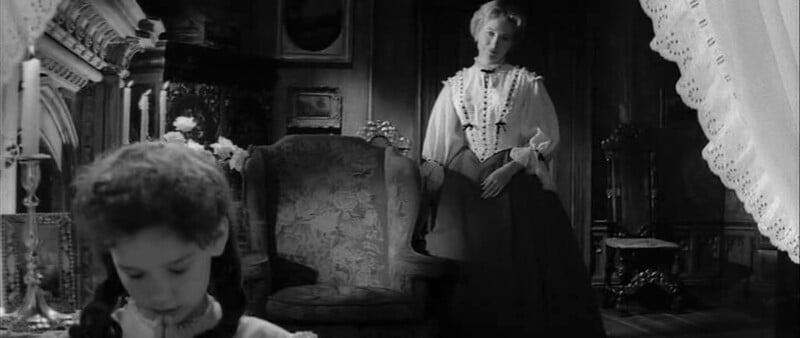
Source: Flickr user Laura Loveday
License
The Innocents (1961) has sat on my watchlist, stealing glances and looking disappointed, for years. Avid film watchers know the feeling all too well. It’s a classic for a reason; its reputation precedes it. That very feeling, however, keeps you from taking it in. Do I want to be disappointed? Am in the mood for something old enough to be my father? How spooky could a 60s haunted house movie be anyway?
I’m glad, as usual in these cases, that I took the plunge.
It is true that this Jack Clayton-directed outing with a Truman Capote script based on a Henry James novella presents as little more than a “scary kids in a big house” movie. But that’s no more than appearance.
Deborah Kerr plays Miss Giddens, the daughter of a country parson turned governess for two wealthy but neglected children, Miles (Martin Stephens) and Flora (Pamela Franklin). Miles’ school has just expelled him for corrupting his fellow youth. Flora seems normal enough, if creepy in that way upper-crust British children always are to American ears. The children’s half-detached affect and occasional flights of ghoulish fancy—as when the two, bedecked in costumes, descend the manor’s stately central staircase and recite a poem by candlelight—begin to alarm Miss Giddens. Once she hears that that the children once worshipped the estate’s cruel, now-deceased valet, she becomes convinced something is wrong. She sees his spectral form wandering around by night. Can they?
The film’s central tension is whether Kerr is insane or, as with many such horror movies, the only perceptive one among dull, unsuspecting adults. The opening credits, which show Kerr, swathed in darkness, rosary beads draped around her hands, pointed in prayer, mumbling how she wishes to save not destroy the children, suggest this tension from its opening moments. Is she a helicopter governess, bound by her own superstitious, repressive upbringing, or (quite literally) the only adult in the room?
What makes this ambiguity work comes down to The Innocents’ deep-blacks, hushed candle-lit nights, and dreamlike widescreen, CinemaScope presentation. When Miles nonchalantly informs Miss Giddens that “big rooms get bigger at night,” we can see that expansion on the screen along with all the bleak darkness it portends. Clayton moves from scene to scene with insistent, oneiric dissolves, layering half-seen nighttime terrors with shocked faces and the occasional nightmare. We ourselves have trouble telling exactly what Miss Giddens sees and how mischievous, even cruel, the two children are.
In essence, The Innocents manages to flip the “scary kids” genre on its head. When Flora retreats to a lakefront gazebo to dance alone, is she showing signs of possession or just being a kid who needs to be alone? When Miles roughly squeezes Miss Giddens’ neck after a game of hide-and-seek, is he haunted by cruelty from beyond the grave or simply learning the limits of his own power to act in the world? Although adults have all lived through childhood, its basic structures remain walled off from the grown mind. Miss Giddens’ inability to understand and respect this chasm has tragic results. Kids may be scary precisely because they are kids—but does that make it our duty to save them? Or are our imaginations just as wild as we believe theirs to be?






 Ad-Free & Subscriber Log-In