

Source
Public Domain
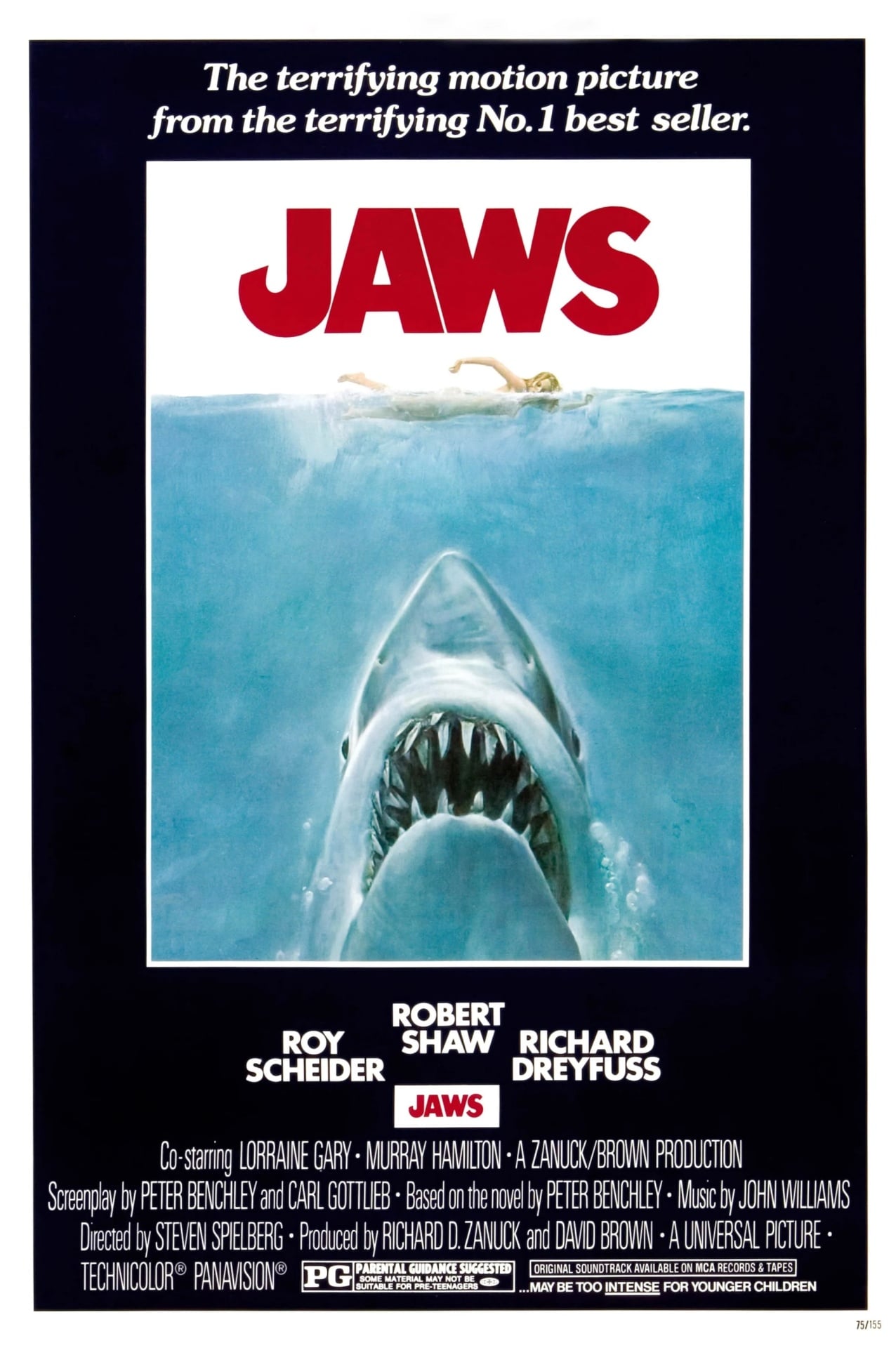
It all started with Jaws (1975). Through decades of changes—digital recording, CGI, the whole gamut—the blockbuster has remained the primary mode for large studios. Push national marketing, give it a summer release, and pray to the ghost of Louis B. Mayer that the greenbacks will find their way into huge sacks marked with dollar signs. I watched the movie dozens of times as a kid. I can still ring out the tune our three protagonist sing late night on their insufficiently sized boat. Jaws might be the film I’ve seen the most. But I hadn’t watched it in decades. I decided to find out: is it worthy of the praise?
The short answer is yes. Despite reams of work crushing my increasingly hunched frame, I sat glued to the TV through its two-hour runtime. I had to know what would become of Amity and its chief, if this shark, this leviathan, could actually be defeated. Spielberg earned his reputation. Tense moments end in deserved resolution—no one hurt—only for the monster to smash into frame when we least expect it. Which beachgoer will the shark go for next? His camera finds equal time, languidly paced to match their calm beach day, for each potential victim. There’s not a moment I would cut. It’s lean; it’s terrifying.
Well, then how did we get here? None of the above sentences could apply to any modern blockbuster I’ve seen lately. Even the ones I like (take, for instance, this year’s Sinners) seem uneven and bloated by comparison.
The answer, I suspect, proves intangible, certainly when crammed into this brief review form (the reams of work remain). But there is a basic point I’d like to make. The blockbuster is a vessel, a means for studios to reproduce and expand themselves. They’re only as good, independent of how much they make, as their moments in history allow.
Hollywood is confused these days. It has no idea where to go, aside from pumping streaming full of slop. This tends to make the blockbuster less pointed, less aware of its own end. Vision fades as the panicked desire for studio reproduction grows. The vessel leaks, empties out, and becomes a hollow form, sleepwalking its way toward a simulacrum of itself. In other words, the form becomes a parody of itself, obsessed with its own size, its vastness, rather than its content. We get CGI-laden multiverses, not quiet Amity hunted by nature’s aquatic mankiller.
It’s sad to look back. The form has outlived its usefulness. In the age of streaming, it too seems to be going the way of the movie theater itself. But, looking at the origin, I am wistful. So long as Spielberg remains, the blockbuster will, if only as a trace, blood in the water, a reminder of what was once there, living.















 Ad-Free & Subscriber Log-In