
 Jonathan Wilson-Hartgrove
In my freshman “Intro to Christian Spirituality” course at Eastern College, I was assigned Athanasius’ Life of Saint Antony as the first in a series of ancient Christian writers who would introduce me to a new language for my faith–a language, as it turned out, that was so old it looked like new. Thanks in large part to the teaching of Chris Hall, I became captivated by these ancient Christians and their faith. For me, at least, the seeds of a “new monasticism” were sown in that semester of reading saints from the early church.
The particular edition of Antony’s life that we read had a preface by C.S. Lewis. I’d come across his apologetic work in high school and appreciated the clarity of his thought. I didn’t get around to reading his fiction until later, though Narnia is what I still read with my kids. But even then, I recognized Lewis’ name and was intrigued that he took the time to introduce this old book. I’ll never forget his advice to Christian readers in that little preface: “For everyone new book,” he said, “read an old book.”
While I’m not great at keeping count, I’ve tried to follow that advice ever since that intro course with Chris Hall at Eastern College. It still leaves me time to read a good number of the books that everyone is talking about. But I also find myself on an airplane occasionally, with an obscure book I’ve borrowed on inter-library loan, explaining to the person next to me who Barsanuphius and John were and why I’m interested in them.
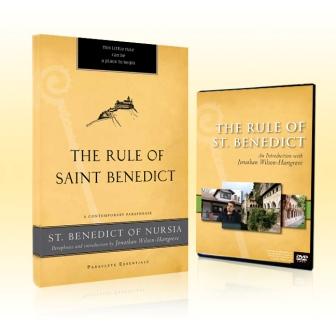
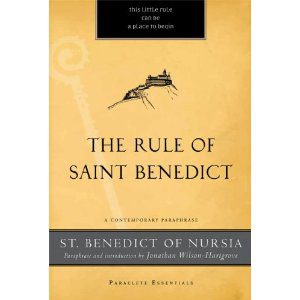 This constant search for good, old books is also the primary source for my deep, deep gratitude that two publishers with which I’ve work closely–InterVarsity Press and Paraclete Press–have committed to lines of “Christian classics.” These are, in short, old books that have stood the test of time as good food for our souls. June 1, Paraclete Press will release my paraphrase of The Rule of Saint Benedict in their Paraclete Essentials Series. (More on that soon.)
This experience of paraphrasing someone I never met who wrote in a language I don’t read well in a time and place far removed from my own has had me thinking a good bit about the challenge of listening to these ancient Christians and why we do it despite the difficulty. I’m grateful to the good folks at IVP for giving me the opportunity to share some of these thoughts in an introduction to Michael Glerup’s very fine paraphrase of one of my favorite 4th century saints, Gregory of Nyssa.
* * * * *
When prospective college students or presidential candidates are interviewed, they are occasionally asked a question that is supposed to open a window into their character and aspirations:
“If you could have dinner with one person from history, who would it be?”
It’s a way of asking, “Who is your hero?” or, “Who would you most like to learn from?” In many ways, it’s a very good question. But it does have its practical challenges. Aside from the straightforward problem of most of the prime candidates for this dinner invitation being dead, there is also this: if, somehow, you could bring them back—or if, for that matter, you could travel through time to sit at their table—how would you understand one another? How, that is, could I, a 21st century English speaker, carry on a conversation over dinner with the Aramaic-speaking Jesus of Nazareth or the Latin-speaking Augustine of Hippo? Even if, given years to prepare, I was able to learn the language of my ancient hero, how long would it take us to become familiar enough with one another’s context to even have a conversation.
I know it might seem a little nit-picky, but what I’m getting at is this: if I could have dinner with one person from history, I’m not sure the conversation would go very far. There is, after all, more than time and death that stand between us and those who’ve gone before us.
And yet, despite this great gap, Christians have always tried to listen to people from our history. For 2,000 years, we have remembered the saints. While the fractures of church schisms have dulled our memory of some saints and the emphasis on experience in the present has downplayed the role of saints in American evangelicalism, they have never entirely gone away. This has something to do, I think, with the fact that we are the inheritors of a living tradition. As mysterious and hard to explain as it may be, we have the conviction that those who are dead are not gone. In Christ, they wait with us for that great getting’ up morning when, as Scripture reminds us, “the dead in Christ shall rise first.”
To consider the gift of the communion of saints is to come face to face with the fact that we do, in fact, have dinner with saints from history all the time. We call this meal “the Lord’s Supper.” It is, as our pastors often remind us, a concrete sign of the unity of the church—“one Lord, one faith, one baptism.” We are the one body that we eat. But the “we” here is not just those of us who gather in the same building, the same congregation. It is the “we” of the global body of Christ. And it is, strange as it might seem, the “we” of the church across time.
Though we might not be in the habit of remembering this, every Lord’s Supper is an opportunity to sit down to dinner with Gregory of Nyssa and Teresa of Avilla, Martin Luther and Fanny Crosby. It’s an incredible thing, really. But the miracle of this encounter doesn’t guarantee that we’ll be able to understand one another. To listen to those who’ve gone before us, we need help.
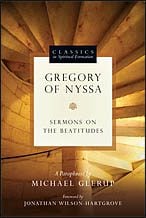 All of this to say, if I’m going to have dinner with Gregory of Nyssa—which I have, in a very real sense, enjoyed doing this week—I’m not going alone. I’m bringing Michael Glerup with me. Fact is, Michael has done the homework I haven’t. He’s taken the time to learn Gregory’s Greek, to listen carefully to his context, to pay attention not only to the words he wrote but also to what those words signified in Gregory’s 4th century context. But Michael also lives with me in 21st century America. He reads the same newspapers I do. From what I can tell, he’s even watched cable TV. As such, he has the ability to mediate between Gregory’s world and my own.
This book is a paraphrase of sermons that Gregory preached some 1700 years ago. In a day when many wonder whether the sermons they hear on a given Sunday have anything to say to their lives, it may seem like a stretch to think about opening yourself to these words. But I’m glad to have this chance to say that I think you should. I think you should because Michael has done an excellent job of paraphrasing Gregory. And because he has, this book will help you to see how well Gregory paraphrased Jesus. And because the body of Christ is a living tradition, I trust that this will help you to become a living paraphrase of the good news in the place where you are.
From where I sit, nothing could be more important.
* * * * *
For those who are inclined to comment, What old books have been important to you?











 Ad-Free & Subscriber Log-In