


“A bridal chamber isn’t for the animals, nor for the slaves, nor for the impure, but it’s for people who are free, simple, and silent. It is through the Breath [Pneuma] that we come into being, but we are reborn by the Christ two-by-two. In his Breath, we experience a new embrace; we are no longer in duality, but in Oneness. None can see themselves in a mirror or reflected in the water unless there is light. None can see themselves in light unless there is something there to reflect them. This is why we must be immersed in water and in light, and the light is in the oil of anointing [Chrism].” (The Gospel of Philip, vs. 72-75)
In Valentinian Christianity, the Bridal Chamber is one of the most profound and mystical metaphors and works as a symbol of ultimate union, restoration, and divine (experiential) knowing.
Valentinians believed that all reality began in the reality of the fullness of the divine realm, where spiritual beings existed in harmonious pairs. Unfortunately, humanity is blinded by the illusion of separation and duality. We need to awaken from this dream and realize our original Oneness with the Divine and with one another.
Human beings are seen as fragments of divine light trapped in material bodies, longing to return to unity with the divine. In this cosmology, salvation is not primarily about forgiveness or moral correction; it’s about reunion.
The Bridal Chamber represents the sacred reunion of what has been divided:
- Spirit and matter
- Male and female
- The Bride and the Bridegroom (Humanity and Christ)
So, to “enter the Bridal Chamber” means to awaken to this reality and to reunite with one’s spiritual counterpart which is Christ.
In some Valentinian communities, there may have been an actual ritual called “the Bridal Chamber,” as it was the highest of five sacraments (after baptism, chrism, eucharist, and redemption).
However, the rite’s meaning was symbolic rather than sexual or literal. It was an initiation into divine union, where the initiate symbolically joined with their heavenly counterpart, and it represented the restoration of the original androgyny of humanity (echoing the Genesis myth that “male and female” were created as one being before being separated to form Adam and Eve).
This was not about gender but about integration. It was about realizing we are all One with the Divine source which is within all things.
For Valentinians, the Bridal Chamber is also linked to the idea of resurrection. Not as a future event but as a present spiritual awakening.
When the soul awakens to reality and recognizes its divine origin, it is “raised” from the darkness of ignorance into the light of eternal Oneness.
The Bridal Chamber, therefore, is what happens at the moment of realization when the soul awakens and unites with the Spirit.
The metaphor of the Bridal Chamber captures the heart of Valentinian spirituality. Cosmically, it reverses the illusion of separation. Personally, it heals the inner division within humanity. Spiritually, it consummates the union between humanity (the Bride) and the Bridegroom (Christ). Eschatologically, it signifies the return of all things into the One and the restoration of the Fullness (Pleroma).
In short, the Bridal Chamber points to the mystical marriage between the human and the divine, the temporal and the eternal, ignorance and awakening.
This passage from the Gospel of Philip distills the heart of Valentinian mysticism and the movement of human consciousness from division to union.
Every image here: the Bridal Chamber, Breath, light, mirror, water, and oil, works together to express the mystery of the soul’s transformation.
So, let’s take a look at each section here to understand what is being said.
“A bridal chamber isn’t for the animals, nor for the slaves, nor for the impure…”
The Bridal Chamber is not for those who remain bound to ignorance or instinct, those still enslaved to the lower nature of desire and fear. To enter the chamber one must be “free, simple, and silent” in order to escape the compulsions of the ego and to become simple in heart and silent before the mystery.
Freedom and simplicity are not moral conditions but states of consciousness—a readiness to awaken to one’s divine origin.
“It is through the Breath [Pneuma] that we come into being, but we are reborn by the Christ two-by-two.”
The Divine Breath represents the animation of life itself. But rebirth comes through Christ, who restores the divided soul to its spiritual counterpart. “Two-by-two” points to the sacred pairing of both the male and the female expressions of humanity, and also to the human and divine, which must all be recognized as One. In Christ, these “opposites” are reunited into One once more.
The Bridal Chamber is thus the place of new creation, where the soul is joined again to its heavenly twin.
“In his Breath, we experience a new embrace; we are no longer in duality, but in Oneness.”
This “new embrace” is the mystical union itself when all illusions of separation dissolve. The breath of Christ is the Spirit that reunites what was divided.
To experience this embrace is to awaken into Oneness and to enter the state beyond opposites where the self and the divine are no longer two.
The Bridal Chamber, then, is not a physical space but an inner reality: the union of the fragmented self with the indwelling Spirit.
“None can see themselves in a mirror or reflected in the water unless there is light.”
Both the mirror and the water represent consciousness. The light is divine revelation.
Just as no reflection can appear without light, the soul cannot see its true face without the light of the Spirit.
Knowledge (gnosis) is not gained by intellect but revealed in illumination—when divine light awakens the capacity of the soul to recognize itself.
“None can see themselves in light unless there is something there to reflect them.”
This paradox deepens the metaphor: even in the presence of divine light, we need a reflective medium. We need a soul that has been purified and made still enough to mirror the divine image.
Without this inner transformation, Divine Light cannot be perceived. The mirror must be clean; the water must be calm.
Therefore, purification and contemplation are not ends in themselves but preparations for reflection of the divine likeness.
“This is why we must be immersed in water and in light, and the light is in the oil of anointing [Chrism].”
The passage ends with the unification of the sacraments: baptism, illumination, and anointing.
Water symbolizes cleansing and rebirth. Light signifies enlightenment. Oil points to the reality of the Christ (the Anointed One) within all things.
To be “immersed in water and in light” is to undergo both purification and illumination. It is about dying to ignorance and awakening to the reality of Oneness.
In Valentinian theology, the Bridal Chamber is not merely a ritual or a symbol. It is the experiential reality where the human and the divine are joined in a glorious union and everything becomes One.
**
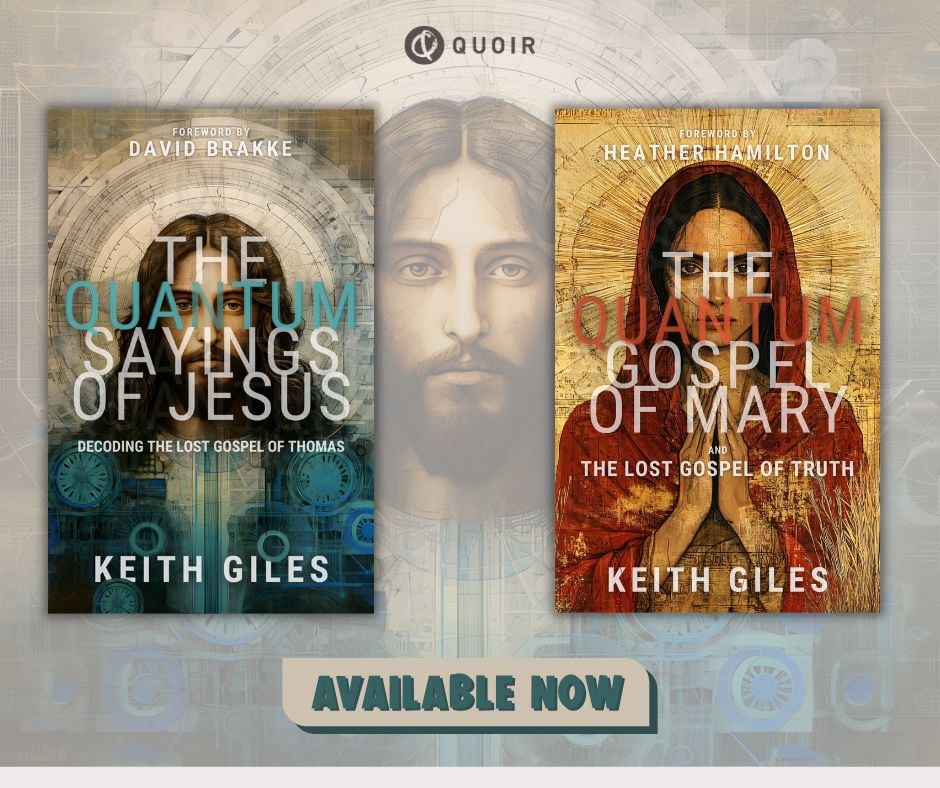
My new book, “The Quantum Gospel of Mary and the Lost Gospel of Truth” is now available on Amazon.
The book from Keith Giles, “The Quantum Sayings of Jesus: Decoding the Lost Gospel of Thomas” is available now on Amazon. Order HERE>









 Ad-Free & Subscriber Log-In