


Let me start with an honest question: How many of you feel tired?
I’m not talking about the kind of tired that you can cure with a nap.
I’m talking about being deep down, in your bones, soul tired. The kind of exhaustion that comes from living in a world that feels constantly on edge and uncertain.
If that’s you, you’re not alone.
You’re not broken.
It simply means you’re paying attention.
Last week I watched an interview with sociologist Tressie McMillan Cottom who said something that resonated with me: “American institutions aren’t broken. They are working exactly as designed.”
There’s a version of that I learned from my days working in corporate America that goes like this: “The systems you have now are perfectly designed to give you the results you’re currently experiencing.”
And if that’s true…and I believe it is…then the world we’re living in right now is the logical outcome of the stories we’ve been telling ourselves.
This suggests to me a hopeful opportunity to change our world.
If we don’t like the world we have, maybe just have to have to tell ourselves a better story.
Scripture says it like this: “Without a vision, the people perish.”
Because, when we lose the story of where we came from, and who we are, and where we’re going, we lose ourselves along the way.
The Stories We Live Inside
Poet Drew Dellinger once said that nearly every culture in human history told stories that said humanity was embedded in nature, connected to it, born from it. Our modern story, however, tells us we are separate from nature, superior to it, walking on top of it instead of within it.
That reminds me of the story I read about the Cheyenne Creation Myth which says that God created the world and fell in love with her as if she were a beautiful woman. He loved her so much he created humans simply to remind her every day of how beautiful she was, and how much God loved her.
What an amazing story. Just imagine if you and I had grown up being told that the Earth was a beautiful woman created by God and that our purpose here was simply to remind the Earth how much God loved her.
The stories we tell have consequences. Those stories change us, and they change our world.
Science Fiction Mythology
My friend, Science fiction scholar Damien Walter talks about humanity’s need for a new mythology because every civilization lives inside a story about who we are. That story shapes what we imagine is possible for the future.
Look at the stories dominating our culture right now. They are stories about the end of the world.
The Last of Us.
The Walking Dead.
Fallout.
Plur1bus.
These aren’t really stories about zombies or radiation or apocalypse. They’re stories built on a quiet, shared belief that “The systems we have don’t work anymore… so maybe everything has to burn before anything can be healed.”
I wouldn’t call that nihilism. I’d call it grief.
I believe it’s our collective intuition saying: This story can’t continue the way it is.
Look at the heroes of our stories. They’re billionaires like Tony Stark and Bruce Wayne, or people with supernatural powers.
But in real life, the billionaires aren’t saving the world. In many ways, they’re part of what’s making it worse.
Waking Up
Maybe we need to stop listening to the stories that tell us to put our hope in people with great wealth or power?
Maybe there are no super-powered billionaires coming to save us and make the world better.
Maybe our real hope is found in on eaother?
Maybe the best way out of this dystopian nightmare is simply to love one another, and to learn to tell stories about the power of community.
Because, when we stop telling hopeful stories about the future, the dystopian stories rush in to fill the vacuum.
Damien Walter puts it this way:
“It’s not that dystopian stories deleted the future. It’s that we stopped telling better stories, and we left the door open. And now it’s easier to imagine the end of the world than to imagine the end of capitalism.”
One of my favorite Science Fiction authors is Ursula K. Le Guin, and just before she died she gave an amazing speech where she said:
“We live in capitalism. Its power seems inescapable. So did the divine right of kings. Resistance and change often begin in the arts—and very often in the art of words…in the stories we tell.”
The stories we tell ourselves matter.
When we stop telling hopeful stories about the future, dystopian ones rush in to fill the vacuum.
Why Are We So Exhausted?
We often think we’re overwhelmed because we know too much.
But Tressie McMillan Cottom offers a different diagnosis. She says, “We are overwhelmed with information we can’t act on.”
We are flooded with outrage, news, commentary, and analysis, but given almost no agency to change anything.
We’re shown everything that’s wrong… and then told to keep scrolling.
Our media ecosystem rewards outrage, not wisdom. Fear spreads faster than hope. Anger is more viral than joy.
And many leaders—political, cultural, even religious—have learned to exploit this.
They find something people are angry about. They promise to fight it. But they never really want to solve it, because if the problem disappears, so does their influence.
So we stay perpetually activated… and perpetually exhausted.
We’re told the solution is to disconnect. Log off. Take a break.
And sometimes that’s helpful. We take a much-needed Facebook Fast, we stay away from our Instagram. We detox from social media.
I get it. That’s a good call if you’re feeling overwhelmed by the algorithm.
But withdrawal doesn’t heal us.
Tressie Cottom puts it plainly: “We’re not exhausted because we know too much. We’re exhausted because we’re doing too little.”
And the real problem is that we’re doing too little together.
Because, we as human beings are wired not just to consume stories, but to participate in them.
Why Connection Is What Heals Us
Research into addiction shows something fascinating: the opposite of addiction isn’t willpower.
It’s connection.
In the famous “Rat Park” experiment, isolated rats chose drugged water. Rats placed in rich, relational environments ignored it.
Their addiction wasn’t about the substance. It was about the absence of belonging.
The same is true for us.
When people are traumatized or isolated, they bond with whatever brings relief: substances, distractions, social media, outrage.
But healthy bonds with other people? Those bonds heal.
This is why solitary confinement is considered torture. Not because humans need entertainment, but because the human soul cannot survive without relationship.
I think this is partially why Jesus told us, “Where two or three are gathered, I am there among them.”
Not because Christ arrives from somewhere else, but because Christ is revealed within us and among us, as we come together.
Black Elk said it beautifully: “The first peace comes within the souls of people when they realize their relationship, their oneness, within the universe… and that its center is really everywhere, and within each of us.”
Telling A Better Story
I believe there’s a better story we’re being invited into:
It’s not a story about rich, powerful, Billionaire heroes who are coming to save us.
It’s not a story about burning everything down and starting over after the apocalypse.
It’s not a story about retreating into ourselves and shutting out the noise.
It’s a story where those who are exhausted by injustice engage the problem directly.
It’s a story where those who are tired of dehumanizing policies stand up and help those people who are oppressed by those policies.
It’s a story where those who are tired of the “Us vs Them” narratives start to tell a different story of oneness, connection, and unity as loudly as they possibly can.
The Future is Us
Let me tell you this: If you fall on hard times, it won’t be your social media followers who show up to help.
It will be your neighbors. Your friends. Your family. Your community.
The world doesn’t change because one powerful person fixes it. It changes when people remember they belong to each other.
The future isn’t waiting on a billionaire superhero.
It isn’t waiting on a perfect system or politician…[thank God].
It isn’t waiting on the algorithm to shift in our favor.
The future is waiting on us.
Every time we choose connection over isolation…
Engagement over retreat…
Oneness over division…
We are changing the story.
The lie says we are separate.
The truth says we belong.
The lie says, “Pull away.”
The truth says, “Lean in.”
Because when we gather—when we come together in love, courage, and shared humanity—something holy happens.
Not because Christ finally arrives. But because Christ is finally revealed.
Let’s tell better stories.
Let’s build deeper connections.
Let’s engage the world instead of escaping it.
Because the healing power of this moment…the hope of the future…the story that changes everything…
Is the story of us.
**
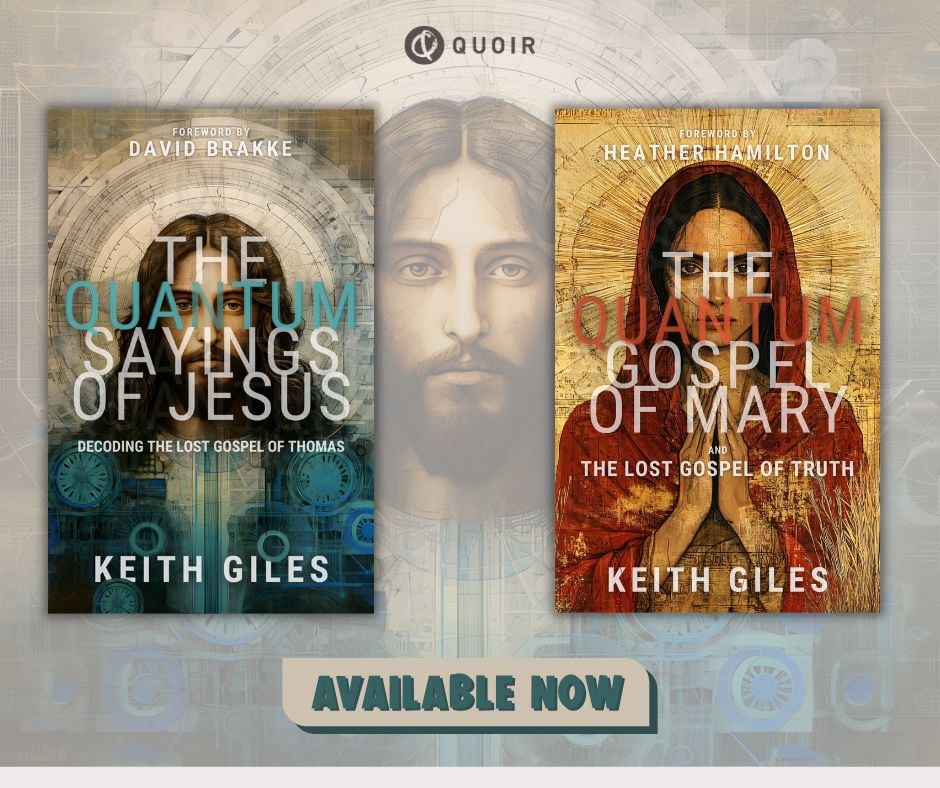
My book, “The Quantum Gospel of Mary and the Lost Gospel of Truth” is now available on Amazon.
The book from Keith Giles, “The Quantum Sayings of Jesus: Decoding the Lost Gospel of Thomas” is available now on Amazon. Order HERE>








 Ad-Free & Subscriber Log-In