

Religion News Service goes for a just-the-facts headline: “Trump allies lead thousands in prayer to ‘rededicate’ America to God on National Mall.” So does NCR: “Thousands flock to the National Mall in Washington for an America-themed prayer rally.” Those give you the who what and where.
Those outlets cover religion news, and this is a story with a religion angle — the Trump allies were leading prayers, the thousands gathered were mixing prayer and worship with their political rallying, a bunch of the celebrities involved run various Christian ministries or work for Christian entertainment companies. But despite the prominence of some of the participants — cabinet secretaries, the speaker of the house, the star of a hit show, several people whose posts sometimes get shared by Catturd — there wasn’t a lot of actual news here. Not a lot of story to this story: Thousands gather to do religiously flavored political thing.
Tens of thousands, probably. Not quite as many thousands as flocked to Citi Field that same day to rededicate themselves to the Subway Series, but maybe that’s not a fair comparison. “Rededicate 250” may have featured the biggest celebrities in MAGA Christianity — Pete Hegseth! Eric Metaxas! Franklin Graham! Mike Johnson! The Other Falwell! — but that’s still not quite the star power of Aaron Judge or Carson Benge.
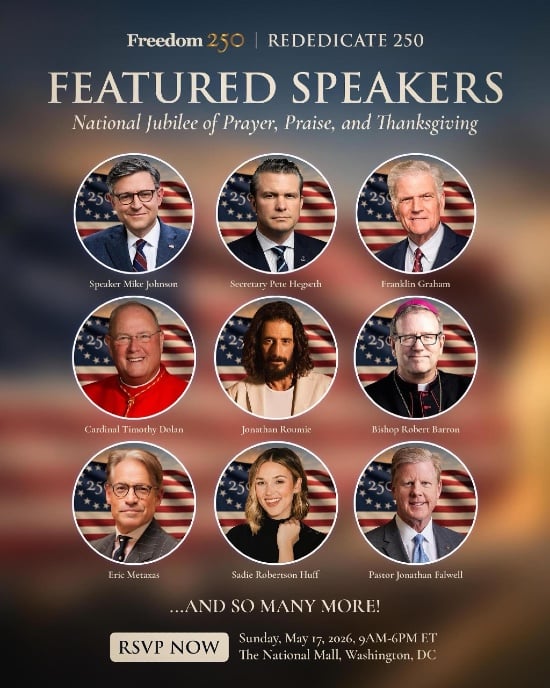
“Rededicate 250” was a weird event, befitting the narrow-spectrum diversity of its lineup of celebrity speakers. This was a mix of NeoConfederate Southern Baptists, New Apostolic Reformation dominionist Pentecostals, Ultra-Calvinist Reconstructionists, End Times Protestant Zionists, and various strivers and climbers of the sort who will show up wherever there’s a camera and a microphone.
Many of these folks are often described — accurately — as “Christian Nationalists,” but it’s important to recognize that their various preferred forms of Christian nationalism are ultimately incompatible. Each imagines and desires a different specific form of sectarian hegemony — an America in which their own particular sect is established and privileged, with all of those competing Christian nationalist varieties consigned to the second tier of second-class, conditional citizenship and whatever second-class rights they deign to allow for Quakers, Freethinkers, Jews, Slavs, Catholics, Black people and maybe the Irish.
These disparate, competing groups are capable of calling a temporary truce to join together for an event like “Rededicate 250” — or any other Trump campaign rally, — but in the end there can be only one. The subtle ways the representatives of these different factions of Christianist authoritarianism advocated for their particular strain above and against the others present were interesting, but still not big news because, again, a mid-sized Trump rally that he couldn’t even bother to attend in person is just not a big news story.
Trump would not have had to travel to attend the event in the park just down the street from the White House, but instead he spent the day golfing. He did send a pre-recorded video to play for his fans, but it wasn’t new material — it was the same video he’d done for the recent Museum of the Bible event, in which he read from 2 Chronicles 7.
That passage was chosen for Trump to read because its a story of national religious “rededication” leading to peace and prosperity. It includes the famous 2 Chronicles 7:14, in which it says that God says: “If my people, who are called by my name, will humble themselves and pray and seek my face and turn from their wicked ways, then I will hear from heaven, and I will forgive their sin and will heal their land.”
It continues to be funny that the organizers of these events are trying to associate Donald Trump with humbling himself.
“Humble themselves” is one of the conditions this passage insists must be met for a nation that desires forgiveness, healing, and prosperity. “Rededication,” it says, is contingent upon humility, prayer, and turning away from wickedness. “Rededicate 250” had a lot of prayer.
So, 1-out-of-3.
The event was, as Dorothy Thompson’s second husband might have said,* “wrapped in the flag and carrying a cross.” It was a day-long effort by a bunch of compromised media personalities to equate “rededication to God” with dedication to Trump. That might have been a big news story back in 2015, but in 2026 this same shtick from this same sad bunch is neither new nor news.
For those of us shaped by or raised in white evangelicalism, the name of this event prevents us from regarding anything about it as meaningful. We know from extensive, intimate experience that “rededication” is a fleeting wisp of nothingness — the very symbol of inconsequence and inconstancy.
We know this because we have all “rededicated our lives to Christ” more times than we could count. We did this sincerely. We really meant it, every time. And we did not mean to mean it any less each time, but the staggering repetition of hearing our own voices say”No, but seriously, this time I really do really mean it!” ultimately becomes the only thing we know to be true about that supposedly earnest experience.
“Rededication” is like quitting smoking. For someone who does it once, or maybe even twice, it can be a meaningful act that indicates a genuine change in that person’s life. But if someone does it dozens of times it is not at all meaningful. It’s just a bitter joke.
Everybody in my church youth group rededicated our lives to Christ more often than we got our hair cut. We did it weekly or monthly for years, routinely registering to attend multiple regular events where we planned and expected to do this again and again and again. We dutifully and routinely raised our hands or came forward at every altar call to rededicate our lives to Christ and to re-reedicate, and to re-re-rededicate, until we all sounded like Aretha’s background singers — “Re, re, re, re, re, re, re, re … sock it to me, sock it to me, sock it to me …”
None of that negates our sincerity or our genuine pathos. Every one of those rededications was an emotional experience. But that emotion and passion had nowhere to go and so that is where it went — nowhere. Because this faith of constant revival and renewal and rebirth was an otherworldly faith that carried no content or substance or responsibility beyond some vague notion of abstinence from a very limited and limiting understanding of “sin.” It asked nothing of us and gave us nothing to do except to return to the next rally or retreat or service where we might again be invited to rededicate and re-rededicate our lives to Christ.
“Rededication” is the action of those whose initial dedication has failed. We had to perpetually “rededicate” our lives because we were incapable of any lasting dedication. And that is because our heavenly minded faith offered nothing in this world for us to be dedicated to. We were thus incapable of dedication and could be dedicated only to an endless cycle of rededication.
The only difference between the “rededication” at all of those countless youth group rallies and the Rededicate 250 rally held last weekend was that the latter was held on the National Mall.
If any of those in attendance had wanted to think more deeply about what “dedication” might mean if it were allowed to have meaning, they were just a short walk away from the perfect place to ponder that. The Lincoln Memorial was right behind them, where the words of the Gettysburg Address are carved into stone. “Dedication” is a thread woven throughout that great manifesto:
We have come to dedicate a portion of that field as a final resting place for those who here gave their lives that that nation might live. It is altogether fitting and proper that we should do this. “But in a larger sense we cannot dedicate, we cannot consecrate, we cannot hallow this ground. The brave men, living and dead, who struggled here have consecrated it, far above our poor power to add or detract. The world will little note, nor long remember, what we say here, but it can never forget what they did here. It is for us the living, rather, to be dedicated here to the unfinished work which they who fought here have thus far so nobly advanced. It is rather for us to be here dedicated to the great task remaining before us,that from these honored dead we take increased devotion to that cause for which they gave the last full measure of devotion, that we here highly resolve that these dead shall not have died in vain, that this nation, under God, shall have a new birth of freedom, and that government of the people, by the people, for the people, shall not perish from the earth.
Between that address and Lincoln’s Second Inaugural — carved into the opposing wall of the memorial — you can see how different it looks when all of the conditional conditions of that verse from 2 Chronicles are met. When it’s not just hollow, show-off-y prayer, but actual humility and repentance made tangible by turning away from the wickedness woven into this nation since before its first, failed founding.
That same wickedness — the original, undemocratic wickedness of America’s original, undemocratic Constitution before it was transformed and reborn through the Reconstruction Amendments — was really the thing to which “Rededicate 250” was dedicated. It was dedicated to the rejection of the great task Lincoln described and to the reversal of that cause for which the Americans who died at Gettysburg gave the last full measure of devotion. That is what “MAGA” means and that is, ultimately, all that it means.
The “celebrity” speakers at Rededicate 250 may have recited talk about their desire to “dedicate America to God,” but such talk of “dedication to God,” coming from them, is best understood as meaning that they intend to do to America what Jephthah did to his daughter. She was also “dedicated to God.” This is the only “dedication” they understand, and it will result in death and ashes.
* The statement that “When Fascism comes to America, it will be wrapped in the flag and carrying a cross” works as a rough summary of Sinclair Lewis’s theme in his 1935 novel It Can’t Happen Here. It describes the way the fictional dictator, Buzz Windrip, rises to power in that book. But the quote itself cannot be found in anything Lewis wrote.
Or in anything that Dorothy Thompson wrote, either, in her many writings about the American potential for American fascism. It’s always useful to re-read her fiercely clear-eyed August 1941 essay “Who Goes Nazi?” Thompson certainly saw the danger that her then-husband wrote about in It Can’t Happen Here, with its cross-carrying, star-spangled demagoguery and jingoism. But her essay is less concerned with the ideologues and theocrats than with the unprincipled strivers and climbers whose resentment and sense of entitlement would make them willing to go along with anything. The sight of delegates to the Republican National Convention gleefully waving placards calling for “Mass Deportation Now” would not have surprised her.
“Who Goes Nazi?” is “an amusing game,” Thompson writes. “Try it at the next big party you go to.”
And it works for the big party the MAGA Christians threw last weekend. J.D. Vance and Marco Rubio — the ultimate embodiments of Thompson’s “Mr. C” — were not at Rededicate 250, but Eric Metaxas was there to represent that faction. (Metaxas, famously, likes to portray himself as Bonhoeffer, but he nothing like the Bonhoeffer character in Thompson’s essay — and there is one, a theology student who studied under Barth! Eric Metaxas is Mr. C, through and through.)
Pete Hegesth is surely “Young Mr. D” — the “spoiled son” who “spends his time at the game of seeing what he can get away with.” Franklin Graham is another Young D, even if he’s not so young anymore.
Mike Johnson is a gender-swapped Mrs. E (“So sweet, so clinging, so cowed. She is a masochist. She is married to a man who never ceases to humiliate her”).
Sammy Rodriguez is Mr. J., but he’s destined for the same fate as Mr. G. (“We may be sure that Mr. G would be a Nazi with purse-lipped qualifications. He would certainly be purged.”)
We could go on. It’s an amusing game but, as Thompson understood, not really.










 Ad-Free & Subscriber Log-In