

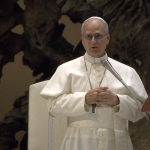
On May 12th, 2025, the newly elected Pope Leo XIV held an audience with the many journalists who had been eagerly waiting to see white smoke emerge from the roof of the Sistine Chapel. He concluded his remarks to the hundreds of members of the media stating, “You are at the forefront of reporting on conflicts and aspirations for peace, on situations of injustice and poverty, and on the silent work of so many people striving to create a better world. For this reason, I ask you to choose consciously and courageously the path of communication in favor of peace.”
This call for peace in mass media by the Pope does not pertain only to the secular media, but begins at home with Catholic media. Among the journalists present that day, on the front row, was the Peruvian Paola Ugaz. A friend of Pope Leo, she anticipated meeting with him after the conclave to give him a gift – a beautiful blue alpaca scarf. Recognizing that would be an impossibility, she presented the scarf as he greeted those sitting on the front row, and they even took a selfie. Paola Ugaz, together with fellow journalist Pedro Salinas, have led a ten-year investigative fight against a Catholic institution founded in Peru in 1971 which was suppressed by Pope Francis just days before his death. As Bishop of Chiclayo, Bishop Prevost worked closely with journalists to give a voice to the many victims of psychological, sexual and financial abuse by members of this now defunct religious institution. As Prefect for the Congregation of Bishops, Prevost oversaw the premature retirement at age sixty-eight of Bishop Jose Antonio Eguren of Piura, Peru, the first member of this same institution to be named a bishop, followed by his expulsion from the religious community.
In a letter written in June 2025 to Peruvian citizens commemorating the opening of a play based on the journalistic work of Paola Ugaz, Pope Leo noted that journalists have walked with victims with courage, patience, and faithfulness to the truth. “They illuminate the wounded, yet hopeful face of the Church,” he wrote. He commended the work of Ugaz and other journalists in the face of unjust media and judicial attacks orchestrated by the suppressed religious institution. He concluded his letter telling the Peruvian press, and through them all journalists, not to be afraid. “With your work, you can be instruments of peace, unity and social dialogue. Be sowers of light in the midst of shadows.”
The Pope addresses this toxic negativity within the Catholic press because he too has suffered from misinformation by sectors of the Peruvian Catholic press. These false reports have made appearances in international media, accusing the Pope of improperly handling cases of abuse in his Diocese while the facts show otherwise. Among the Bishops of Peru, and in his position as Vice President of the Peruvian Bishop’s Conference, he became the recognized advocate for victims and the champion for transparency. The Pope said to the journalists after his election and echoed it on his letter to the Peruvian nation, “truth does not belong to anyone, but it is everyone’s responsibility to seek it, guard it and serve it.”
Pope Leo has expressed strong support for journalists and their indomitable task of standing for the truth. At a time when we are witnessing profound division in society, which is then inordinately exacerbated by a sensationalist press sometimes more concerned with ideology than truth, Pope Leo provides guidance based on his personal experience. It is from his recent dealings that he exhorts journalists, “I ask you to choose consciously and courageously the path of communication in favor of peace.” Not only journalists, but each individual, has a responsibly to celebrate what is right in the world, and seek paths of understanding as well as peace. The Pope’s plea will not fall on deaf ears as long as the many Catholics news outlets worldwide choose to build up the Church with truth and peace. The Catholic media has a substantial role to play in presenting the Church to the world, and it must always seek truth in charity.
Picture is not mine, but is free to use. Information here.






 Ad-Free & Subscriber Log-In