

When it comes to prophecy, how are your prophetic perspectives? Do you think prophecy only moves one way at one time?
In my book The Divine Feminine: A Treatise on the Female in Christian Spirituality, I look at specific female characters in the Bible. While researching chapter 4, , I came across Noadiah, a Bible woman I knew nothing about. Admittedly, I had never heard of before I started my research.
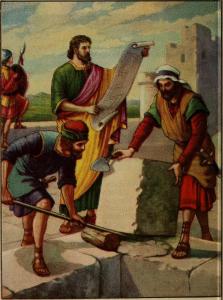
If you don’t know who Noadiah is, don’t feel bad. We find her in one verse in Nehemiah 6. Given most don’t study the book of Nehemiah in depth, it’s no surprise we don’t know who she is. The thing that I took most note over when it came to Noadiah was the reality that nobody seemed to agree about who she was, or what she did. Given this fact, there were still an awful lot of people who brushed her off as a false prophetess, for one simple reason: she opposed (or so we are led to believe) the building of the wall in Jerusalem.
I wasn’t sure what to think, so I did a little bit of further research on her. What I got a huge lesson on was prophetic perspectives and how one disagreement (especially a public one) can paint a misleading picture of someone, without cause.
Who is Noadiah?
To understand the complete picture, we must start up a few verses. Nehemiah 6:10-14 says:
One day [Then] I went to the house of Shemaiah son of Delaiah, the son of Mehetabel. Shemaiah had to stay at [was confined to his; perhaps related to a vow or to ritual uncleanness] home. He said, “Nehemiah, let’s meet in the Temple [house] of God. Let’s go inside the Temple and close [bar] the doors, because men are coming at night to kill you.”
But I said, “Should a man like me [in his position] run away? Should I run for [to save] my life into the Temple [to seek asylum; Ex. 21:13–14; 1 Kin. 1:50–53; 2:28–34; 2 Chr. 26:16–20; 27:2]? I will not go.” I knew [realized; perceived; recognized] that God had not sent him but that Tobiah and Sanballat had paid [hired] him to prophesy against me. They paid [hired] him to frighten [intimidate; terrorize] me so I would do this and sin. Then they could give me a bad name to shame [accuse and discredit/blame] me.
I prayed, “My God, remember Tobiah and Sanballat and what they have done. Also remember the prophetess Noadiah and the other prophets who have been trying to frighten [intimidate; terrorize] me.” (EXB)
Noadiah seems to appear out of nowhere. We find her at the end of a few verses where Nehemiah speaks about his encounter with a false prophet, Shemaiah. He spoke lies and came to lead him into sin. But what of Noadiah and “the other prophets?” Who are they and what did they do, and why were they considered to be intimidating Nehemiah?
Her work
Noadiah lived during Nehemiah’s lifetime. It is evident she had an active prophetic ministry during the time of the wall rebuilding in Jerusalem. She is not identified by Nehemiah as a false prophet, neither her, nor “the other prophets” mentioned in the second sentence of Nehemiah 6:14. All that is said is she, along with the rest of these prophets, were opposed to the rebuilding of the wall, and, most likely, voiced their opposition with a few prophetic utterances here and there.
We can probably deduce that Noadiah was of considerable note in her day, because she is specifically mentioned by name. She might have led action against the wall, influenced others against the rebuilding, or somehow related position opposed to it. This would be why Nehemiah would have been upset with her stance, and would have specifically mentioned her.
None of this means Noadiah was a false prophet. There’s nothing that indicates she spoke false prophetic word. It simply means that, for whatever her personal reasons might have been, she took issue with the rebuilding of the wall. Miriam also opposed Moses (Numbers 12:1-16), and we have no indication that she lost her standing as a valid prophet. We have more detail on Miriam’s position and what she did, but that still has not erased her prophetic standing from history, nor from the people of her day. We can say the same for Noadiah: she did not lose her prophetic standing for opposing the wall, but the question remains: just what happened here?
Gaining prophetic perspectives
Nehemiah received word from God to rebuild the wall around Jerusalem. Many prophets of his day did not. When we read Nehemiah’s call to build the wall, we do so with a certain level of bias: we automatically side with Nehemiah. After all, it is his recounting of his experience. We know the end of the story. We read the text from the perspective that Nehemiah was right to build the wall (he was), and that God was in his project (He was), and that everyone and everything had to see what he did the same way, without any question.
It is that last point where we start to make judgments about lesser characters who might have objected to the building of the wall. We don’t consider that it was Nehemiah’s assignment, not that of the other prophets, and for that reason, others might not have understood it in quite the same way Nehemiah did. Instead of saying maybe it was nothing more than disagreement, we start declaring one side true and the other false.
There are probably several reasons why Nehemiah saw value in rebuilding the wall while others did not. While many prophets in his time focused on helping families, Nehemiah was a government official. As cupbearer to the king (Nehemiah 2:1), he knew firsthand the ramifications of having a broken down or nonexistent wall around the city of Jerusalem. Such left the city open to military invasion. Then there was the spiritual aspect of the walls, which represented the spiritual compromise present in Judah at that time in history. Intermarriage was common, and the Jews of that day weren’t observing the Sabbath, festivals, or practicing the divine laws. Rebuilding the walls served as a sign that Judah needed to step up its spiritual game.
Both can be right
I’m not saying that Nehemiah was wrong in his viewpoints. He received an assignment from God, and he expected everyone else to see it the same way. That’s not what happened to him, and it’s often not what happens to us. This is where we need prophetic perspective.
I once watched an episode of Hate Thy Neighbor on Viceland in which host Jamali Maddix made a comment to the extent that people think “free speech” means being able to say whatever they want, and that no one can ever argue or disagree with the point that one makes. He pointed out such thinking is flawed, because this is not how free speech works. We love Nehemiah because we narrate his story through the “American spirit”: Nehemiah was called to do something, he did it by himself, and anyone can spearhead any project they desire by themselves, if they are only willing to step out and take the chance. Anyone who doesn’t see things in the same way is branded as a “hater” and “false.” We enjoy attacking those who attack or dislike us.
In reading Nehemiah’s story, we write in “fake haters” where they are not clearly defined. That might be the romantic notion of Nehemiah, but Noadiah and “the other prophets” remind us that going off and pursuing such things can have consequences. One such consequence is others do not agree with, nor see things, from the same prophetic perspectives.
Two perspectives, two purposes
What happened between Noadiah and Nehemiah is common. They were two people who didn’t have the same vision about an important topic. They looked at the same project through different eyes. It didn’t make Noadiah false; it made her different. We often assume that for a prophet’s work to be valid, it must perfectly align with every other prophet’s word or vision. Sometimes we forget that God provides different assignments and purposes, and there may be specific reasons why prophets don’t receive the same exact thing. But when we don’t see identical results, we automatically take sides and assume someone is false, rather than examining the contents of the message and considering different results from a project or work.
Nehemiah heard from God and went forward with the project without the approval of other prophets. He didn’t hear them out or consider what their prophetic perspectives. He also expected the rest of the prophetic community to line up and support his vision of the wall, which they did not. This led Nehemiah to feel hurt and rejected, not to mention exaggerated in his viewpoints of what others said or did to him.
There are speculations Noadiah might have had concern for dividing families of mixed marriages, or for pagan women abandoned by their husbands (due to spiritual renewal) to receive proper support and sustainability. It is very possible that advocating for these under-represented groups was a part of her ministry. She also desired the realities she saw to be considered and heard. No matter how we spin it, however, Nehemiah and Noadiah both saw a certain level of reality with their perspectives, and neither one of them were false. They were simply on different sides of the wall, so to speak, and their prophetic perspectives needed voice.
Emotions can cloud judgment
This is not to say that there are no false prophets or false word, or that there is never an instance where people do come against the people of God to stop a work. It is just for us to consider that it doesn’t happen as often as many of us make it out to be. Sometimes people are just seeing a different side of thing. While it might match our prophetic perspectives or the vision God has given to us, it is something He has shown to them, for a reason, for their ministry.
Noadiah will forever be a naughty character in the eyes of the world that likes to easily categorize Bible characters. She will forever stand to me as a realistic picture of prophecy in action, and how easily our emotions and feelings can change our perception of who someone is and the gifts that they may have.
















 Ad-Free & Subscriber Log-In