

I never paid much attention to Acts 8 until I prepared for baptism in Jesus’ Name. This was many years back, when I was hook, line, and sinker figuring out my way as a Oneness Pentecostal. The focus was the baptism in Jesus’ Name (which I noticed, of course). However, another part of that passage that jumped out at me. It remains with me today: What doth hinder me to be baptized? In other words, what stops – hinders or blocks – me from baptism? His point was clear. He desired baptism, he desired it at that moment. Was there any reason why it couldn’t happen? He was ready for baptism. There was nothing he desired to stop, nor stand, in his way.
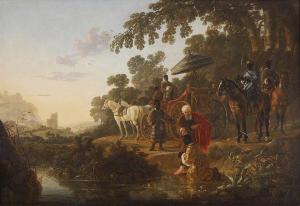
And as they went on their way, they came unto a certain water: and the eunuch said, See, here is water; what doth hinder me to be baptized? And Philip said, If thou believest with all thine heart, thou mayest. And he answered and said, I believe that Jesus Christ is the Son of God. And he commanded the chariot to stand still: and they went down both into the water, both Philip and the eunuch; and he baptized him. (Acts 8:36-38, KJV)
Understanding the Acts 8 experience
We hear this passage invoked as a criticism against new believers classes, usually when someone desires baptism, but must go through a church class prior to baptism. Yes, it can apply in that way (although I think there’s nothing wrong with new believers classes before or after baptism, as deemed appropriate). There’s something more relevant we need to hear in this passage. That is the question and its answer: What doth hinder me?
The answer to the question was, nothing hinders you. There was water, there was a willing individual to do the baptism, and there was an individual who desired baptism. He knew enough of Christ to embrace being buried and risen to new life with Him. There was no good reason to hinder the eunuch’s baptism.
Not being a hindrance
The reality, however, is that Philip the evangelist could have hindered him…had he desired to. He didn’t…but he could have been a hindrance.
Let’s imagine the story if Philip had decided to hinder the process. “Look, here’s water! Look, let’s get this show on the road! I’m ready for baptism!” And instead of doing the baptism, Philip responded like this, instead:
- “Are you a member of a church?”
- “Well, you don’t go to my church, so I can’t be sure of your beliefs.”
- “I’m not used to baptizing in this river. We’ll have to wait until we can do it somewhere else.”
- “I don’t like doing baptisms outside.”
- “You’re not using the King James Version of the Bible.”
- “What is your doctrine on baptism?”
- “Were you baptized before?”
- “You didn’t take our church membership classes.”
- “Are you gay?” (trans, queer, fill-in-the-blank)
- “What sins have you committed lately?”
We can laugh as we look down this list, but there are an awful lot of ways Philip could have hindered the eunuch’s baptism into the Kingdom. There are any number of ways that had Philip wanted to make this about himself, distract from the issue at hand, or exercise ungodly power and control, that he could have “doth hindered” the baptism of the eunuch.
A bigger hindrance context
For a few minutes, let’s take this passage out of the exclusive context of baptism. There are an awful lot of ways we hinder others who desire to come into the Kingdom. When we are consumed with our concepts, traditions, rules and regulations, we avoid the real issue at hand – someone is before us and wants to be a believer. They want to get it right with God. No, it’s not going to happen all at once, but we find a million reasons why they shouldn’t even start. We tell them they can’t do this, or that, because of this, or that.
We make sure they know just how opposed we are to them. Jesus says He’s the open gate, and that He stands at the door and knocks. But instead of opening it up to others, we slam it shut, making sure that there is no way someone can enter the Kingdom on our watch.
Does this sound right? It shouldn’t, but it’s all too common. Most of the time, it’s not lack of access, interest, or desire that keeps people out of the Kingdom. It’s those who appoint themselves as personalized gatekeepers, as the official door slammers of the church who make sure no one comes and finds their way in if there is something about that person that the door slammer finds offensive.
An example of a shut door
Several years ago, I worked with another minister to establish a church. It was a great challenge. Many belonging to both of our groups didn’t want to attend services for different reasons. There was a family I’d met in the area, a woman who had a daughter and a son, and the woman’s mother, who were very interested in working with me. They had a long history of floating from church to church and of power and control struggles therein. At the time, we were so preoccupied with finding new members, I didn’t think that maybe I should sit down and talk to her about what joining the church would mean.
The entire family came and seemed excited about what we were doing. Then they didn’t return. One day, I received an inbox full of complaints. They weren’t quite as happy as they indicated. One of the primary issues raised was the perception of a specific “spirit” (which is not a spirit) on the men present in the church. She wasn’t “comfortable” with it. She then said that when that “spirit” is present, nothing that can be done about it. It just has to rest there because it will eventually lead to everyone’s spiritual destruction.
I was livid for two reasons. The first was that she wasn’t honest and upfront enough to say anything to anyone’s face about this. The second reason? She seemed so comfortable with the idea of damning everyone she deemed “unredeemable” instead of praying for them, believing God, introducing some teaching, or doing something to work with others. She felt, in her opinion, that for people who had the “spirit” she perceived to exist, they needed the door slammed, right in their faces.
Who gets to decide what?
The woman in my story was so busy deciding that others were beyond salvation, she didn’t realize she’d become a hindrance. It wasn’t that they couldn’t be saved or weren’t saved. It was that she decided they weren’t and couldn’t be. To her, that meant it was the end of the discussion. They desired salvation, knowledge of Scripture, and to know God for themselves. The water was there. When the question “What doth hinder me?” came up, the answer…was her.
I’m not one who believes that when the last day comes, everyone is going to make it into the presence of God without any consequence for sin. God does not force anyone to be saved. If we do not want to remain in His presence forever, He is not going to force us. But there are many out there in the valley of decision uncertain, who find themselves shoved off unto the other side because there is something about them that others deem undesirable.
A lesson from the eunuch
The eunuch had things going for him – and not going for him. He was sexually castrated, thus not considered a “proper man” by modern standards. Still, he held a high political status within Ethiopian leadership. Because he lived far away, it wasn’t like he could join Philip’s church in the next town over. Whatever he did after his baptism was between him and God.Philip didn’t have the time nor the commission to check in and see where he was at later in time. The odds are good, they probably never saw one another again. Regardless, Philip realized something important: he didn’t want to be a hindrance to the eunuch’s salvation, nor his relationship with God. He wanted to do whatever he could to see the eunuch succeed in his faith.
Throwing off every hindrance…including ourselves
Whenever we talk about throwing off a hindrance of salvation, we always think of a few specific things:
- Those that hold us back
- Situations or people that are negative or cumbersome
- Anything that impacts our relationship with God in a negative way
Hindrances are far more than things we dislike or don’t want to encounter. Anything that keeps us from God can be a hindrance. Most relevantly, we can be a hindrance ourselves. We can hinder ourselves and others, and we can keep ourselves and others from the fullness of the Kingdom.
Instead of making stumbling blocks, let’s make roads and connections. Let’s make sure that when others seek God through us, we give every opportunity for success. I know that when I stand before God, I don’t want the answer to “What doth hinder me?” to in any way be me…based on what I did or didn’t do for someone else… I am sure you don’t, either.
Therefore, since we are surrounded by such a great cloud of witnesses, let us throw off everything that hinders and the sin that so easily entangles. And let us run with perseverance the race marked out for us, fixing our eyes on Jesus, the pioneer and perfecter of faith. Hebrews 12:1-2a (NIV)











 Ad-Free & Subscriber Log-In