

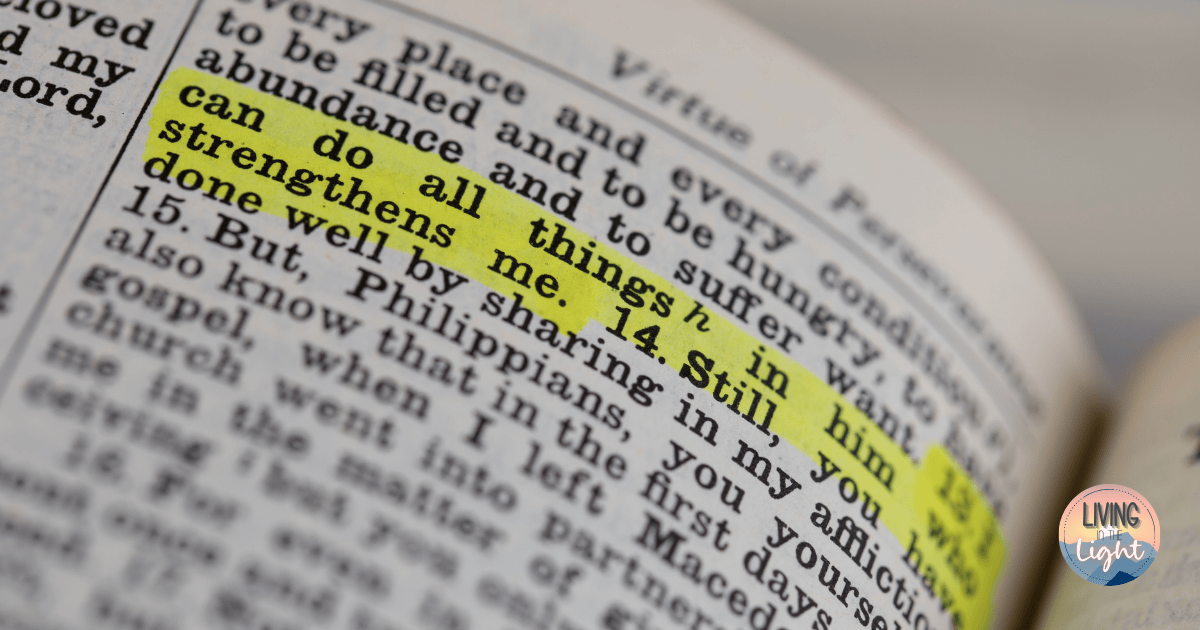
Philippians 4:13 is one of the most quoted verses in the Bible: “I can do all things through Christ who strengthens me.” This verse shows up everywhere: on coffee mugs, t-shirts, graduation cards and social media captions. Philippians 4:13 has become associated with motivation, perseverance and personal victory. However, sometimes, the more familiar a verse becomes, the easier it is to misunderstand it.

When Paul wrote these words, he was not standing at the top of a mountain celebrating success. Actually, Paul was sitting in a prison cell bound by chains. This context matters a lot.
What Paul Was Actually Saying
When reading and studying the Bible, it is important to look at context. The two verses just prior to Philippians 4:13 give us some insight into why Paul wrote this verse:
“Not that I speak in regard to need, for I have learned in whatever state I am, to be content: I know how to be abased, and I know how to abound. Everywhere and in all things I have learned both to be full and to be hungry, both to abound and to suffer need.”
And then Paul writes: “I can do all things through Christ who strengthens me.”
Paul is not claiming unlimited ability or personal empowerment. He is describing contentment. Specifically, contentment that does not rise or fall based on circumstances.
“I can do all things” refers to everything he just named – living with abundance and living with lack, being honored and being forgotten, enduring comfort and suffering.
Christ’s strength did not make Paul immune to hardship, it made him faithful in the middle of it. This distinction changes everything.
(To Read About False Doctrine in the Church, Click Here)
How the Verse Is Often Misused
Philippians 4:13 is frequently treated like a promise of achievement. We use it to imply that with enough faith, success is guaranteed, goals will be reached and obstacles will be overcome on our terms.
But Paul wasn’t saying, “I can accomplish whatever I set my mind to.” He was saying “I can remain faithful, content and obedient no matter what I face.”
The verse is not about winning, it’s about enduring. This may feel far less glamorous, but it fits the context.
Strength That Looks Different Than We Expect
Paul’s strength did not remove the chains from his wrists or the shackles from his ankles. It kept his heart steady while he wore them.
Going through trials is often one of the most challenging situations in the life of faith. Many believers pray for strength, expecting God to change their circumstances. When He doesn’t change them, it’s easy to assume that faith is lacking or prayers have gone unanswered.
However, Scripture shows that God often answers our prayers in ways we do not expect. His strength may look like endurance when what we really want is escape. It may look like peace when resolution is longed for. It may look like obedience when clarity feels out of reach.
Paul’s life reminds us that strength in Christ does not always mean moving forward, sometimes it means standing firm right where we are when everything within us wants to quit.
A Verse for Real Life, Not Just Highlight Reels
Philippians 4:13 is not a slogan for our highlight reels, it’s meant to steady us in real-life circumstances.
This verse speaks to the parent who is exhausted and feels unseen. It’s for the believer who is walking through illness without receiving answers. And it’s for the person who obeyed God and still finds themself going through hard times.
Christ’s strength does not promise that everything in life will be easy, it promises that He is enough. Paul says in 2 Corinthians 12:9, “But he said to me, “My grace is sufficient for you, for my power is made perfect in weakness.” Therefore I will boast all the more gladly about my weaknesses, so that Christ’s power may rest on me.”
Paul could face hunger because Christ sustained him. He could face loss because Christ was enough. He could face uncertainty because Christ remained faithful.
This is what Philippians 4:13 truly means.
Biblical Context Matters
When we take the time to read Philippians 4:13 in context, it stops being a verse about self-confidence and becomes a testimony of deep dependence.
Paul’s confidence was not in himself, it was in Christ’s unchanging presence in every season. Jesus is always with us through the good, the painful and the unresolved. Maybe that’s why this verse still resonates so deeply, not because it tells us we can do anything, but because it reminds us we are never asked to do anything alone.
Final Thoughts
Philippians 4:13 was never meant to be a slogan for success or a promise of ease. It was written as a testimony of faithfulness in every circumstance. When we read Paul’s words in context, the verse does not lose its power. It gains depth.
Scripture invites us to listen carefully, to resist the temptation to isolate familiar phrases and to receive God’s Word as it was given. Context does not weaken what God has spoken. It helps us understand it rightly.
When we read the Bible in context, verses like Philippians 4:13 stop asking us to be strong in ourselves and instead invite us to trust the strength Christ provides. That strength may not change our circumstances, but it will sustain us as we go through them. Honestly, this is the greater gift.
Blessings,
Amy
I’d love to hear from you! Please feel free to share your insights, experiences or questions in the comments section at the bottom of the page.















 Ad-Free & Subscriber Log-In