

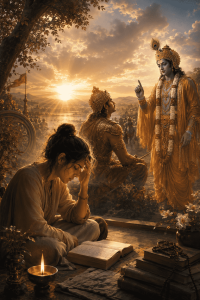
The Collapse Nobody Sees
There comes a moment when even the strongest person quietly collapses.
Yesterday, I reached that moment.
Not the kind of collapse people notice from the outside. The world still moves. Emails still arrive. Responsibilities still wait. You still speak normally. You still smile at people.
But inwardly, something gives way. I was tired of being strong.
For many years, I had taught myself one thing: you cannot break down. No matter what happens, you must stay strong. That is what adulthood often trains us to believe. Keep functioning. Keep moving. Keep handling things. No matter how exhausted you feel internally, you continue carrying responsibilities because that is what you are “supposed” to do.
So I kept going with the flow of strength. I kept trying my best to hold everything together. No matter what happened, I told myself: I cannot collapse.
For a long time, I carried emotions silently, pushing through life the way many people do — fulfilling roles, handling responsibilities, surviving difficulties, convincing myself that strength meant endurance.
But buried emotions do not disappear simply because we ignore them.
Sometimes unresolved pain sits quietly within us for years — hidden beneath work, routines, deadlines, obligations, and distractions. We become skilled at surviving. Skilled at appearing fine. Skilled at helping everyone else while slowly exhausting ourselves internally.
The Coffee That Felt Like Grace
A few months ago, I met a wise man and his wife. From the beginning, I felt an unusual connection with them — the kind that feels deeper than coincidence. Our conversations naturally drifted toward scriptures, philosophy, and quotations from spiritual texts. He would often send me encouraging reflections and wisdom from books.
Yesterday, unexpectedly, he messaged me and asked if I wanted to meet for coffee.
Looking back now, it almost felt intuitive — as though he sensed something was wrong before I fully admitted it to myself. We sat together quietly and talked.
He explained how prolonged stress changes the body itself — how anxiety and depression are not merely emotional weakness, but deeply connected to exhaustion, hormones, unresolved grief, suppressed emotions, and internal conflict.
Sometimes, he said, the things we bury continue living silently within us.
Sometimes we do not speak because we fear judgment.
Sometimes we cannot explain our pain because we ourselves do not fully understand it.
And sometimes we remain strong for so long that vulnerability itself begins to feel unnatural.
When Buried Emotions Finally Emerge
I came home afterward and tried to continue the day normally. Then one of my close friends called me. As we spoke, something inside me finally broke open.
I wanted to express everything I had been carrying, but I did not know where to begin. I did not know how to organize pain into sentences. Emotions that remain buried too long rarely emerge clearly; they erupt chaotically.
And perhaps the hardest part was this: I had never truly shown vulnerability in front of anyone before.
I had become so used to being the strong one, the composed one, the person who manages everything internally, that even speaking honestly about my pain felt unfamiliar.
I wanted to explain what was happening inside me, but the words came out tangled with exhaustion, frustration, fear, and years of suppressed emotion.
And we ended up in a big argument.
That is the strange thing about emotional collapse — sometimes what we most need is understanding, but pain does not always know how to ask for it gently.
“Invoke Your Higher Being”
Later that night, I remembered the words of my Acharya.
Earlier that day, I had attended an Ashtavakra Gita class. The teaching was simple, yet deeply powerful: “Invoke your higher being.”
He told us not to wake up immediately thinking about work, emails, deadlines, and worldly responsibilities. Before becoming a professional, a parent, a teacher, or a person fulfilling endless roles in society, spend a few moments remembering your deeper nature.
Wake up with a smile.
Spend five minutes in silence before entering the world.
Read scriptures.
Remember who you truly are beneath the noise of life.
“You are Gyani,” he reminded us. “Wake up your higher self.”
That teaching stayed with me through the night.
I reopened the verses of the Ashtavakra Gita and found myself returning again to similar teachings from the Bhagavad Gita.
Slowly, the storm inside me began to settle. Not because my external problems disappeared. But because the scriptures reminded me that the real battle was internal.
I Am Arjuna
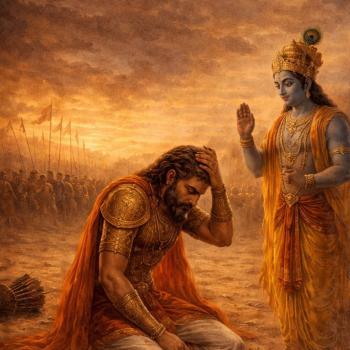
And suddenly I understood Arjuna differently.
Right now, I am Arjuna.
Emotionally exhausted.
Mentally conflicted.
Standing in the middle of an inner battlefield.
And the scriptures before me are Krishna.
Not merely ancient poetry.
But living wisdom speaking directly into human collapse.
The Bhagavad Gita does not begin with victory. It begins with breakdown.
Arjuna trembles.
His body weakens.
His mind becomes clouded.
His bow slips from his hands.
He no longer knows what to do. Only after the collapse does wisdom begin.
Perhaps this is why these scriptures continue to survive across centuries — because they understand the human condition with extraordinary depth.
The Gita does not shame emotional struggle. It guides us through it.
And the Ashtavakra Gita goes even deeper.
It reminds us:
You are not merely the anxious mind.
You are not merely the passing storm of thoughts.
You are not merely your emotional pain.
At your deepest level, you are consciousness itself.
Brahman.
That teaching does not magically erase suffering overnight. But it creates space within suffering.
A witnessing. A quiet inner stillness beneath the storm.
A reminder that even while the mind trembles, something deeper within remains untouched.
Rise. Awaken.
Yesterday, I collapsed.
But perhaps collapse is not always destruction.
Sometimes it is the moment the soul becomes tired of pretending.
Sometimes it is the breaking point before awakening.
And perhaps this is why Krishna’s call still echoes through every human battle: “Uthishta. Jagrata.”
Rise.
Awaken.
Do not forget who you truly are.










 Ad-Free & Subscriber Log-In