


“These qualities are born of the divine nature and lead to freedom.” — Bhagavad Gita 16:5
The Blueprint of Divine Mental Health
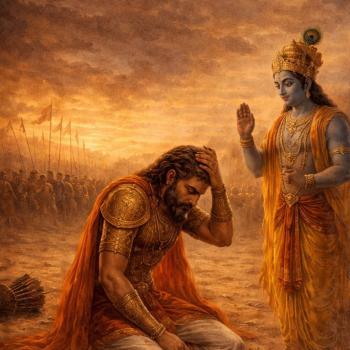
In the sixteenth chapter of the Bhagavad Gita, Krishna describes thirty-five daivi sampatti — divine qualities that illuminate the path to freedom. These are not mere virtues to memorize but psychological states to embody. Each quality represents an inner posture of the mind that transforms how we think, feel, and live.
In Bhagavad Gita, these divine qualities become living principles of emotional well-being. They dissolve the roots of anxiety, comparison, and restlessness — not through suppression but through awakening higher awareness. The divine mind, Krishna tells Arjuna, is not created by outer success but cultivated through inner clarity.
This first part (qualities 1–10) explores the foundation of inner peace — the shift from reaction to reflection, from ego to empathy, from attachment to awareness.
1. Adveshta Sarva Bhuta Naam — Hating No Being
To hate no being is to live from your higher self. Hatred shrinks the heart and clouds the intellect. The Gita begins with this quality because it purifies the very foundation of consciousness. When we hold hatred, we carry the burden of the one we despise.
Freedom begins when we let go. When we understand that every being acts out of its own ignorance or pain, compassion replaces anger. In that understanding, love flows naturally, without resistance.
He who hates no being and is kind to all, he is dear to Me. (12:13)
2. Maitri — Friendliness
Maitri means friendship toward life itself. It is the willingness to meet others with warmth and openness, not judgment or fear. True friendliness doesn’t depend on who the other person is; it comes from who we are within.
A friendly mind sees unity where the ego sees separation. Every encounter becomes sacred — a chance to express the divine within us.
Be friendly and compassionate, free from possessiveness and ego. (12:13)
3. Karuna — Compassion
Compassion is love in motion. It doesn’t arise from guilt or pity but from deep connection — the awareness that we share the same spark of consciousness.
When we practice Karuna, we don’t look down on anyone; we look through them and see the Self. Compassion heals silently — not just others, but also the one who offers it. True compassion asks nothing in return, for it recognizes no separation between giver and receiver.
4. Nirmama — Freedom from Mineness
Nirmama comes from nir (none) and mama (mine). It is freedom from the illusion of ownership. We say “my house,” “my children,” “my success,” but in truth, nothing belongs to us. Everything is entrusted for a while.
This realization doesn’t detach us from love — it deepens it. When we no longer cling, we can truly care. Possessiveness breeds fear; freedom births joy.
When we act without attachment, we serve without anxiety and love without chains.
5. Nirahankara — Freedom from Ego
The ego is the veil that hides our true light. Nirahankara doesn’t mean erasing identity; it means seeing through it — knowing, “I am not this limited self; I am the consciousness behind it.”
When we live from ego, every success inflates us, and every failure wounds us. When we live from the Self, we stay balanced, for we act as instruments of a greater will.
Humility, not humiliation, is the fragrance of Nirahankara. The moment we stop saying “I am the doer,” peace begins to descend.
6. Sukha-Duhkha Samah — Balance in Pleasure and Pain
Life flows in waves of gain and loss, joy and sorrow. The wise don’t fight the waves — they learn to surf them.
A calm mind remains centered through both delight and disappointment. This is Samatva, the inner balance that the Gita calls yoga itself: “Yoga is equanimity.” (2:48)
Pleasure and pain are passing experiences, but awareness is constant. The more we identify with awareness, the less we suffer.
7. Kshama — Forgiveness
Forgiveness is not weakness — it is strength purified of pride. It is not about others being right; it is about freeing your own heart.
When we forgive, we stop replaying old wounds. The past loses its grip, and we rediscover our natural peace.
Kshama teaches that resentment is self-punishment. To forgive is to return home — to your own serenity.
8. Santosha — Contentment
Contentment arises when gratitude replaces comparison. It is the quiet joy of knowing that life, as it is right now, is enough.
When we stop measuring our worth through possessions or recognition, we feel a subtler wealth — the peace of simply being.
He who is content with anything, who has mastered himself, is dear to Me. (12:19)
Contentment is not complacency; it is power without restlessness.
9. Yogi — One Who Is United
The word Yoga comes from Yuj — to unite. To be a yogi is to live in harmony with oneself and the world. It is to experience the inner union of body, mind, and spirit.
All paths of the Gita lead here — to union with the Self. A true yogi doesn’t escape the world; they move through it with grace, guided by inner alignment.
The yogi sees the Self in all beings and all beings in the Self. (6:29)
10. Dama — Self-Control
True self-control is not about suppression but conscious direction — choosing awareness over impulse.
When the senses are disciplined, the mind gains strength. When the mind is strong, life flows with order and purpose.
Self-control means engaging with the world without being enslaved by it. It’s not the denial of pleasure but the mastery of it.
He who has conquered his senses, mind, and intellect stands serene in heat and cold, pleasure and pain. (6:7)
Pause & Reflect
-
Which of these first ten qualities resonates most with your present stage of life?
-
Can you recall a recent moment when your mind reacted instead of responded? How would Samatva have changed that?
-
What one small act of Karuna (compassion) can you bring into your day today?
Coming Next: The Warrior Within
In the next part of this series, we’ll explore qualities 11–20, where Krishna reveals the traits that build inner strength — from dhrida nischaya (firm resolve) to ahimsa (non-violence). Together, these qualities form the spiritual muscles that help the modern mind remain still amidst chaos.











 Ad-Free & Subscriber Log-In