
 Looking Closer
 Did your plans go wrong? Did a deal go bad?
No matter. You can outwit the devil. You can get away clean. You just need the right stuff. Cleverness. Strength. Resourceful friends. Enough money. Slick gadgetry. A holster at your hip. Courage and charm. Oh — and an escape route, in case you need to disappear. Don’t worry… you can untangle yourself, learn from your mistakes, and start fresh.
This is America, after all. For those who get wise and pull themselves up by their bootstraps, this is the land of second chances.
That’s what the movies tell us. Over and over again. The best way to manage in a world of bad men with guns is to become a good man with a gun. Doesn’t the Bible tell us we can overcome evil with good — or at least with good intentions?
And if you’re really good, you can look cool doing it.
Cormac McCarthy does not believe that.
McCarthy’s human beings may be catch occasional glimpses of grace — but it’s always in the distance, unreachable on the darkling plain between birth and death. His stories are not about decent men falling into trouble and then extracting themselves in the nick of time… because he doesn’t believe that there are any good men to begin with. (And more power to him!) His spectrum of humanity ranges from the dangerously naive, who live in denial of the darkness around and within them, to the wholeheartedly barbaric. We’re either bloodthirsty predator or panic-stricken prey.
If we dare to place our hopes in something beyond the frame of human influence, a dream of benevolence waiting for us out there in the dark, then we might find some strength to serve a higher cause… but don’t expect to see that make much of a difference in the here and now.
As he has made clear in stories like No Country for Old Men and The Road, he sees a world being perpetually sucked into a black hole of evil. Any belief that we can do something to stop it… “That’s vanity.” In No Country, he troubled moviegoers by suggesting that a central character — an opportunist who took money from a crime scene — was as expendable as any nameless bad-guy henchman in a shootout. There are no heroes, McCarthy suggested. There are only antiheroes. And no matter how sympathetic they might be, no matter how well-intentioned or guilty by association, they’re likely to end up as roadkill on evil’s merciless highway.
Innocents? There aren’t any. But even those who believe in love will die miserably in the hands of villains so cruel that they are capable of doing anything. You don’t want to know what human beings will do to one another, he says. You really don’t. And then he shows us anyway. And we, the despairing audience, are left fumbling about in the dark
As my colleague Dr. Jeff Keuss observed in a recent lecture, the men of Cormac McCarthy stories almost always end up on their knees, weeping, grasping at the earth as if trying to return to the dust they came from. (And Keuss hasn’t even seen The Counselor yet!)
McCarthy’s skepticism — no, his cynicism — about humankind runs so deep that the titular character in his new screenplay, The Counselor — which has been swiftly realized for the big screen by the legendary director Ridley Scott — seems to be anything but a “counselor.” He’s never actually named. Everyone calls him “Counselor.” And yet he seems to be receiving counsel from one questionable source after another almost every time he appears on screen.
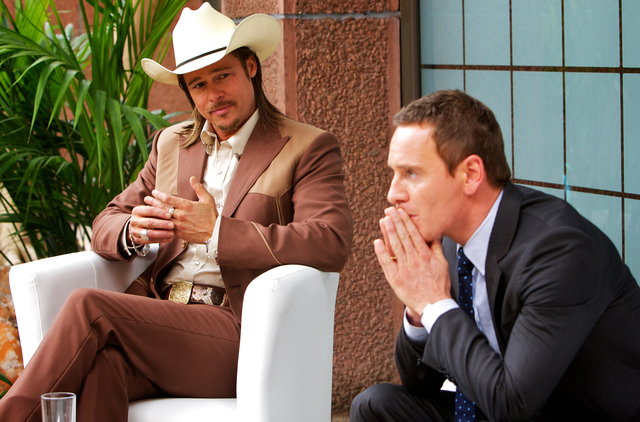
As played by Michael Fassbender, this counselor is a lawyer who seems to have stepped right out of a Vanity Fair fashion ad. Scott Tobias at The Dissolve rightly describes him as “nameless and purposefully generic, like the world’s most handsome paper sack.” Playful in the sheets with Laura (Penelope Cruz, playing sexy and dumb), he emanates movie star charm and confidence. But after the title card fades, his sense of cool goes flat faster than cafeteria soda. He looks hollow and lost.
Hoping to find an engagement ring for Laura — one with a rock as impressive as his igorance — he consults a diamond expert (Bruno Ganz, scene-stealing as usual). The jeweler teaches him that diamonds are ultimately defined by their flaws. That sound you hear — it’s English majors reaching for their highlighters to underline this passage as important.

But how can the debt-burdened Counselor afford such a rock? Easy. A fellow like him, suave and connected and worldly wise, should be able to pull off a one-time drug trafficking deal with a Ciudad Juárez cartel.
But his collaboration with Reiner, a wealth-happy El Paso crime lord (Javier Bardem, hamming it up), brings him under the influence of Reiner’s malevolent girlfriend, Malkina (Cameron Diaz), who has her tentacles in all kinds of sordid affairs. Apparently the criminal underworld has a theme song: a sick and twisted version of “It’s a Small World.” And when the Counselor tries to help an incarcerated client (Rosie Perez in a sassy, long-overdue return to the screen), he learns just how small the world really is.
It’s almost funny, how stupefied the Counselor seems when he realizes that deals with the devil can, yes, go badly. But the laughs won by McCarthy’s script are painful. The wages of sin in this world are so severe, they’ll make you pity all victims, no matter how “clean” or “dirty” they might seem.
Watching The Counselor, the first story McCarthy has written directly for the screen, I felt a strange fascination watching movie stars who are well-known for their onscreen swagger, charisma, and cool, playing those familiar notes in a story that shows up the emptiness and futility of ego. “Cool” in McCarthy-land is only self-deception, ultimately absurd.
That the film is captured by one of cinema’s Masters of Cool speaks to the power of McCarthy’s script. No matter how atmospheric, textured, and scrumptious Ridley Scott’s images become — and they are often glorious in this film — McCarthy refuses to let us get carried away with aesthetic enjoyment. He wants to horrify us. He succeeds. This is one of only four films in Scott’s catalog of more than twenty in which I’ve felt that the script’s substance lives up to — even surpasses — the seductive qualities of its imagery. (The other three I admire, if you’re curious, are Matchstick Men, Blade Runner, and Alien.) For all of the aesthetically immersive flamboyance of last year’s sci-fi epic Prometheus, this McCarthy adaptation takes us to a far more frightening, and even alien, place — the America we don’t want to see.
After all, here we have a self-proclaimed Counselor who needs an influx of cash to settle debts (like America) which will lead him to make “risky” deals (like America) that really aren’t so risky… because they’re certain to go badly. Even the coolest gambler in the business (played here by Brad Pitt with self-aware cool), who talks about the necessity of an escape plan, is a fool. Thus the Counselor (like America) plays into game that has no winners, losing his capital (like America), and falling from any moral high ground (like America). There’s nothing he can do but watch himself and his loved ones slowly sucked into evil’s insatiable appetite, a black hole personified by Malkina.
To some extent, he (like America) has himself to blame. But does it matter? Even innocents seem doomed to suffer violence in McCarthy’s world. And in ours.
In other stories, McCarthy has suggested the possibility of hope. But it’s beyond the frame of this valley of death. We can sense it in dreams, perhaps — a mysterious and transcendent source of grace. And that may be small comfort for those of us in trouble now.
We need movies like this. They show up all of those movies that have sought to inspire us with stories about men who, caught in a compromise, bravely seek to correct their wrongs and pry themselves free of the influence of villains.
This is what most impressed me about Steven Soderbergh’s thriller Side Effects, in which a Cary Grant-ish Jude Law played a fellow who, realizing the implications of his morally compromised state, sought to fight back, to shut down the villains, to regain his family, and to set himself free to enjoy the “happiness” of his upper class privilege again. But his methods were corrupt. And in the last act of the film, everything took on a strangely satirical edge — as if we could have a happy ending only if we acknowledged its artificiality. In The Counselor, there’s no such allowance for wishful thinking. Once you’ve logged on to evil’s network, even for a moment, to achieve an honorable end, you cannot wipe your hard drive, you cannot stop the viruses you’ve downloaded, and you will never be able to escape the devil’s program. And you would probably have been taken down anyway.
Thus, The Counselor is a truthful diagnosis about the wages of sin in this world. It’s unpleasant, humbling, even appalling. But it’s necessary.
There are a lot of “key moments” in this film, but one that stands out as most important to me: The scene in which Malkina asks the naive, lovesick Laura if she wants to know what her gaudy engagement ring diamond costs. Laura — strangely fearful — insists that she doesn’t want to know how much her dream is costing anybody. Of course, she doesn’t. Men as suave and rich and charming as the Counselor cannot be the Dream Husband — it’s a fantasy. On some level, Laura knows she’s been seduced by a man with devilry in his rakish grin. And his compromises have been expensive. She doesn’t want to know what this ring has already cost him. And she really, really doesn’t want to know what it will cost him.
Is the Counselor’s “love story” a glimpse of a better path? “Laura” means “light,” after all. Surely McCarthy knows that.
But as a vision of a higher, more rewarding path, this love story seems sentimental, superficial, and sex-obsessed. It’s primarily a physical intimacy achieved through poorly placed trust and flattery. Laura comes across as a pretty little fool, lacking the substantial virtues and beauty of heart that we saw in No Country for Old Men‘s tender-hearted Carla. Carla had the stuff to shake the even the devil’s confidence. By contrast, Laura’s just a gullible fool drowning in Denial (the murkiest river, as the joke goes).
The film’s biggest problem with The Counselor is that it belongs to the character of Malkina, and that part has been given to Cameron Diaz. Malkina’s the “Jaws” in a sea of sharks, lesser predators, bottom-feeders, and krill. Diaz is aging spectacularly, becoming a gargoyle of Hollywood beauty, her face spectacularly lined, her monstrous smile increasingly Grinch-ian in its writhing elasticity. No special effects wizard could have imagined her. In her already famous sex-with-a-car scene, she throws herself with wild abandon into a dance that demonstrates the inevitable end of consumerism — self-indulgence that terrifies even her witless boyfriend. Watching Reiner and Malkina sit back, sip martinis, and enjoy the sight of cheetahs hunting jackrabbits, we get the unnerving feeling that we’re watching the One Percent smugly watching FOX News reports about the bungled, the botched, and the poor.
And yet, while Diaz looks the part, she never convinces us that lines as literary as these could come from Malkina’s forked tongue. McCarthy’s dialogue takes on a certain ponderousness that asks us to accept McCarthy’s vision as something more than “realism.” Perhaps Angelina Jolie, the actress first sought after for this role, could have pulled it off. 20 years ago, Lena Olin would have been absolutely perfect. And I would have given anything to see Juliette Binoche add this character to her collection. I’m not sure, though… we might not have an actress right now who could achieve it. Marion Cotillard, perhaps?
Is there any glimmer of hope at all? Is there any offer of true friendship? If by “friendship” we mean “someone willing to die for us,” then… no. Not in this film’s cast of characters.
Do you believe there’s anyone out there willing to die for you? It’s a question that hangs over the movie. Perhaps the priest, played by Edgar Ramirez, could address that question. But no one asks him. Malkina, visiting a confessional for the first time, can’t think of anything to do but boast about how bad she’s been. To his credit, the priest gets up and walks away. He refuses to participate in such exhibitionism, such lurid and inappropriate sensationalism.
McCarthy seems to sympathize with the priest. He knows that if he’s not careful, stories of smooth-talking con artists and glamorous criminals will become seductive. Thus, having Ridley Scott at the helm, he poses the audience with a challenge. Will be be swept away by the way Scott aestheticizes greed, power, and violence? If we are, then we’re in Malkina’s court, savoring the sight of killers chasing down prey. Malkina’s made a heaven of hell. If we follow her example, we’re proving McCarthy’s worst speculations to be true.
No, this is not more of the trendy Tarantino revelry in nastiness and violence. This is a true horror film. Like David Fincher’s Se7en, one of this movie’s closest spiritual cousins, The Counselor ultimately delivers a diagnosis that tells the awful truth. And the Counselor doesn’t want to know it. He really, really doesn’t want to know.















 Ad-Free & Subscriber Log-In