

Inexplicable & Unexplained Pt. IV
Having begun this story right from my youth, from the events that most struck my imagination, I now recall that strange things had happened to me before that, which are probably also destined to remain unexplained. For example, from my very childhood, from the first illness that remains in my memory, I remember a vision that subsequently constantly warned me of my illnesses. Did I see it in reality or in a dream? Probably in a dream. But always the same, and so vivid that its impression remained in me vividly, although after I turned eighteen it was no longer repeated. One clever person—my governess—to whom I am indebted, taught me from the age of ten to constantly keep a diary; thanks to this habit, I remember everything well and can confirm the accuracy of my memories for many years. So I find in my childhood memories that I was only five years old when I first saw in the middle of my nursery, where I had been sleeping for several hours, a tall gray man, judging by his cowl, a monk. He stood motionless, all light gray, as if translucent, as if woven from smoke, and, raising his hand with his palm open, as if pointing to the ceiling or the sky, but looking to the side. The night light burning behind the bed cast a fairly bright light on him, and from it a long, black shadow across the floor.
I remember very well that during his other appearances this shadow changed direction, depending on the position of the light; but he himself never moved, and change neither his pose nor his vague look. The “monk,” or “gray man,” as I called him, was a symbol of illness for me. That first time I fell dangerously ill with nettle fever, and then I was ill a lot, and always before the illness I saw my “monk.” He brought me inflammation of the brain, and measles, a nasty fever, and again inflammation of the brain. The last time we saw each other was when I was seventeen years old. I don’t know what happened to him. Why did he disappear from my life’s path, and why did he stop predicting illnesses for me? Perhaps I will see him again? Before that last illness, with which I am destined to end my earthly calculations and perplexities.
I have had prophetic and true dreams many times. The latter are those that literally came true in life. For example, about six years ago, living in Tiflis and not at all imagining that in three or four years I would leave for Odessa, I saw in a dream a room down to the smallest detail exactly the one in which I had to live for the first time in Odessa…but I will not get ahead of myself.
I don’t know whether it was in a dream, or somewhere in reality, that I saw places that I later recognized down to the smallest detail in places where I was for the first time in my life. In this world, “anything can happen,” an old woman I knew used to say, “for some, a sparrow never leaves the ground, while for others, a bear flies up into the clouds!” That’s what my friend said—but I am of the opinion that in every person’s life there is bound to be at least one “flying bear.” I have had quite a few of them or similar curiosities; and I think that only a very superficial, thoughtless person can, having climbed the mountain of life and to its opposite slope, see nothing on it except sparrows jumping on the ground, for everyone, even the most prosaic person, will certainly find something in life that “the wise men never dreamed of.”
It’s all about being able to notice this something more easily or more difficultly. I’ll confirm this with an example.
I recently had a heated argument for an entire evening with a lady who stubbornly insisted that “all this is nonsense, rubbish, just imagination or old wives’ tales!” I got tired of arguing and fell silent, listening to a rather interesting story told by one of those present about a phenomenon beyond the grave, which, however, was not based on personal experience.
Suddenly my skeptical lady lazily muttered: “Well! Things like this have probably happened to everyone…even to me.” The lady told a very remarkable story of how her father appeared at the moment of death and announced this to her in the third person. “‘Masha!’ he said. ‘So-and-so (giving his last name) has just died. Don’t be scared and don’t cry.’ And what do you think?” concluded the lady. “I jumped out of bed (it was night,) ran to my father and found him dead!”
“So how do you argue that nothing like that happens?” we pounced on her. “Could there be anything more amazing than such a vision?”
“Yes, perhaps,” the lady drawled phlegmatically. “But still, it’s all nonsense!”
How could I respond to such logic? However, I return to my authentic curiosities.
The first facts “out of the ordinary” that present themselves to my recollection after this date, belong to the later years of my life. Not that nothing remarkable of the same kind happened to me in the interval, but I am afraid to dwell on the details in their chronological order, so as not to tire attention. I will mention only one dream from among the ones that came true. In 1860 I went again to Tiflis, and in 1862 I returned for a short time to Pskov and Rugodevo. I had just married for the second time. My husband was a young, energetic man without any means of living except his remarkable abilities, but on a good road with great hopes for a career in the service. At that time, I was imbued with the conviction of his strong will and was sure that he was completely healthy—both physically and morally. I came to the village to see my father, to persuade him to move to us in Tiflis, I expected to stay in Pskov for a short time and, constantly receiving letters, I was completely at peace about my husband, and my life in general.
On the very first night after arriving in Rugodevo, I had a dream from which I woke up in horror, which twenty years later I recalled with fear and anguish, especially when I saw that it was beginning to come true.
I saw that I was walking along a difficult, narrow path, among barren rocks and stones. I was scared; it was hard! My legs were beaten; my head was pressed by some kind of suffocating fog. All around was semi-darkness, in the midst of which my difficult road was barely visible, all the way uphill and uphill. I could barely move my legs, but I felt that I couldn’t stop! That I had to climb higher and higher.
Suddenly I found myself in a small, almost empty, unfamiliar room. Someone was sitting in front of me in a large armchair, dressed all in white, emaciated, pale, with a face exhausted by suffering. Horror and inexpressible despair were on the face of this unfortunate man, whom I did not immediately recognize. He stretched out his helpless, trembling hands to me, and desperately whispered: “Vera! Vera! Pray for me!” Only then did I recognize my husband in this strange phantom.
I screamed and woke up in a cold sweat. When, almost twenty years later, my husband’s long illness forced him to go to hospital. Entering for the first time his small room (where his things and some furniture had been moved,) I stopped on the threshold, struck by the memory—it was the same room I had seen in my prophetic dream! And my husband, just as pale, weak, exhausted, dressed all in white, was sitting in his high chair and helplessly stretching out his hands to me.
Who shows us such pictures from our distant, unknown future?
My husband’s illness, the difficult time my family went through during it, and finally his death, were probably those difficult life trials, that “dark river” that my old friend Liphardt once predicted for me.
As I have already said, our family is truly an exceptional phenomenon in relation to so-called “supernatural” facts. I do not consider myself entitled to speak in detail about cases with other members of it, but I can safely say that I am no exception.
Much that is inexplicable from the point of view of a narrow, earthly outlook, has fallen to my lot. Namely, a narrow, insignificant outlook in nature, as insignificant as a drop of water in the great ocean. I recall the words of my late uncle, R. A. Fadeev, one of his many thousands of successful, pictorial comparisons.
It was not long ago. He was sitting, quite ill, listening to the reading of one of the least noteworthy objections to the latest articles on Spiritualism—I don’t remember whose exactly. Someone remarked how childishly inept these objections were.
“How can you expect it to be otherwise?” my uncle, objected. “After all, it is the same as expecting breadth and truth from a man who would decide, on a dark night, to describe the universe from the circle of light falling on the earth from his lantern!”
And truly so! Poor, blind pygmies! Our only possible great merit should consist in sincerely and sacredly declaring always one truth! And how few people honestly use this right, useful for science and morality—and how many encroach on completely useless talk and bickering about what, for us sinners, is dark water in the clouds of God’s omnipotence.
There were almost no examples, in our family, when the loss of a loved one was not announced to us in advance in one form or another. Some of these warnings may be considered by skeptics to be mere accidents—but that is always said! Here is one of these accidents. I was in Kiev in 1860, when my grandmother E. P. Fadeeva died in Tiflis. To my greatest alarm, for several days I had been feeling, when I prayed for her, that strange feeling of insufficiency—the emptiness of prayer, which I spoke of above. This frightened me very much, but I kept silent, afraid to unnecessarily alarm my aunt. Once she got up herself, very frightened by a prophetic dream about her mother. Then I also admitted that I was uneasy, and we went to the Lavra to serve a prayer service. But even during the health service I could not pray, no matter how hard I tried to motivate myself! In grief and anxiety, I stood on my knees before the icon of the Mother of God, and finally a desperate question came to my mind: “Lord! How can I pray for her?”
At that moment the priest proclaimed: “We still pray for the health and long life of the boyar Elena!”
“Not so! Not so!” something seemed to whisper to me. But I was afraid to utter to myself those words with which I wanted to pray for my mother’s mother.
In despair, I almost cried out loudly: “Holy Mother of God! Teach me how to pray?” I raised my eyes to the icon. The first thing that caught my eye were the words: “For the repose of the soul!” They were carved on the flat rim of a lamp hanging in front of the icon of the Mother of God.
A few days later, on the way back to Tiflis, we arrived in Odessa. There we were met by Uncle Y. F. Witte, who came to meet us on purpose with the news of grandmother’s death.
Let’s agree with the skeptics—this could be a coincidence. But here are three, even four, similar facts from my life, in which it seems difficult to suspect a coincidence.
I will cite these four incidents from my life, in which it is impossible to admit just one coincidence: Seven years later, my grandfather A. M. Fadeev died. We spent that summer in Manglis, the headquarters of the Yerevan regiment, 40 versts from Tiflis. I moved from there to the city with my family on August 25; my relatives were supposed to arrive two days later. On the evening of August 28, I was busy tidying up the apartment and especially my room, when my ears were struck by familiar ringing and knocks on the walls, on the shutters (we lived on the second floor,) and on the furniture. Amazed by the sound of these knocks, too familiar to me from the time of my life with my sister, I listened, not trusting my ears. I could not confuse these knocks with anything! I would have recognized them, it seems, among the whole chaos of sounds. At the same time, I knew that since the departure of my sister Elena they had never been given away for free in our family. It is clear that I was frozen with fear. What could this mean? Where could one expect grief? My thoughts did not stop for a moment on my mother’s family. I had just left them all completely healthy! Today or tomorrow, they were supposed to return from the dacha themselves. That very morning, I had been in their house to convey some orders, and I knew that they were expected, and that everything was fine. Meanwhile, the ominous knocks clicked and clicked their memento mori throughout the entire room, and finally concentrated in the eastern corner, near the iconostasis. Not trusting myself, I called my maid Masha. She was one of my Rugodevo people, and she also knew the sound of these mediumistic knocks well. To my great confusion, she immediately heard them and recognized them. My sister Liza, who was already a seventeen-year-old girl at the time, and had just graduated from the institute, also recognized them. Although she was a child during our life in Rugodevo with my sister, she remembered these knocks very well. She was surprised by them and was very frightened, as if they were a phenomenon that had not happened for a long time. I told her that they happen to me very rarely, almost never, and unfortunately, only as harbingers of some catastrophe.
“But what could it be? Is it father?” we wondered. Father was still living in Petersburg. Naturally, our fears were focused on him. But we were wrong.
The knocking that had kept us awake all night grew louder by morning to the point that neither my husband, nor his sisters who lived with us, could sleep. We all walked around as if we were in a daze, dejectedly waiting to see what would happen. “Who was next?”
At eight o’clock in the morning I heard the sound of a horse’s hoof. I rushed to the balcony, certain in advance that it was a messenger. Indeed, it was one of Fadeev’s servants. Seeing me, he stopped his horse under the balcony without entering the yard and shouted: “What a great misfortune, Vera Petrovna! General Andrei Mikhailovich has died!”
Grandfather felt unwell the day after my departure from Manglis, but wanting to be in the city as soon as possible, he left there on August 27. Halfway there, in the Priyut Settlement, they had to stop because he felt very ill. By morning he died, having confessed and received the Holy Mysteries. It is remarkable that two months before this, while passing through Priyut for the summer in Manglis, grandfather, staying in this very village house where he always stayed when leaving, told the landlady. “Well, goodbye, old woman! We’ll see each other again. Maybe I’ll drop in to see you on my way back to die!” What caused such strange, prophetic words? Nobody knows, but they were said and came true literally.
Twice more in my life I was warned of the death of my loved ones by means of spontaneous mediumistic sounds. Exactly eight months later, in May 1868, my sister, husband and I returned one evening from our relatives very late, leaving everyone completely healthy and calm. Their family at that time consisted of my eldest aunt and her husband, Y. F. Witte, with their children and my younger aunt N.A. Fadeeva. Uncle Rostislav Andreevich Fadeev was no longer in Tiflis. We lived then very close to them in a huge government apartment with massive walls and doors—namely, in the building of the gymnasium, of which my husband was the director. As soon as we went to bed, an incomprehensible movement began in all our rooms. The windows shook, the doors trembled, as if someone was breaking in, the locks knocked on them, and the familiar, fatal knock did not stop above my head, near the icons!
My husband had already fallen asleep, but I woke him up in fright. At first, he began to laugh, blaming it all on my imagination, but it was too obvious: “How can you deny the knocks and movements so strong that they woke up the whole household?”
Again, and this time, we all came together in indescribable fear—my sister, Masha, and I began to think: “What is this? Whose turn has come so soon again?!” And again, our thoughts stopped at our distant loved ones—at my father, at my sister Elena, at Uncle Rostislav, at my brother Leonid Hahn. At everyone, in a word, except for the one whose hour was already near, although we had just left him cheerful, calm among his family! Again, our assumptions turned out to be wrong—like almost all human predictions! In vain did my husband calm us with completely unconvincing convictions; in vain did he prove to us that the massive doors and windows were shaking from gusts of wind—on this quiet, motionless May night! In vain did he diligently walk through the rooms, locking the bolts, plugging the cracks, tying and tightening the heavy door handles together—they still knocked, creaked and moved, as if laughing at his efforts! And we ourselves laughed at him, through our tears. This continued until three o’clock in the morning. By dawn, the movement stopped, and the knocking ceased. We were finally able to lay down and fall asleep, but not for long. At seven o’clock in the morning, we were awakened by the terrible news. My uncle, Y. F. Witte, was found dead in his bed.
It was an unexpected and heavy blow to the family, and to all of us who dearly loved this wonderful, honest, and kind man, unexpectedly torn from the life in which he was so needed and useful!
The same story repeated itself in 1873. There was no great noise, but I, my husband, Masha, and the children clearly heard the knocking. However, I had been warned of this loss in advance by the same usual feeling of the futility of my prayer for my father. So, when the next morning I saw that my husband was hiding the telegram from me, I said in front of everyone: “Give it here! I know what’s there—father has died!”
And so it was. He also died unexpectedly, after only three days, in Stavropol, living with his sister and his younger brothers. Here are the facts. As I name years, places, and living beings, I trust that even the most skeptical people will not have the opportunity to accuse me of “inventing.”
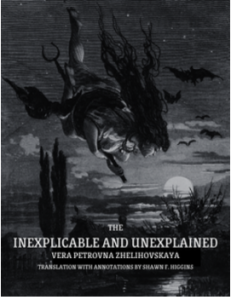
The full text of “Inexplicable And Unexplained” is available as a free PDF here: The Inexpliable And Unexplained
Read more about Vera’s family in:


The Memories Of Andrei Mikhailovich Fadeev







 Ad-Free & Subscriber Log-In