

Inexplicable & Unexplained Pt. III
Three years passed. I was again living in Tiflis with my relatives, having come to visit them while my husband, busy with the affairs of his uncle Kandalintsev, had to spend the whole winter in the wilderness, in the Vetluga forests, where I, expecting the birth of my second child, could not follow him. He left Tiflis in the autumn of 1857, and was supposed to return in the spring, but I, I don’t know why, had a presentiment that we would not see each other again. Perhaps such a presentiment was facilitated by an accident that strongly influenced my superstition. On the day of his departure, in Mtskheta, the first capital of Georgia, 21 versts from Tiflis, there was a ceremonial funeral of one of the Georgian princesses. Having gone to see him off, we kept meeting priests returning from the burial… Of course, this was an accident, unworthy of the attention of prudent people; but at that time, I was too young and impressionable and, moreover, not entirely healthy.
I imagined that I would die in childbirth. But God judged otherwise.
There were no telegraphs, railways or other improvements in the Caucasus at that time. Letters took weeks to arrive, and during snowdrifts in the mountains they were delayed for months. Winter passed, February came; I was expecting my husband any day now, but the time he had appointed passed, and he did not come. There were no letters either. I was terribly tormented by the unknown, and my dark presentiment of disaster. It had already befallen me by then, but news of it only reached us at the beginning of March. On February 10, my son Rostislav was born—on February 15, my husband died on the road in the Saratov Province, having caught a fatal cold while cutting wood. As if protecting me from a blow that I would not have been able to bear, accidental snowdrifts delayed several mails, giving me time to recover from the illness and regain my strength. However, I was prepared for the terrible news—I had been warned about it in a dream.
To explain it, I must say that until then I had the habit of praying especially fervently to the Mother of God about everything that concerned earthly blessings. Beginning in mid-February, when I prayed for the health and safe return of my husband, I began to experience some strange, inexplicable feeling of emptiness and aimlessness, as though I were uttering hollow words without meaning, for which there could be no satisfaction. This feeling has remained inherent in me forever in such cases and constantly warns me of the death of loved ones, if, without knowing it, I pray for them as if they were alive. But at that time, I could not understand what it meant. Nevertheless, it was very difficult for me!
At the beginning of Holy Week, I was getting ready to fast and, as I now remember, from Monday to Tuesday, disturbed by a terrible dream seen by one of our courtyard-women.
I prayed to the Mother of God with deep despair in my soul. On Monday evening this woman, who had known me as a child, was careless enough to tell me that she had seen in a dream that my husband rode into our yard on three white horses, but instead of a coachman they were driven by a torchbearer in mourning cloak and wide-brimmed hat. Exhausted by tears, I fell asleep that night only in the morning under the weight of heavy grief. And suddenly I saw myself in a vast, empty field in the gray, cold twilight. My heart was still heavy as in reality: even in my sleep I remembered that I had to pray for the safe return of my husband, and I prayed fervently when, looking at the colorless sky, I saw the Mother of God above me. She looked at me with inexpressible sorrow and affection. I knelt down and stretched out my hands to her, expecting her consolation. And suddenly a ray of light descended upon me from her, and by this ray I saw how the tears of the Most Pure Virgin quietly rolled down, falling straight onto my heart. These tears did not promise me joy, did not console or encourage me, but I felt that together with them a great, solemn calm descended into my agitated soul. I woke up with the words: “Thy Holy will be done!”
From that night onwards I was convinced that I would never see my husband again on earth, and the news of his death didn’t catch me off guard, unprepared.
The following autumn I returned to Russia with my two sons and wanted to move immediately to live in my village in the Novorzhevsky District; but my late husband’s relatives begged me to spend the winter with them. That winter I witnessed many amazing facts of a spiritualistic nature—but I will not speak of them, so as not to repeat what was recently told in the pages of Rebus in the article, “The Truth About E. P. Blavatsky.” In this “Truth,” the author did not mention, only, that although everyone considered the phenomena that occurred in the presence of Elena Petrovna to be the result of her inherent mediumistic power, she herself always stubbornly denied this. My sister, E. P. Blavatsky, spent the greater part of the decade of her stay outside Russia in India, where, as is well known, the Spiritualistic theory is held in great contempt, and the so-called mediumistic phenomena are explained there by completely different reasons, by a different source, to draw from which my sister considers beneath her dignity, which is why she does not recognize this power in herself. Be that as it may, whatever the power that produced the phenomena, during the time that I spent with my sister Elena at the Yakhontovs, the phenomena occurred constantly in full view of everyone—those who believed them, and those who did not believe them—and they plunged everyone into amazement.
In early spring, I sent the children to my estate Rugodevo, and I stayed for a few more days with my husband’s relatives. At that time, my father-in-law, Nikolai Aleksandrovich Yakhontov became seriously ill, and I did not want to leave him. My father and sister also left with the children for my village, and a few days later I followed them, since during that time, old Yakhontov passed away.
I consider it necessary to mention his death in this truthful story, precisely because it, too, was accompanied by unusual phenomena. All night before, there had been unusual movement in the attic of the Yakhontovs’ own one-story house. There was such a hum and knocking, as if wheels were rolling along the ceiling, or bombs were being thrown, or dozens of feet were running. People were sent there several times with lanterns to investigate, to find out what was going on. Of course, nothing was found, people returned empty-handed, and we, the family, continued to listen to the knocking in bewilderment. By morning, the commotion had calmed down—but with the onset of dusk, it began again, although weaker, and died down completely only just before Nikolai Alexandrovich’s death, at eleven o’clock. It is remarkable that almost no noise was heard above the dying man’s room and in the adjoining rooms. It was all concentrated on one side of the spacious house, above the girls’ room and my room. It was as if unknown engines were taking care of the patient and did not want to disturb the peace of his last minutes.
Having settled in our village, we found ourselves in some kind of magical world and became so accustomed to the inexplicable movement of furniture, the transfer of things from one place to another, and the intervention of some unknown intelligent force in our everyday life, that we soon began to look at it as something quite ordinary, often barely paying attention to such facts that struck others as miracles.
Truly, habit is second nature! Our father, such an extreme skeptic, who had declared so sincerely that he would allow himself to be taken to a madhouse if he ever believed that tables could spin, fly, or stick to the floor at the will of those present, now spent whole days, and part of the nights, in conversations with “Helena’s spirits.” They told him many details about the lives of his ancestors, the Counts Hahn von der Rotter-Hahn. They offered to teach him how to find, and prove the right to, a lost title, and sometimes told such interesting legends and funny anecdotes, that both those who believed in their truth, and those who did not, could not help but be interested in them.
We were so accustomed to their direct answers to mental questions, they answered us so intelligently (if not always truthfully,) that we finally stopped being surprised. Very often it happened that my sister was busy reading, or doing something else from which we did not want to distract her, and I, my father, or Leontine (the governess of the youngest sister,) would calmly converse mentally with our invisible interlocutors, silently writing down the letters of the alphabet, which were followed by a response from the table or the walls, and then we would communicate the answers to those present if anything worthy of attention came out.
I remember how I once had a remarkable conversation in this way at the station in the Holy Mountains, where Pushkin’s grave is located, while my sister was sleeping peacefully. I was told things that absolutely no one else in the world knew about, except for myself and one old man who had lived for many years in his distant village. I had not seen this gentleman for six years—my sister had no idea about him (we met him about two years after she left Russia.) In this conversation I was told his first name, last name, and the name of the village where he lived, to the mental question: “Where is the one who loved me more than anyone in the world?” It is clear who and what I meant. Having unexpectedly received a long-forgotten name, I was perplexed, then indignant, and, finally, I burst out laughing so hard that I woke up my sister.
“How can you prove that you are not lying?” I asked.
“Remember the second volume of Lord Byron’s works!” was the answer.
I was dumbfounded! No one had ever known and I myself had long forgotten that, while sending me English classics to read, this gentleman, who was almost old enough to be my grandfather, had decided to write me a letter proposing his “hand and heart,” and put it in a volume of Byron. Of course, my interlocutors, whoever they were, were making fun of me, but their omniscience was brilliantly demonstrated by this answer.
It is surprising that our silent conversations with the intelligent force that manifested itself in my sister’s presence were more successful during her sleep or illness. Once a doctor, a newcomer who had never visited us before, was so frightened by a knock and movement in her room (while my sister lay unconscious) that he himself nearly fainted. Such tragicomic scenes often happened among us, but almost all the most remarkable things from our short life together with my sister have already been told in the pages of Rebus for 1883. It remains for me only, as a witness to them, to confirm all the facts, but only the facts, without touching on their origin or cause, and then to mention some more inexplicable phenomena, which I heard about from others, but did not myself see. All our household constantly saw, often in broad daylight, some vague shadows gliding through the rooms, sometimes appearing in the gardens, in the flower garden, near the old chapel. My father and Leontine often reported that they saw them quite clearly. Besides, Leontine often found in her locked chest or trunk some mysterious letters containing secrets known only to her, cried, fussed over them for weeks—and I am obliged to declare that once or twice events justified what was predicted in them. But here is another fact, more deeply imprinted in my memory.
One morning, my father came out for morning tea pale, and not himself. I was frightened by his upset appearance, thinking that he was ill, but he dismissed my suspicion.
“I’m not sick, but I’m very upset, that’s true!” he said. “I didn’t sleep all night. In the evening, as soon as I went to bed, your mother came to me. She sat at the foot of my bed, and we talked for a long time.”
“You spoke with Mom?!” I asked again, deeply shocked. “About what? In what form did she appear to you?”
“In what form? Would you believe that I can’t say now in what form?! I only know that it was her—she herself! I saw her suddenly. She looked at me calmly and kindly. When I rose to rush to her, she extended her hand, asking me not to touch her. I was so amazed that I couldn’t see or remember anything else! I only know that I saw her, that I spoke to her!”
“And the voice was hers?”
“Her voice, her face, her manners—everything was hers! Everything, even the habit of frowning when speaking! I saw her myself; I am quite sure of that.”
But my father could not—or did not—want to tell me what they talked about, although he assured me that he remembered every word. Several times later, he expressed the desire and hope to see the ghost of my long-dead mother again, but this never happened.
I have one more incident to tell from that time, of a different kind, but no less remarkable. In my household there was a young, lively girl named Olga. I considered her a very kind and honest girl and never imagined that she was the culprit in the frequent disappearances of small things from me. Finally, something quite valuable disappeared, which could not go unnoticed, and it turned out from all the evidence that the thing had been stolen by Olga. I called her in and spent a long time persuading her to confess to me first, face to face. Seeing that no requests or exhortations had any effect on her, I called those who had accused her. There were three of them—the governess, the housekeeper, and another maid, Masha Rugodevskaya. My sister came in with them. Everyone was proving with certainty that the thing had been taken and hidden by Olga. She swore and vowed that she had not. It happened on a bright, quiet spring morning in my spacious corner office on the second floor of a house built 50 years ago, almost from mast timber. The window to the garden was open, streams of light and the cheerful chirping of birds poured into it. Near the window, in the corner, hung high the framed icon of St. Nicholas of Spring, but without a shrine. In the heat of her assurances, the girl suddenly glanced at the icon and, as if in a frenzy, began to cross herself and swear:
“If I took this,” she screamed furiously, “may Saint Nicholas the Wonderworker punish me! May I never leave this place! May Saint Nicholas strike me down! May my eyes burst! May I die now, like—”
She didn’t finish her sentence. In the corner, in the icon itself (or under it,) there was a blow, like a shot. Olga’s hand, raised to make the sign of the cross, fell. She jumped back and, all green, looked sideways with fear at the icon. We all shuddered and became frightened. A minute of heavy silence passed. Everyone looked at the icon, expecting something, but nothing happened except that Olga fell at my feet, whispering:
“I took it! I stole it! Me! Me! Me!”
“I knew it!” I said. “Your chests were searched this morning, as were all the girls’ chests. They themselves asked for it. Only you did not know that the missing item had already been found in your things. Do not bow to me, but to the Lord God! Pray that Saint Nicholas the Wonderworker does not punish you for such a lie and great sin!
Olga almost had to be carried out in people’s arms—her legs were shaking so much that she barely made it to the girls’ room.
But this amazing knocking did not end the matter. In the evening, Olga did not come to the rooms for the usual preparations in my bedroom. I asked what was wrong with her.
“I’m sick,” she answered. “I have a high fever.”
I thought it was due to fright and excitement—but it turned out to be different. You can imagine how deeply everyone was shocked when the next morning Olga had two solid red blisters instead of eyes. She was also unconscious.
We sent to Novorzhev for a doctor. He announced that the patient had erysipelas before her eyes. The disease is very rare and dangerous because it easily attacks the brain. For six weeks the unfortunate girl was between life and death, and for several months she lived in fear of going blind. We were all tormented for her! We felt sorry for the stupid girl! Finally, she recovered. The danger was over, but her sight was unlikely to have fully recovered. At least, several years later, I heard that her eyes were very weak. One must think that in her entire life, she has never again given false testimony or, at the very least, has never cried out: “Burst my eyes!”
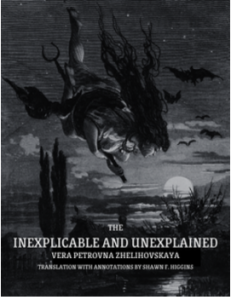
The full text of “Inexplicable And Unexplained” is available as a free PDF here: The Inexpliable And Unexplained
Read more about Vera’s family in:


The Memories Of Andrei Mikhailovich Fadeev








 Ad-Free & Subscriber Log-In