

Inexplicable & Unexplained Pt. II
Voiskovitsy, the Gatchina estate of my husband’s uncle, was a beautiful manorial village, with an exquisite garden, ponds, and a house with about twenty rooms, at least half of which were always hospitably open to visitors.
Guests and merry receptions were never lacking in both the village and city home of N. F. Kandalintsev during the life of the young hostess, but after her death, life became quieter. There was no one for the owner of the house to embarrass himself with receptions that he himself did not even care for. His family consisted of three children: son Nikolai, sixteen years old; daughter Anna, fourteen, and Lydia, a pretty, ten-year-old girl. With them also lived Nikolai Fedorovich’s sister Agrafena Fedorovna Verevkina—an old widow, who acted as a mother to her early orphaned nieces and nephew. She was much older than her brother; her sons were all already married, and I had known the eldest as a general in the Caucasus. The old woman was highly respected in the family but had little influence. The girls spent all their time with the Englishwoman; the household was run by managers, butlers, housekeepers, and a trusted woman, Agafya—the whole house was in her hands. Agafya, although purely Russian, was so rational and sensible, so to speak, that from her appearance, with her white starched apron with a waist, slicked-back hair, and onion-shaped time-piece on her belt, one could easily mistake her for a German. We rarely saw Nikolai. He was a very pale, weak, perpetually sick boy who had unsuccessfully passed through the hands of almost all the capital’s doctors.
My husband went to Petersburg with his uncle almost every morning before lunch. He didn’t serve, but was engaged in private affairs, while Nikolai Fedorovich was the district leader of the nobility.
One day Nikolushka (as he was called in the family,) did not come to dinner. He became more ill… I did not ask about the nature of his illness, but I knew from conversations that it was some kind of strange, nervous, not amenable to any analysis, which is precisely what confused the doctors.
It was the time of Daniel Dunglas Home’s greatest fame. He had just visited Petersburg, filling it with stories of miracles that had occurred in his presence. N. F. Kandalintsev, a zealous adherent of Spiritualism, had himself been present at several of Home’s séances, and spoke with enthusiasm about the ringing of bells, the movement of furniture, tables suspended in the air, bouquets and flowers scattered by invisible hands, musical chords played by who knows what, and other miracles. Besides Home, we also had some of our own home-grown Spiritualists. Agrafena Fyodorovna Verevkina was afraid of these stories and did not like it when they were discussed, but Nikolai Fyodorovich, on the contrary, happily expatiated on various phenomena and table-writings. He especially, I remember, often told the story of how he had not previously believed in it, considering it a trick, but then, one day, he wanted to stay longer in a house to observe the table-writing even though he needed to return home, for he was waiting for a certain Shirinsky-Shikhmatov on a very important matter.
“And so,” he continued, “I’m sitting there, looking at the evolutions of the table under the hands of a complete stranger. I sat there thinking: What if he arrives, and I’m not there! Things will turn out badly! And suddenly, what do you suppose happened? This young lady, who was sitting at the writing table, turns to me and says: ‘Mr. Kandalintsev has written something for you.’ I stood up, of course, very surprised. She hands me a sheet of paper covered with writing and on it, under my name, is scratched: ‘Don’t bother going home: Shirinsky-Shikhmatov has already arrived, and not alone, but with his wife.’ And what do you think happened next?” our narrator asked triumphantly again, telling this incident for the tenth time. “I come home and find out that everything was exactly as stated—that my sister and Anyuta received them without me, and they never waited for me!”
I have heard this story so many times that every word of it, and the whole figure of the late Nikolai Fyodorovich—with all the shades of his voice and expression—are indelibly imprinted in my memory. I remember the following scene no less vividly. It was on the same day as Nikolushka’s illness. Before dinner, I went from the flower garden onto the balcony, curtained by marquises, and through the open doors to the living room I overheard a heated argument between the brother and sister. Agrafena Fyodorovna was asking him not to do something, to ask someone not to bring them, but rather to send for their doctor instead, and hold a prayer service.
Nikolai Fyodorovich grew excited.
“And I tell you, sister, that my only hope is in him! If he doesn’t help, then no one else will! You understand—he works miracles! Home lowered his eyes before him and confessed that he had never seen so much magnetism in a human gaze.”
“But he already magnetized Nikolushka.”
“So what? Did he not fall asleep?”
“He fell asleep, but what good did that do? The next day he became even weaker. And besides, Nikolai hates him!”
“What does it matter that he’s weakened? That’s the usual consequence of the first sessions. He’ll weaken at first and then get stronger. It’s always like that! And so, what if he hates him—it is the best proof of the magnetizer’s power, if the subject feels hatred towards him. You, sister, don’t read about this, but I’m interested, and I know. No, as you wish—and tomorrow I’ll ask Prince Alexei Vladimirovich Dolgoruky. Let him come two or three times a week, as many times as necessary! As long as he helps—and I won’t stand for anything!”
“That’s it—if only he would help,” the old woman confirmed with a sigh. “Well, and I confess, it’s not that I don’t believe in his treatment, but I’m simply afraid of him himself, your bulging-eyed prince!”
When he came that time and stared at Nikolushka with his black eyes, as if he wanted to eat him, God forgive me! And so, I thought—there will be no way out of this treatment! There will be none, yes!
“What nonsense you are talking, forgive me, sister. Dolgoruky has put many people more ill than Nikolai back on their feet, and God willing, he will cure him.”
“God will not give this! Because his strength does not come from God—and the healing does not come from God!”
But then all those present, my husband and I, the old neighbor who always came to Voyskovitsy for dinner, and most of all, the master of the house himself, attacked the old woman and overpowered her protests. It was decided that if Nikolushka did not feel better by evening, they would telegraph Prince Alexei Dolgoruky and ask him to finally take over the treatment of the patient.
By evening, Nikolushka had gotten worse. They sent a telegram and ordered him to catch the morning train. A carriage was sent for the prince.
I confess that I began to await the arrival of the famous magnetizer with impatience and great curiosity. I had heard a lot about him—but I had no hope of seeing him in person, and even less hope that I would witness his magnetic sessions.
In the morning, I was drinking tea with Agrafena Feodorovna when Prince Dolgorukov’s arrival was announced and he himself came out onto our balcony. His appearance struck me. He was short, very swarthy, unattractive, and with enormous black bulging eyes; extremely lively and active in speech and manners, he did not make a pleasant impression at first. Only after talking with him for a while did this impression disappear, and for many it was often replaced by a feeling of unaccountable sympathy. There was something inexplicable in his gaze—it both attracted and frightened. Few could bear that gaze. The prince was conscious of his strength, and sometimes amused himself with it, like a child. In essence, he was an extremely simple-hearted and kind man, but proud and honest to the point of exaggeration and scrupulousness. If he had possessed even the slightest bit of self-interest, and even a drop of charlatanism, the ability to present his goods in their best light, he could have made himself a huge fortune, but he treated his power so simply and lightly and spent so much time on poor patients—who could reward his care only with heartfelt gratitude—that he remained a poor man for the rest of his life.
But to the point:
The prince, having asked in detail about Nikolai Kandalintsev’s condition, expressed the wish that everything be arranged for him as he always demanded, and half an hour later he went with the father and aunt to the sick boy’s room. I would not have gone with them if the prince himself, having learned how interested I was in magnetism, had not invited me. His demands consisted of the indispensable condition that his presence should not be known to the patient and that he could begin to magnetize him from afar, unseen by him. This was easily arranged. Under the pretext of making the bed, the boy was moved from the bed to the sofa and laid with his back to the wide-open doors into the next room.
Nikolushka had had a bad night and was very weak. I, not having seen him for more than two days, found a big change in him. We all went in to him, greeted him as if nothing had happened and quietly moved away. Dolgoruky, stopping halfway across the first room, began issuing his magnetic passes.
The father stood longer than the others beside the sick boy. He leaned over him and asked sympathetically: “Would you like to eat something? Would you like to drink something?” He had not eaten for more than a day. Nikolushka weakly turned his head and whispered barely audibly: “I don’t want anything. I’m tired! If only I could fall asleep.”
“Yes! You, poor thing, haven’t slept peacefully for a long time. Try it!” objected the father. “Sleep would strengthen you.”
And Nikolai Fyodorovich walked away from his son, not taking his anxious gaze off him. The prince continued his work, fixing his eyes intently on the boy, silently approaching him with each pass closer and closer.
I remember my heart was palpitating.
I also remember that the thought flashed through my mind: “It’s no wonder that the poor boy, weakened by fasting and lack of sleep, would fall asleep!” But taking a closer look at Nikolai’s face, I became convinced that a peculiar sleep had taken possession of him. On his emaciated, pale face there was a tense expression, far from resembling a calm slumber; his eyebrows were slightly drawn together, his eyelids and the corners of his lips trembled, tears appeared from under his eyelashes, and he himself shuddered every time Dolgoruky shook his hands after the pass. The prince kept inching closer. Now he had crossed the threshold of the bedroom; now he had come up to the very sofa and was already passing his hands over the sick boy’s head. Nikolai’s face looked calm. It seemed that he was already, indeed, sleeping a deep, healthy sleep. The room was completely silent, nothing was moving. Only the birds’ din of a beautiful summer morning could be heard from the garden. We all froze, as if rooted to our places. The magnetizer passed his hands over the sleeping patient once more, lowering his hands and leaning close to his face, then to his chest, listening to the beating of his heart. I was terribly afraid that Nicolai would wake up! But no. He didn’t even blink. His face seemed to freeze, and his breathing gradually became more audible, like that of a healthy, strong person.
Another minute, and the prince, without taking his eyes off him, leaned over and asked in a measured voice. “Are you sleeping?”
“He’s sleeping!”
We all shuddered at the hoarse, alien whisper in which this was said.
I exchanged a puzzled glance with Verevkina. She probably expected this, because she was not at all surprised, but only shrugged her shoulders in annoyance and moved her right hand under her mantilla. It seemed to me that she was crossing herself. I confess—I myself felt the desire to cross myself, having heard what followed.
Dolgoruky asked louder and more confidently: “If he is sleeping, could you tell us what he is sick with?”
The answer also came louder, in a rough, male voice: “I won’t tell. Why? I’ll write a prescription later. In an hour. Now go away!”
And the sick boy, who had just lost both strength and voice, turned with a powerful movement towards the wall and almost started snoring.
“Now let’s go, let him rest as long as he was told; and we’ll be back in an hour,” the prince told us.
He took out his watch and went out, not at all careful about making a noise with his boots. Everyone followed him.
“What does this mean? Who is he? Who were Nikolushka and the prince talking about?” I asked, bewildered, in my strongest voice, as soon as Nikolai Fedorovich locked the door to the bedroom.
Dolgoruky smiled and answered me himself: “Magnetized patients always speak about themselves in the third person.
I remembered reading about this. “But why did his voice suddenly become so rough?”
The prince shrugged. “Don’t ask me about that,” he said. “I know just as much about it as you do. And it seems that no one has yet been able to explain this strange phenomenon! At least, I personally, no matter how much I read or heard about it, could not find any points of agreement.”
“And is it always like this with all patients?” I continued to ask.
“Yes, with almost everyone.”
N. F. Kandalintsev then turned to him with questions specifically about his son, and I slipped into the garden and went wherever my eyes led me. My husband was not with me—he had left the day before for a few days in Moscow. I had no one with whom to share my bewilderment and, to tell the truth, even my fear, and I felt the need to concentrate my thoughts, to calm down.
What else did I see and hear later?! When I returned from the garden, the whole company was in the dining room at breakfast, but no one was eating except the prince, who was regularly snacking. At the same time, he was telling the most reassuring stories from his practice, assuring that everything depended on the correctness of the implementation of the advice that the patient himself would now give regarding his treatment.
I knew from hearsay that patients of this kind prescribe medications to themselves and others; but in no way could I imagine what was happening to Nikolai Kandalintsev.
Exactly an hour later, Dolgoruky approached the sleeping boy and, without saying a word, looked at his deep gaze, he suddenly, like a machine, rose up and sat up.
“Is it time?” the prince asked.
“It’s time,” the same rough, alien voice answered. “He’s rested.”
Suddenly the patient opened his eyelids and looked around at everyone with cloudy, cold eyes. What a terrible, unpleasant look it was! I turned away almost in horror, meeting his eyes.
“Can you dictate what treatment Kandalintsev should be given?” asked the prince.
“Write!” was the sharp answer.
The magnetizer took out a notebook and a pencil. The patient dictated the treatment and medicine. He dictated the latter in Latin—and he quickly defined, also in Latin, what kind of disorder was affecting his body.
Dolgoruky and the boy’s father questioned him in detail about everything, all the time speaking about him in the third person.
“Does he want to get up?” asked the prince. “Does he need exercise?”
“Not today. Next time. Now give him food.”
And they brought him food. They brought cabbage soup. They brought beefsteak with cucumbers. They brought something else. Nikolushka, this sickly boy who previously ate almost nothing except broth and weak tea, ate plates full of all this before our eyes. He devoured this food with some kind of bestial greed while looking at everyone from under his brows with an angry, clouded look, now and then screaming wildly or smiling to himself. He calmed down only at the look and word of his magnetizer. It was terribly hard for me! I regretted that I had come to watch this spectacle, and I was glad when he finally stopped eating and hoarsely said: “Enough! Let him sleep some more. Go away!
We all went out again. Dolgoruky made a few more passes over the patient who had once again lain down and, leaving the room, announced that he would not return to him that day, but would come again the day after tomorrow and bring medicine.
“Until then, please keep to the diet he prescribed,” said the prince when leaving. “This is very important!”
How could this be important, after the enormous amount of food that the patient had just consumed? I was confused! My perplexity was destined to grow with each passing day.
In the evening, Nikolai Kandalintsev woke up again as the same nice, frail boy we all knew him to be. Again, his eyes shined meekly and clearly, and he spoke in his usual quiet voice.
I looked at him and did not know whether to believe my eyes and ears? If there were no others with me, I would be ready to suspect myself of insanity or in a dream in reality.
“That’s how it’s always done!” Agrafena Fyodorovna told me in the evening with regret. “It’s scary to look at! Tell me—what kind of treatment is this? Can any benefit come from it? Only sin! Honestly, it’s like someone is possessing the child! I’m surprised how my brother can agree to this!”
In my heart I agreed with her and waited, in great confusion, to see what would happen next.
The next day Nikolushka was very weak but said that he had spent the night more peacefully; except for tea, however, he did not want to eat anything, he felt an aversion to meat but, with difficulty, agreed to swallow a soft-boiled egg at noon. Looking at him, I could not tear myself away from a feeling of suspicion of his sincerity. Something was compelling me to ask: “What did you dream about? Do you remember anything special?” I restrained myself, realizing that it would be extremely indecent, perhaps dangerous; but, nevertheless, even looking into his meek, blue eyes and comparing their gaze with that dull, tinny, malicious look that I saw the day before, I could not completely rid myself of my suspicions. And his voice! Where did he get that disgusting hoarse bass? The more I thought about it, however, the more convinced I became that my suspicions were ridiculous…but still, they did not leave me.
Needless to say, Nikolushka did not notice anything, nor did know or remember anything, and was the embodiment of harmless sincerity and tender powerlessness.
The next day, after a bad night, I got up late. The magnetic session had already begun when I, having quickly drunk some tea, hesitantly made my way to the part of the house where Nikolai lived. In the corridor I met Agafya, who was in a great hurry, sorting through the keys to her storeroom, but bowed to me affably, nevertheless.
I asked if I could go to the patient.
“Go, madam,” she answered, “please go straight to the classroom, from there to the bedroom. The doors are open. Everything is visible. They are already up. The prince arrived early, and they slept no more than half an hour today. They sent me for lemonade—I’m running to make them some lemonade!”
She left quickly, and I went to Nikolai’s rooms. Approaching the bedroom door, I involuntarily stepped back. Neither the magnetizer nor the patient’s father, who stood with their backs to the door, noticed me; but he himself was sitting on the edge of the bed facing me. His cloudy eyes were directed into the distance and immediately fixed on me as soon as I appeared. Again, I heard that hideous voice: “You fool, stop! Talk!” he grumbled, ruffling his thick blond hair, which usually lay smoothly, but now stuck out uncombed in all directions, like tow.
I walked around the corner in confusion, so as not to see that look, and wondered: “Who is he scolding? Does he really know that Agafya spoke to me?”
Within a minute, there was no doubt about it.
“Who are you angry with?” asked Dolgoruky.
“That fool Agafya is messing around with lemonade, and he wants to drink!” was the answer.
There were a few seconds of silence.
Suddenly, I heard an angry cry and determined steps towards me. I was ready to run away from fear! But the prince stopped his patient, authoritatively grabbing him by the hand.
“Where to?” he cried. “Wait! We must first try if the medicine is good.” He forced him back into his former place.
“I said I wouldn’t try it until they brought me some lemonade!” Nikolai or whoever acted and spoke for him answered rudely.
“Agafya will bring it now.”
“The hell with it! (Nicolas never said such words!) This stupid woman spilled a glass and makes a new one. There will be no end to this!”
Extremely interested, I quietly left the room and ran to explore, looking back at the long corridor with some inner chill: “Was Nikolai running after me? In the storeroom.” I said in a hurry: “Bring the lemonade quickly, Agafya! Nikolai Nikolaich is angry.”
“Oh, my lady!” the housekeeper answered, bustling about the table. “Such a sin has happened—I knocked over the glass! Here’s another one, right now, all ready!”
I shuddered in amazement and returned with Agafya and the lemonade. Curiosity overcame fear.
Dolgoruky handed the patient a dark bottle with drops (that the patient himself prescribed,) and another glass of lemonade.
Nikolushka took the medicine, uncorked it, and sniffed it—then, without any ceremony, he tipped back the bottle on his tongue, savored it and said: “Good. There’s a little bit of arsenic missing. We were afraid, fools. Well, never mind. Let’s give it to him. Three drops in the morning, at noon, and in the evening. The lightest food. Nothing sour or salty.”
“He doesn’t want to eat anything at all,” interrupted the magnetizer.
“Pour it in by force. Broth, milk. Something nutritious. Fruits are also good. Well, that’s enough. Let’s go! We need to warm up. Shake him up good! Let’s go!”
He stood up. Only then did I notice that he was dressed and shod properly.
“Would you like to wrestle?” the prince asked him jokingly.
“With you?” the patient said contemptuously, looking at the stocky magnetizer with his tinny gaze. “Thank you!” He grabbed him with both hands above the elbows, pressing hard on him, and the prince, a broad-shouldered, healthy man, gave in, unable to withstand the pressure.
“Nikolushka!” the father said with fear.
“Leave it!” Dolgoruky whispered to him, turning around.
“He’ll hear a lot of you!” Nikolushka muttered in response.
I looked at him. Was it really him, Nikolushka Kandalintsev, this rough, strong guy with clenched teeth and veins bulging on his forehead. It seemed to me that he had grown and become rougher somehow.
Dolgoruky was positively unable to cope with him. He could not do so by force. I fixed my eyes on the patient—he immediately became agitated, embarrassed, dropped his hands and went silent.
“Well, let’s go for a walk now,” the prince suggested. And they went out.
They spent more than two hours walking around the garden, the yards, climbing into the ravine, and climbing up the tower. We sat on the balcony, watching them from afar. The patient walked like a healthy man, now and then climbing trees with the ease of a cat, climbing up the balcony posts, wrestling with the servants, knocking down the strongest lackeys and coachmen. I finally went into the house. It became unbearable for me to watch this.
I sat down at the table, puzzling over the miracles I had seen, and was about to write them down in my diary, as usual, when I was frightened by the desperate screams of old Mrs. Verevkina. I ran to her and saw through the window that Nikolai was standing, as it seemed to me at first, in the air above the pond, and the household gathered around Agrafena Feodorovna were trying to persuade her not to be frightened, to be calm, because the prince himself was looking after him and would not let him fall, and asked only one thing—that no one should frighten him with a scream or wake the sick boy. Looking closely, I saw that Nikolushka was not standing in the air, but actually making a semi-airborne journey, several fathoms from the ground, along a gutter laid for the water wheel that watered the upper vegetable gardens. Dolgoruky stood below and, without taking his eyes off him, watched his movements, holding tightly by the hand Nikolai Fyodorovich who was pale as marble.
I can only imagine what his father must have been going through during those minutes!
Nikolushka moved slowly, with a dull smile on his face, looking not at his feet, but somewhere into space, like an equilibrist on a tightrope. Having reached the place where there was already land under the trough, and not a pond, he sat down and, grabbing one of the pillars supporting the trough, safely descended to the ground. Dolgoruky immediately approached and, taking him by the arm, led him to the house and made him lie down in bed. The next morning, the sick boy woke up again as a powerless, meek, and quiet youth.
During our stay in Voiskovitsy, Dolgoruky came several times. I will not undertake to describe all the miracles he performed on his subject, and no one has ever been able to explain them to me. I would not have believed anyone if I had not seen it all with my own eyes, and therefore I have no right to make any claims if my stories are not believed. Conviction is enough for me. What I saw and heard, I submit to the general judgment, not only without adding anything, but due to lack of space, and fear of boring with details, I do not say much.
Here is the gist of the facts. In general, it seemed that there were two completely different people—Nikolai Kandalintsev, and the Nikolai Kandalintsev put to sleep by Dolgoruky—not only in appearance, but also in their internal organism, moral and physical strength and abilities. In magnetic sleep, he devoured—literally—that which he would not be able to digest an ordinary life, even with a healthy stomach. He sipped those medicines which, outside of magnetic sleep, brought him benefit in drops. I saw how in his sleep he easily bested strong men; how, having wound the reins around his hands, sitting next to his trainer in a light tilbury, he himself tamed young, unbroken horses, that a skilled coachman could not wrangle alone. I saw all this with my own eyes, as well as the fact that the next morning that same boy, outside the influence of the magnetizer, became so helpless that he could not get up without outside support, and so weak that he could barely raise a spoon to his mouth. These are facts that others who were witnesses to them will probably not hesitate to confirm.
I cannot finish my recollections of this time without telling an interesting incident, what happened to me personally.
On his last visit to Voiskovitsy, the prince arrived with us in the evening. He found it more convenient to magnetize a patient early in the morning, and therefore, arriving with the afternoon train, he spent the evening with us in conversations that, thanks to his stories, were very lively. He had been begging me for some time to allow him to magnetize me—finding that I must be a very capable subject—but I would not agree under any circumstances. We were great friends with the prince; he assured me that he was my great-uncle on the grounds that my grandmother, Elena Pavlovna Fadeeva, was his second cousin. Grandmother was indeed the last branch of the senior line of the Dolgoruky princes and was highly respected by all members of this ancient family. Prince Alexei constantly talked to me about her and, in general, about all my Tiflis relatives, but that evening I was not talkative, having slept poorly the night before. From all these worries, incessant amazement and fear, and perhaps also from the fact that I was upset by my husband’s prolonged absence, my nerves were in great disarray. I suffered insomnia and was constantly in some kind of anxious state.
That evening many neighbors had arrived. It would have been awkward to leave early, and so I sat and conscientiously tried to keep up the general conversation. Many guests, including the prince, went out to smoke on the balcony, talked there, and returned again. I sat with my back to the balcony. It was a warm, almost stuffy evening.
Suddenly I felt a shiver run down my spine. Then it felt as though a hot stream flowed through my entire body; my heart somehow froze, and then began to palpitate, before my eyes passed not so much a fog, but some kind kaleidoscope of bright circles, shining stars, and lightning.
“Aha!” I thought. “I must have caught a cold. I just need to make sure I don’t get sick here alone.”
At that very moment, I felt an irresistible drowsiness. Had I not made desperate efforts, seeing smiling faces before me as if through a veil, and fearing that they were laughing at me, I would, it seems, have fallen off the chair in a deep sleep. But despite all my willpower, I felt that I could not fight any longer, and that I was falling asleep. I would have fallen asleep, too, if something extremely amazing had not happened! I already felt that warmth, heard that pleasant ringing in my ears, which are always the harbingers of sleep, when suddenly some kind of sad, painful sensation pinched my heart, and I saw two gray, cloudy eyes close above me. I recognized them! I jumped up in horror, screaming involuntarily.
There was a general commotion! Everyone rushed to me, some with alcohol, some with water. Questions and reassurances arose. It turned out that Prince Dolgoruky had acted treacherously towards me—he had been standing in the balcony doorway all this time magnetizing me! At first, many did not notice it. Then, seeing how sleep was overcoming me, they became interested and deliberately remained silent, insidiously abandoning me to the mercy of the magnetizer and waiting, like a performance, to see what would come of it.
I don’t know what would have come of the dream, but what came of my premature awakening was that I flared up, burst into tears, and went to my room completely upset and frightened. To my greatest happiness, not even ten minutes had passed when, after I went to my room, I heard the worried footsteps of my husband entering the room. He had returned unexpectedly, having been freed from work a day earlier than he anticipated. They hadn’t had time to tell him exactly what had happened, and he came in fully convinced that he had found me ill. To tell the truth, I wasn’t completely healthy, although I tried to convince him of this. My husband, however, soon noticed this himself. Realizing that all of “Nikolushka’s miracles” had had an effect on me, he promised me that we would leave for Petersburg the very next day, and he was very sorry that he had left me there alone.
We did leave the next day, but the morning of that last day was not without incident, for that was when I witnessed, perhaps, the most remarkable of all of Nikolai’s miracles.
I said above that I was brought to my senses by familiar eyes, which scared me almost to death.
Yes! And those eyes had been giving me no peace for a long time! Those were his eyes. Not the gentle grey-blue eyes of sick and harmless Nikolushka—no, they were cloudy, cold, and hard eyes with which he looked at everyone during his mysterious sleep. They positively haunted me! Ils me hantent! They were especially hard on me before bed; they kept flashing before me as I fell asleep. I am ashamed to admit, in the room where I slept, there hung an old oil portrait of some great-grandfather of the owners. I had not noticed it before; one evening, looking at him, I shuddered—his eyes seemed familiar to me. Like many portraits, his gaze seemed to follow you, wherever you stood. I could not bear this gaze and covered the portrait with a kerchief. My husband immediately noticed this black scarf hanging like a trophy, and I had to tell him. Of course, he laughed at my cowardice, but I was not afraid of his ridicule.
The next morning, I asked him to go to Nikolushka, who had long since been brought into a magnetic state, and see for himself. Still laughing at my “exaggerations” and “fears,” my husband agreed. We arrived during “feeding time,” which aroused in him a smile of distrust, as it once did in me. But if he could only imagine what would happen, he probably would not have smiled so skeptically, looking at his cousin.
Although I had already seen everything—Nikolai’s clairvoyance, and other wonderful manifestations of his magnetic state—when he left the food, suddenly raised his gaze to me (that very gaze,) and, giggling, nodded his tousled head at me, I confess, my heart sank! But oh! What happened to me, and I suppose to my husband, when Nikolai suddenly stood up and addressed me directly:
“You got scared yesterday when I looked at you,” he said in his disgusting voice. “Why did you scream? I was already here. I would have entered you, too—it’s a pity I didn’t have the time!”
He suddenly moved decisively towards us. I still don’t understand how I could refrain from screaming; I was imbued, perhaps, with the conviction that any sudden movement or cry could awaken the patient and harm him. My husband only managed to whisper desperately: “Prince!” Dolgoruky was already near Nikolai and grabbed him by the arm at the very moment when I bravely retreated behind my husband’s back.
The patient, or the one who acted for him, (no one will convince me that it was he himself!) only laughed sharply and said: “She’s closing the portrait! She’s afraid! Is it really the portrait that’s looking? It was me who was looking at you, me! I will always look at you, whenever I want, whatever you do.”
I was absolutely in no condition to listen any longer. My husband led me hurriedly out of the room into the fresh air of the garden, where I learned for the first time in my life (and thank God, it seems, for the last time!) all the delights, if not of hysteria, then of something very akin to it. That same day, we left Voiskovitsy. The prediction, thank God, did not come true: The terrible haunting gaze gradually faded away, and I never saw him again.
Magnetism brought temporary relief to Kantsev, but he probably did not completely cure himself with the remedies prescribed in his sleep. All his short life he was just as sickly, suffered from incomprehensible ailments, more mental than physical. Nikolushka never could overcome the feeling of hostility, almost hatred, towards Dolgoruky. About five years later, he marked his coming of age by committing suicide, shooting himself. Thank God that this happened after Nikolai Fyodorovich’s death.
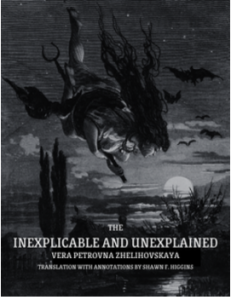
The full text of “Inexplicable And Unexplained” is available as a free PDF here: The Inexpliable And Unexplained
Read more about Vera’s family in:


The Memories Of Andrei Mikhailovich Fadeev







 Ad-Free & Subscriber Log-In