

[An English translation of Vera Petrovna Zhelihovskaya’s “Inexplicable And Unexplained,” which appeared in 15 issues of the Russian journal, Rebus. A survey of some of the supernatural experiences she and her family encountered—S.]
Inexplicable & Unexplained Pt. I
1853-1854
Whether they will believe me or not, I do not know; but I will tell only the truth, which I know for certain, without a doubt! We live in such a strange, troubled time, when we constantly hear, and sometimes even see ourselves, such inexplicable, almost fabulous things, unexpectedly playing out here and there among the most peaceful, prosaic families, who never thought of any extraordinary manifestations, that, in my opinion, every person has the duty to clear the truth, as far as possible, from inevitable exaggerations and inaccuracies and to declare it to those who may be seriously interested in it.
I grew up in a strictly Orthodox family, sincerely religious, but in no way mystically inclined; we did not cultivate that attitude of denying the unknown and mocking the inexplicable, as many others did, simply because it was not our business. Favoring, rather, skepticism and esprit fort, it was seen as improper for “educated” people to admit their own mental inadequacy. I did not encounter such biases in my family—but I also did not encounter either superstition or hypocrisy, which prepare the ground for belief in everything supernatural. When, at the age of sixteen, I parted with my mother’s family, in which I grew up, remaining a seven-year-old child after her death, and went to live with my father, who was then widowed for the second time, I met in him an extremely skeptical man, rather a deist, who treated everything in life from the most realistic point of view. He was a very intelligent man, knew a lot, one could even say he was a scholar, but learned and developed in his personal scale, far from being in the spirit of humility before the truths of Christianity and blind faith in the immortality of the human spirit and life after death. I am speaking of this so that it is clear to skeptics that my spiritual development was not dominated by any one-sided influence, and also so that my father’s personality would be illuminated more accurately and would immediately become separate from my mother’s relatives, people of a completely different temperament.
Thanks to the exceptional influence on my upbringing of a person who, on principle, gave me a lot of freedom for self-development, if I may say so, who placed a lot of hope on the spiritual, individual powers of each child, if only they were sensibly and honestly directed, I got used to thinking for myself from an early age, to analyze everything around me to the best of my ability and abilities, and to live a conscious life. Having found myself so early a little. If I wasn’t the complete mistress of my father’s house, I felt more independent and, as far as I can remember, I began to be critical of things and people from an age when other girls were still not far removed from being completely helpless children.
This is how I found myself in the year 1853-1854, memorable for many reasons and to many people. A time remembered in Russia for the Crimean War, and in many places for the severe cholera, forest fires; throughout Russia—the death of Tsar Nikolai Pavlovich; and throughout the world—the first manifestations of table-turning and spirit writing, the first rumors of Spiritualism, which had not yet been christened with this nickname.
The first rumors about an unknown force moving objects, as everyone remembers, came to us from across the ocean—from the United States. Despite the hot, troubled times, and perhaps precisely because of the general unrest and anxiety, everyone eagerly pounced on the turning of tables, hats, and plates. Then improvements appeared: pencils built into miniature tables—tables of letters, which were used to make a designated plate, map, etc. move.
I was then living with my father in Grodno and, having barely recovered from my moral loneliness because of separation from the family that had raised me, I was just beginning to get used to everything new that surrounded me. When I left Tiflis in 1852, I was convinced that I was going for no more than two or three months. When my father personally came to Moscow for me, where my uncle and aunt had brought me with them for my pleasure, I, not considering myself entitled to refuse him, followed him, but the first year I was incredibly sad! Everything seemed wild, alien, almost hostile to me. I lived from day to day, waiting for night and sleep as peace and consolation. From night to night, I dreamed of familiar faces, familiar places, familiar mountains of the Caucasus, for which I yearned no less than for my friends.
It is understandable how I seized upon the wonderful means of talking about them, of finding out, without waiting for weeks and months for letters, what people close to me were doing, whether they were well, what was happening to them? I cannot say that I fully believed the answers of our Pythias; but this occupation, entertaining me, often consoled me in sorrow. We soon came up with the idea of conversing with the invisible world through the alphabet written on a sheet of paper and a magnetized card that replaced our plate. We did this everywhere: at my uncle’s, my father’s brother’s, Gustav Alekseevich Hahn, who lived next door to us; in the family of General Nikolai Bogdanovich Bronevsky, the father of Gustav Alekseevich’s wife, Leonora; at the Chairman of the Chamber of State Property, Andrei Lvovich Kozhevnikov, a former Decembrist, married to Alexandra Vladimirovna Kozhevnikova (née Lvova,) great adherents of Spiritualism—may I be allowed to use this word, which was still unknown at that time, in advance. I myself was soon famous as a powerful medium, although perhaps they had not yet called me by that name. My ability amused, delighted, surprised, and even partly frightened me.
I cannot tell anything consistent about these spiritualistic activities of mine now, I forgot, having abandoned at that time a good habit, given to me since childhood: to write down every evening everything that happened to me. But in my mood at that time, considering my vegetating in Grodno as if not life, I found it boring to write it down. I remember only one thing and do not intend to hide it for fear of any suspicions or ridicule: in most cases, when my [card? / planchette] began to move, I knew in advance what it would answer. It often even seemed to me that I myself, of my own free will, was directing it. But, nevertheless, also in most cases, my card clearly and correctly answered mental questions, sometimes from people completely unknown to me!
I soon became famous. Not only Grodno residents began to contact me in writing, but sometimes people completely unknown from Warsaw and other cities began to contact me. Strangers and especially acquaintances gave me no peace! My father was skeptical, laughing at my “dexterity”—no matter how much I protested against his silent accusations, I could not yet persuade him to try it himself. That was ahead.
I was also quite disturbed by the views of some God-fearing individuals—aunt Leonora Nikolayevna and her mother, Olga Ivanovna Bronevskaya (née Shlengovskaya,) an old lady whom I sincerely loved and respected, as I did this entire wonderful family. Olga Ivanovna was positively convinced that there was an evil spirit in my card and even began to avoid me somewhat. This upset me! She asked her daughters, especially Liza Bronevskaya, my friend, not to allow these activities on holidays, during Lent and during church services. I began to refuse to keep a card in the Bronevskys’ house altogether. I remember only one case well, but it is worth many!
Various personalities spoke through my card, but most often some Algerian Arab. Why an Algerian? What did he care about Vera Petrovna Hahn’s activities in the Lithuanian city of Grodno? It is difficult to explain, but it is a fact. I regret that I cannot recall his poetic, purely Arabic name—I will not invent it! This spirit, as we called him then, was very light in speech and mobile, as, incidentally, befits a spirit, and even a natural Bedouin! He very often flew away on request for leave for Sevastopol, or say, Asia Minor—generally speaking, to the place of military action—and returned from there with news.
It occurs to me that the event I am about to tell should be written about more seriously, and not in such a light tone. But what can I do? Unlike a song, one can’t take a word out of a story that has not yet been written. It’s written as it is! I continue.
At that time, one lady, the wife, I think, of the district leader of the nobility in Grodno, Velenina, was very ill, dying of breast cancer. She was a good woman, and we all felt very sorry for her.
Once, I remember, in the Kozhevnikovs’ house, Liza Bronevskaya, several others and I were holding a map, talking with Abd-el-Kader’s compatriot, when one lady came straight from Velenina and began to tell about her grave condition and that, in addition to her illness, she was tormented by the uncertainty about the fate of her brother, who was near Sevastopol and had not written a word for a month. Lisa and I exchanged glances. The same thought occurred to the hostess of the house.
“Well, let Mademoiselle Vera ask her fortune-telling card. Maybe we’ll find out something!” she said.
Of course, the guest immediately joined her, asking me to “tell his fortune.”
My whole fortune-telling consisted of asking: “Tell us what so-and-so is doing, is he well.” I’ve forgotten his name now!
Not even five minutes had passed when Liza Bronevskaya, who was writing down the letters as the designated corner of my card stopped on them, came up with the following phrase: “He is with us. Sister will see him soon.”
Needless to say, this answer greatly embarrassed the whole company and me in particular. –“With us? So he died; killed, probably?”
“Yes. Not killed, but died of a wound…”
“So it means she too…Velenina?”
I threw down the card. It was clear that I did not want to wait for an answer.
But here is a fact that happened in front of several witnesses.
A week or ten days later, Velenina died. She lay in her death throes, everyone thought that she was unconscious and already passing away, when suddenly her face cleared up, first astonishment, then joy was depicted on it. The dying woman raised herself, opening her eyes wide and peering into one of the corners of the room, and clearly said: “Brother!! Have you arrived? Are you alive?! I am glad!”
These were her last words. Velenina died with a smile of happiness on her face. The prediction of my magic card came true; she saw her brother, crossing the line of life from us—to them!
At the same time, I began to receive letters from Tiflis, reporting no less amazing things. There, my aunts, Ekaterina Andreevna Witte and Nadezhda Andreevna Fadeeva, and many acquaintances were already engaged not only in table-turning, but also in automatic-writing. The results of their sessions were much more amazing than ours—but since I was not a personal witness to them, I will not describe them. May God grant me the opportunity to cope with my material!
I warn you that my truthful story about everything inexplicable that happened to me personally or to others before my eyes will include not only spiritualistic facts, but also all sorts of phenomena that occurred in reality or in a dream, which remained mysterious and not explained by anything real.
With the onset of Lent, we completely abandoned our spiritualistic pursuits. It was a very difficult time for all Russians. Our military affairs weighed heavily on everyone’s souls—everything before us seemed gloomy and uncertain, and in this impenetrable fog our glorious, tortured Sevastopol, this all-Russian martyr for the sins of all Europe, burned like a bloody stain. There was almost no family that was not in mourning. We were all burdened by the weight of not only our own, but our neighbors’ grief and despondency, as well as general fear for the future.
On the morning of February 18, I was hurrying to get dressed for mass. I had a young maid, a Polish woman named Julia, a great dandizette and chatterbox, but completely illiterate. It was the time of signal telegraphs, when news was transmitted by them, perhaps, more slowly than it is now transmitted by mail. We still knew absolutely nothing about the Tsar’s ill health. Giving me something to wash, Julia began telling me about a dream she had seen that night.
“I was in a field in the evening— an empty field.” She said. “The sun was setting in big clouds. For some reason, I felt scared, and I looked up at the sky. There, high in the sky, I saw an eagle, but not a simple one—it was a big, black bird with two heads, like the ones they draw on boxes with sealing wax. (The simple girl couldn’t even explain that she had dreamed of the coat of arms of the Russian Empire!) And suddenly this eagle released from its paws the ball and stick that it always holds, and they flew down and began to whirl—falling to the ground—and the eagle itself lowered its heads and also began to quietly fall. I was scared! I wanted to run. I turned in the other direction and…closed my eyes! I was blinded by the light of another sun and another eagle, which was rising all in rays on the other edge of the sky and flooding the entire field with its brilliance!
News was received at noon about Nikolai Pavlovich’s illness. At night, more news came—about His death. Then I, and those to whom I told Julia’s story, understood what her dream meant.
I have been perplexed by this all my life. Why? For what reason, and for what purpose, was such a wonderful prophetic dream sent to a poor, ignorant maid, who could neither understand, nor appreciate, nor even, probably, remember it properly? Was it she, who did not know what to call the scepter and orb, who had no idea of the meaning of the double-headed eagle, who should have seen this dream?
The time came for such events, incessant, sensational news, expectations and all sorts of interests that the emerging spiritualism temporarily faded into the background. Table-turning and table-writing did not cease, but somehow, they talked less about it, were less interested in them. A big change also happened in my life: I was a bride, and the man, whose wife I was supposed to become in two or three months, asked me to leave my spiritualistic activities.
But this very spring, something of a different kind, but no less strange, happened to me than the predictions of my magic card.
I was very friendly with the family of a landowner, Alexander Alexandrovich Liphardt, whose estate was not far from Grodno. He had five daughters, two of whom were my bosom friends, especially the second one, Olga, my age every year, every month, and even every day. We often visited each other, and this spring I spent about three weeks with them in the village while my fiancé́ was leaving for Petersburg. I loved to visit their Krynki, and out of friendship for them, and because of the liveliness that always reigned there, and also partly because they had good horses and side-saddles, and I could always ride and recall, at least by short horseback rides, the excursions-monstres that I used to make in the Caucasus. It was on one of these trips that we, having driven into a forest, decided to rest on the grass under the shade of the pines and got off our horses. Everyone wandered off, each with his partner, in different directions; but I sedately sat down next to the owner of the house, a great friend of mine.
Alexander Alexandrovich Liphardt, although the father of a large family, having endured many life’s hardships, was still an extremely amiable, witty and cheerful man of the old school: well-bred and classically educated. Besides the pleasure of his conversation, which I was counting on, I had another intention for him this time: I wanted, being left alone with him “under the shade of the trees,” to make him fulfill his long-standing promise. I knew from his daughters that he had great faith and was much occupied with phrenology and palmistry. Once, even, several months ago, when I still did not know my fiancé́ at all, and was thinking about another, dark-haired man, Alexander Alexandrovich, as if jokingly, took my hand and declared without hesitation that I was in vain busy with the brunette, that my fate was connected with a fair-haired man whom I did not yet know, but our paths would soon merge…
“Forever and ever?” I joked at the time—not believing the prediction.
“I don’t know if it’s forever,” said Liphardt, objecting to me quite seriously, without letting go of my hand. “Probably until the death of one of you.”
“Oh, my God!” I cried out. “I do not at all wish to leave my husband a grieving widower! Like Ugolino, who once ate his own children in order to save them a father, I would rather wish to outlive my future husband so that he would not mourn me! Look, please, more carefully—how long is the life line on my hand?”
My interlocutor answered with a laugh, so that I wouldn’t worry about myself, that I would live to a ripe old age.
It was winter; and I soon forgot our conversation.
But now, when the first part of Alexander Alexandrovich’s prediction came true, when I was the bride of the fair-haired man whom I loved with all my heart, I remembered my words and his answer, and they tormented me!
I decided to take advantage of this walk, and our solitude, to beg him to look at my hand and tell me everything—the whole truth.
As I later realized, A. A. Liphardt did not want to tell me the truth, and understandably so! Was it time to tell a happy seventeen-year-old bride that widowhood and bitter sorrow were imminent! Alexander Alexandrovich, on the contrary, began to laugh and stubbornly deny his first prediction. I fairly begged him to tell me at least something, at least about the distant, distant future!
Now that time seems so recent! Then the future seemed endless, unattainable.
And I got my way. He predicted my distant future from my hand, which has now long since turned into the past. And everything he said came true. He predicted for me: short-lived happiness; many worries and anxieties; an unexpected, sudden change in life, which at first seemed would illuminate me with new happiness, but then it would bring on a difficult, long, desperate struggle with forces and circumstances that are opposed to me.
“You will have a hard time fighting the current,” he said in conclusion. “It will be a dark time in your life, but you will overcome it. You are a strong woman and will be able to swim out! And then you will reach a better time. Your old age will be calm—but you will earn this calm through persistent work and struggle.”
And all this has come true—except for the peace that I still expect. I have often recalled this prediction made to me in my early youth, and I find it strange that its conclusion—the end of the road—a calm old age—has always had an inexpressibly comforting effect on me. I have already reached the best time, that is indisputable. But I hope that God will send me still clearer days in my old age. I have no right not to believe now that all the predictions of my old friend will come true word for word.
My wedding was in the summer, after which my husband and I immediately left for our relatives in Pskov and St. Petersburg.
It was at this time, during the month of July, which we spent at the Gatchina estate of his uncle Nikolai Fedorovich Kandalintsev, that such mysterious events took place before my eyes that have left me, and continue to leave me, completely perplexed every time I remember them. I dedicate the next chapter of my story to these remarkable facts.
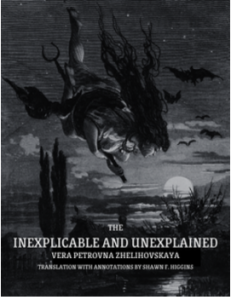
The full text of “Inexplicable And Unexplained” is available as a free PDF here: The Inexpliable And Unexplained
Read more about Vera’s family in:


The Memories Of Andrei Mikhailovich Fadeev






 Ad-Free & Subscriber Log-In