

~
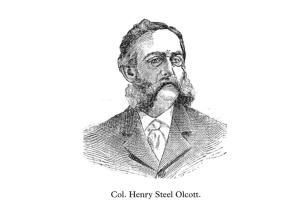
In 1874, Henry Steel Olcott’s dispatches from the Eddy farmhouse first appeared in the pages of The New York Sun and, soon after, in The New York Daily Graphic. Written as on-the-spot journalism, these reports carried readers into the crowded séance rooms of rural Vermont, where ghostly figures were said to emerge from darkened cabinets and mingle with the living. It was in the midst of this investigation that Olcott first encountered Helena Petrovna Blavatsky—a meeting that would shape the course of his life and, in time, lead to the founding of the Theosophical Society. In these raw accounts, we glimpse not only the spectacle of Spiritualism but also the moment when two of the nineteenth century’s most unusual figures crossed paths. Olcott would later expand and reshape these articles into his 1875 book People From The Other World. My recent book, World Of Spirits, gathers those original newspaper reports, which differed markedly from that later version—in the original articles, Olcott’s voice is less polished, more urgent, and closer to the immediacy of the séance itself. Through annotation and contextual framing, I tried to restore the texture of the first reports—unfiltered, theatrical, and controversial—and situate them within the broader currents of American Spiritualism. To allow the reader to return to a farmhouse parlor where the boundaries of the real and the spectral seemed to dissolve—and where a fateful partnership between Olcott and Blavatsky first began. The following is Olcott’s first article (and namesake of my book) “The World Of Spirits,” from the September 5, 1874 issue of The New York Sun.
~
The scene of the objective phenomena known as the Eddy manifestations is a gloomy farmhouse on the turnpike that runs north from Rutland, through a valley skirted on both sides by ranges of the Green Mountains. The distance from Rutland is seven miles, and the nearest Post Office is Chittenden, Rutland County. To reach it from New York, one takes the New Haven and Hartford and Springfield Railroads to Springfield, and the Connecticut River and Vermont Central roads to Rutland, whence conveyance is by wagon to the Eddy homestead. The visitor can also reach Rutland by way of the Hudson River and Troy. The expense is $10, besides meals—is for a ticket from New York to Rutland, and $2 for the wagon ride. The house was built nearly a century ago, stands close to the road, and is shaded by several trees, whose dense foliage, shutting out all sunlight, makes the dark brown structure appear more somber and inhospitable. It is furnished in the plainest manner, the doors all bare, the chairs of wood, the dining tables of planed boards, knocked together like those commonly seen in picnics and camp meetings, the walls without decoration, and nowhere any evidence of luxury, barely of comfort. A wall to the back holds the dining room, a small kitchen and pantry below, and overhead is the circle room, or the Chamber Of Horrors as we would call it.
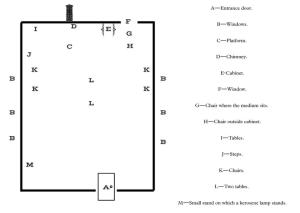
This is an apartment of 38×17 feet, with three windows on each side of the room, about two feet high by four broad, reached by three steps of about ten inches rise. Between the kitchen chimney, which is a small cupboard or closet, bathed and plastered, with a very narrow door, six feet and one inch high, opening from the platform, and a single window for purposes of ventilation. This closet is the “cabinet” in which the medium sits. A light handrail runs from side to side of the room at the edge of the platform. Perhaps a simple diagram will aid in obtaining a clearer idea of the place where most of the occurrences transpired that I am about to relate.
The mediumistic faculty is said to be shared by the whole family of Eddy children, originally twelve in number, but now reduced at the homestead by marriage and date to five—three sons and two daughters. It will interest Dr. Elam, Mr. Upham, Mr. Wallace, and other students of psychology and hereditary transmission of traits, to know that the great-grandmother on the female side was condemned to death at Salem in 1694, for “witchcraft.” She escaped the gallows, however, by being rescued from the jail by her friends. As nearly as I can discover by inquiry from others than the parties interested themselves, the phenomena accompanied the children through their school days and being misunderstood by their parents, were the occasion of their getting many sound whippings to “tick the devil out of them.” The grandmother was a “foreseer,” and the mother was also, like the Goethes, Pietro Alligheri, the son of Dante, Cazotte, the highland gudewives, the Danish seers, and hosts of others in various parts of the world, subject to pre-visionary warnings of events to come, and she ultimately became a believer in spiritualism. But old Mr. Eddy, the father, was a tough knot and complacently assigned a diabolical agency to whatever he could not pronounce humming.
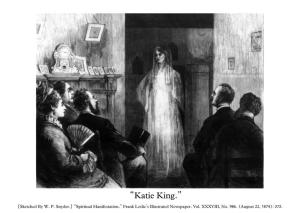
With still small children the Eddys were in the habit of going to a neighbor’s house to see the queer things that happened in “circles” (just as the Paris and Proctor girls went to sit with Tituba, in Salem, before the witchcraft tragedies were enacted, and they supposed that other persons than themselves were the mediums. But after a while the same things occurred in their presence at home, and then followed the parental trouncing referred to. Until about a year ago the phenomena following these are said to have comprised only rappings, playing on instruments, bell-ringings, the show of hands, the tying and untying of knotted cords and unlocking handcuffs, mysterious voices, and the lifting of their bodies to the ceiling of the room or public hall in which the men chanced to be exhibiting; but since then, at their own home and elsewhere, forms, apparently spirits, have been “materialized,” like that of “Katie King,” have walked, talked, produced spectral lights, and woven ghost-cloth in the presence of great numbers of people.
There is nothing about the Eddys or their surroundings to inspire confidence on first acquaintance. The brothers Horatio and William who are the present mediums, are sensitive, distant, and curt with strangers. They are more like hard-working, rough farmers than prophets or priests of a new dispensation, have dark complexions, black hair and eyes, stiff joints, a clumsy carriage, shrink from advances, and make newcomers feel ill at ease and unwelcome. The house is dark, rough, and uninviting, the appurtenances of the rudest, the astounding stories of what the Eddy’s do excite suspicion and invite distrust, and it would not be strange if a majority of persons attending only one “seance” should leave, as did a gentleman who came here with me, persuaded that it was a colossal humbug. I thought about as much myself at first, and it was not until a second and third opportunity had been afforded me to enter the circle room, to inspect the cabinet before and after the performances, and I had informed myself from perfectly trustworthy sources as to their antecedents, that I became willing to put my name to this tale and say that, whatever the nature of the marvels may be, it is certainly the chicanery or legerdemain of a pair of expert thaumaturgists. It suffices to leave each to form his own doctrine and join with Cicero, who describing the different kinds of magic, says, “What we have to do with is the facts, since the cause we know little. Neither are we repudiate these phenomena, because we sometimes find them imperfect.” Perchance Mr. Varley or Prof. Crookes or some other savant may in time give us a name for the new force that is responsible for phenomena already proven not to be the bits of either electricity or magnetism, singly or in combination. Perhaps the discovery of this occult power may help Prof. Lyndell out of the materialized slough in which he seems to be floundering.
The visitors to the Eddy homestead during the past year exceed several hundred in number, and hail from every section of the country. A very rigid ordeal of scrutiny has to be undergone to come admission to the house is obtained, more than forty persons having been rejected last week, the brothers say their encore choice is made under spirit impression, and that it is as easily and more satisfactorily made from a letter and from a sight of the applicant. They do not like the business of mediumship, are anxious to sell their farm and quit, do not want visitors, shrink from new acquaintances, and if “the spirits would let them, would never hold another circle.” It is sheer folly to come to their house on the chance of being admitted if time and money are any object, communication by letter being in all cases preferable. They can get a reservations to live in the house, and so have to do all the housework—cooking, washing, and everything—housewives, and as they charge nothing for seances, and but $8 per week for board, there is small profit and much work in taking boarders. They say they sit for the pleasure of others, not for their own, and if people do not choose to comply their rules they can stay away. They are at feud with some of their neighbors , and as a rule not liked in Rutland or Chittenden. I am now satisfied after a very careful sifting of the matter, that this hostility and the ugly stories told about town are the result of their repellent manners and the ill name that their ghost-room has among a simple-minded, prejudiced people, and not by moral forfeiture on their part. They are in fact under the bun of a public opinion that is not prepared or desirous to study the phenomena as either scientific marvels revelations from another world.
I have been thus particular and circumstantial in preface, because the data are necessary to enable the intelligent reader to judge both as to the credulity of this narrative and the thoroughness of the narrator. Many points noted in my memorandum book as throwing suspicion upon the Eddys I omit, because, upon sifting them, I found there was an easy explanation, and I cheerfully admit that my impressions of the brothers, as to their honesty in the matter of the manifestation, as well as their personal worth, have steadily improved since the first day. I am satisfied, moreover, that they have not the ability to produce them if they should try, which they do not, nor the wardrobe nor properties requisite to clothes the multitude of forms estimated at over 2,000 that during twelvemonth last past have emerged from the cabinet and stalked the narrow platform.
My narrative will be confined to appearances of material, or “materialized” for, as the reader chooses, little or no account being made of the class of minor phenomena such as have been witnesses by vast numbers who have attended the exhibitions of the Davenport brothers and other like mediums, and which the Eddys show both in dark and light circles in great perfection. After seeing what one sees here, the “hands” of the Davenports, the “masks” of Slade, the “busts” at Moravia, and the shadowy hands that so puzzled Lord Brougham and Sir David Brewster may be regarded as trivialities, worthy of no more than a passing mention in any future treatise on these mysteries of psychology.
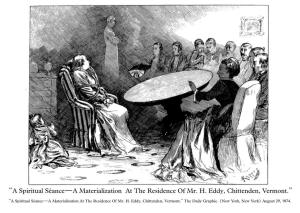
The circles here begin at 8 o’clock P.M. every day but Sundays, when none are held. The visitors assemble in the circle room, which has been kept locked all day (another cause for suspicion to the skeptic, but accounted for by believers on the ground that each person sheds a certain magnetism, aura, or something about him which tends to pollute the electric atmosphere of a room, and that is prejudicial the best exhibition of these phenomena, at half past 7, and spend a half hour dancing, singing, or otherwise to promote something like harmony and cheerful feeling in all present. The are invited to seat themselves on the benches, and William Eddy hangs a thick shawl over the door of the cabinet, which he enters, and sits in chair ‘G.’ The lamp is turned down until only a dim light remains; the sites in front join hands; and a violinist, placed at the extreme right of the row and nearest the platform, plays on his instrument. All is then anxious in expectation. Presently the curtain stirs, is pushed aside, and form steps out and faces the audience. Seen in the obscurity, silent and motionless, appearing in the character of a visitor from beyond the grave, it is calculated arouse the most intense feelings of awe and terror in the minds of the timid; but happily the idea is so incomprehensible, the supposition so unwarrantable, even absurd, that at first most people choose to curiously inspect the thing as a masquerading pleasantry on the part of the man they saw a moment before enter the cabinet. That the window of the closet is twenty feet from the ground; that no ladder can be found about the premises; that there is no nook or corner of the house where a large wardrobe can be stored without detection; that the medium totally differs in every material particular from the majority of the phantoms evoked; that the family are barely rich enough to provide themselves with the necessaries of life, let alone a multitude of costly theatrical properties avails nothing, although everybody can satisfy himself upon these points as I did. The first impression is that there is some trickery; for to think otherwise is to do violence to the world’s traditions from the beginning until now. Besides which, the feeling of terror is lessened by the apparition being seen by each person in company with numerous other mortals like himself, and the locked hands and touching shoulders on each side soon beget confidence. If the shape is recognized it bows and retires, sometimes after addressing words in an audible whisper or a natural voice, as the case may be, to its friends, sometimes not.
After an interval of two or three minutes the curtain is again lifted and another form, quite different is again lifted, and another form, quite different in sex, gait, costume, complexion, length, and arrangement of hair, height and breadth of body, and apparent age, comes forth; to be followed in turn by others and others, until after an hour or so the session is brought to a close, and the medium reappears with haggard eyes and apparently much exhausted. In the three seances have attended, I have seen shapes of Indian men and women, and white persons, old and young, each in different dress, to the number of thirty-two; and I am told by respectable persons who have been here a long while, that the number averages about twelve a night. The Eddys have sat continuously for nearly a year and are wearied in body and mind by the incessant drain upon their vital force which is said to be inevitable in these phenomena. For want of a better explanation, I may as well state that they claim that the manifestations are produced by a band of spirits, organized with a special director of ceremonies, chemist, assistant chemist, and dark and light circle operators. The director is an unknown spirit of high intelligence, the mistress of ceremonies in William’s circle, a Mrs. Eaton, who died about two years and a half ago in central New York; the chemist, a very aged white woman calling herself “The Witch of the Mountains” the assistant chemist, an Indian girl named Honto; the light circle operator, a sailor, named George Dix; and the mistress of the dark circle, a little Italian maiden calling herself “Mayflower,” who is assisted by Dix and number of others. I saw of these Mrs. Eaton, Honto, and The Witch of the Mountain, and heard them, and Dix and Mayflower also speak. The two last named did not appear to the eve but spoke in a dark circle. Mrs. Eaton is a little old woman, dressed in a grayish calico dress (or some stuff that looked like that fabric), and a long check apron. Her voice is loud and strong, but more like a man’s falsetto, and the first evening, before I had seen her I fancied it was William Eddy himself and was much annoyed at the apparent cheat. Honto is about 5 feet 5 inches high, a well-made, buxom girl, of dark copper complexion, and with long black hair. She is very agile and springy in gait, graceful in movement, and evidently a superior person of her class. At my second seance, she in my presence reached up to the bare white wall and pulled out a piece of gauzy fabric about four yards long, which parted from the plastering with a click, as if the end had been glued to it. She hung it over the railing to show us its texture, and then threw it into the cabinet. At either end of the platform she plucked, as if from the air itself, knitted shawls, which she opened and shook, and passed behind the curtain. Then descending the steps to the floor of the room, she pulled another from Horatio Eddy’s chair, where I had seen nothing but the bare floor a moment before. Then returning to the platform, she danced to the accompaniment of the violin, after which she re-entered the cabinet and was gone. Let it be noticed that this creature had the shoulders, bust, and hips of a woman, a woman’s hair and feminine ways, and that she was at least four inches shorter than William Eddy, who measures 5 feet 9 inches and weighs 174 pounds.
A very estimable old lady of the neighborhood, a Mrs. Cleveland, told me that one evening, some doubt being expressed as to Honto’s sex, she beckoned my informant to the platform, opened her own dress, and caused her to place her hand upon the naked bosom, and feel the beating of her heart. Mrs. Cleveland certifies that she is indeed a woman, and in the action of her heart, the inspiration and expiration of her lungs, and temperature of her skin as substantial and life-like as any woman she ever laid hand upon. It will also be recollected that Mrs. Florence Marryatt Ross-Church was permitted to feel “Katie King’s” body in the manner in London, and that her report corroborates Mrs. Cleveland’s. At my third seance the same old lady being present, Honto called her up, and instead instantly forming one of her shadowy shawls, pulled it apparently from the back of Mrs. Cleveland’s neck. She also, it almost seemed as if to answer the doubt in my mind, stood beside that lady, who is the average height of her sex, and showed that she (Honto) is just about five feet four or five inches high. Before retiring on this occasion, she danced with Mrs. Cleveland as a partner. Little Mayflower, whom, as I said, I did not see, but whom I felt and heard talk and sing in a dark circle, favored me with her history. She says she has been dead about a century. She is of Italian parentage, her parents settling in the wilds of Canada, being murdered by Indians, and herself made captive and adopted into the tribe. She only lived to the age of eleven, and , therefore, according to the laws of spiritual intercourse, is obliged to appear as a child whenever she approaches us. I held quite a long discourse with this charming little creature, whose voice is sweet and sympathetic, who improvises verses upon any subject given on the spur of the moment, like an expert Italian improvisatore, and who plays upon the mouth harmonicon in a truly ravishing manner. The child came and stood at my knee, talking to me the while, and playing upon the guitar that she rested upon my lap. I make this statement thus unqualifiedly because, although it was dark and I saw nothing, her presence was palpable to at least two of my senses, both as the time preternaturally acute. I can at least vouch that this phantom was neither of the Eddy brothers, if I doubted the genuineness of any of the rest, which I now do not.
One of the most amazing sights I have beheld in this memorable vacation visit was the appearance of an aged lady, clad in white, who emerged from the cabinet, called her son to her, met him near the steps, put her arms about his neck, kissed him so audibly that everybody in the room could hear it, helped him clear across the platform to the chair ‘H,’ one arm over his shoulder, and the other hand holding his hand, whispering some private matters into his ear, and again embracing him before retiring into the cabinet. The gentleman, a Mr. Pritchard of Albany, says he saw every wrinkle in his mother’s face, the color and sparkle of her eye, the color of her complexion and hair, and every detail of her dress to the very ribbon in her old-fashioned cap. Fancy, for one moment, being witness to a meeting between a son and his mother, who comes from beyond the grave to see him after a lapse of several years! The same thing occurred to him before, and on that occasion his mother having apparently overstayed her time and exhausted the force, whatever it may be, that materialized her body, turned suddenly to leave him.
As she receded toward the curtain, she began to sink to the floor, “as,” to use Mr. Pritchard’s own words, “a piece of butter would melt down if placed on a hot plate,” and having barely strength to push aside the shawl, she dwarfed until she was not above eighteen inches in height, when her son finally lost sight of her. Once Mr. Pritchard saw a like catastrophe happen to Honto, who ventured too far away from the cabinet, and entirely dissolved before she could regain it. As a further evidence, if any should be required, that William Eddy and the Indian girl are not identical, I again quote Mrs. Cleveland, white word none who know her will dispute, and who says that once, when on the platform at Honto’s bidding, she grasped her by the hand, and chancing to pass the other hand along Horatio’s arm, she found, to her horror, that it was only partially materialized, the hands alone being perfectly solid.
Of the thirty-two spirit forms I have seen, more than three-fourths were recognized by persons present as near relatives. The first evening, my eyes not being accustomed to the light, nor my powers of observation trained to watch details, the spectral shapes came and went in a confusing manner; but the second and third seances found me prepared to scrutinize the phenomena with deliberation. The readers will please remember that owing to my inhospitable reception, the suspicions excited by the place and its surroundings, and the astounding claims put forth by the spiritual press as to the Eddy manifestations, I was on the alert to detect fraud and expose it. As each phantom came into view I observed its height against the door jamb, its probable weight, its movements, apparent age, style of wearing the hair, and beard if man, the nature and elaborateness of its costume, and the external marks of sex, as regards form—all the while having my mind the square, Dutch build and heavy movements of William Eddy. I saw men, women, and children come one after another before me, and in no one instance detached the slightest evidence of trickery. Among the remarkable tests of identity coming under my notice was the appearance of a young soldier of about twenty years of age, the son of Judge Bacon of St. Johnsbury, Vt., whose death occurred under painful circumstances in the army, and whose name or existence even had not been mentioned by his father to any person about the place. The spirit was clothed in a dressing gown, light trousers, and a white shirt with turn-down collar. He was instantly recognized. The night that Mr. Pritchard was sitting on the chair ‘H,’ two of his nephews, dressed differently, wearing their beards in different ways, differing in height and appearance in a marked degree, stepped forth, and shook hands with him. I sat within five yards of them and saw them with entire distinctness.
At my last seance the old “Witch of the Mountain,” a withered old hag, with tottering gait and Snow-White locks, came out, sat in a chair, called up several of the audience to shake hands with her and receive other tokens of her friendliness, and after making Judge Bacon feel the length and silkiness of her hair, gave him leave to pull out a lock as a keepsake, which he did, and I saw the hair in his possession. This old woman is credited with the performance of a sort of miracle, of which I think I was almost the sole witness. William Eddy does most of the housework about the place—even to the washing—and very frequently goes about chattering an Irish brogue, and acting like one of those model servant girls, whom somebody describes as “steam engines in petticoats.” At such times he is supposed to be obsessed by the ghost of a servant girl, one Ann Cuddy, an honest sort of creature, who departed this life at Cleveland some years since. Yesterday William was washing in the yard, the kettle for boiling the clothes hanging over a chip fire nearby. For want of something better to do at the moment. I gathered a few chips and was mending the fire when William, or perhaps we might rather say “Ann,” using his vocal organs, said to me; “Shure, any fool can make a fire with wood; I’ll show yes how to make one burn with water!”—and dipping some water out of the horse trough close at hand, he flung it upon the flickering fire. Immediately the cauldron was enveloped in a great blaze as if he had poured alcohol or oil upon the embers, and every piece of fuel was kindled. Recovering from my surprise, I laughingly said that any fool could do that, and flung some of the self-same water upon the fire, effectually putting it out. I leave Mr. Paine, the water-gas man, to explain how water poured upon a weak wood fire can be made to serve the purpose of kindlings. I am told that the “Witch” has frequently done this trick before, besides other things in the circles equally remarkable. She gave warning yesterday morning that at a certain hour and minute William’s spirit would leave his body, go to the other world, and return in exactly thirty-two minutes. At the time prescribed William, sure enough, went into a trance, his body became as cold as marble, the skin turned livid purple, his tongue black and protruding, his eyes glazed, and he presented every appearance of a corpse. But at the expiration of the allotted half hour he came to himself and wept bitterly at being recalled from what he described as one of celestial joy. Of course, this species of cataleptic vision is common enough, and I should not think it worth mentioning but for the pyro-technic experiment of the ancient wizard, and her appearance in propria persona the same evening at the regular circle.
If your readers have not already had their fill of marvels, let me tell them a story that I have from Mrs. Cleveland’s own mouth. Since I read the “Castle of Otranto” and Lewis’s “Monk,” I don’t recall anything more uncanny. One evening the old lady was sitting in the house alone, reading, when there came a single loud rap on the front door. She went and opened it, and saw a man standing there, dressed in dark clothes and a white hat, and carrying a small black box or trunk under his arm. Over his face, he held a napkin, behind which he addressed Mrs. Cleveland and asked a night’s lodgings. His mysterious behavior excited her suspicions that he was some escaped lunatic, or perhaps a tramp who might be disposed to rob her, so she refused the application, and he moved off toward the Eddy house, whining remark that it was too bad to turn a man away on such a winter night as to perish. Presently, Horatio Eddy came running over to say that a man had walked into their house, scaring the family as they sat together in the living room by his abrupt appearance, and being refused shelter, had passed on down the road. While the two were conversing, there came another loud knock on the door, and this time Horatio and Mrs. Cleveland went to see who it was, the former carrying a kerosene lamp. Upon opening, they saw the same person standing there, and as he was repeating his application for shelter, Horatio let the lamp-light shine full on his face, now uncovered, which was hardly larger than a large man’s fist. Being again refused admittance, he flung the little trunk up into the air and caught it and walked off rapidly toward the Eddys again. Horatio followed him up, saw him enter, go into the sitting room, put his hand on his sister’s shoulder, causing her to scream, and then moving forward toward the back door, suddenly sank through the floor! It was a materialized spirit, and his appearance, attested by several witnesses, shows what a diabolical atmosphere apparently surrounds the family and homestead.
A person visiting here feels the whole air alive with phantoms, and he can nether walk the road at night, nor retire to his room without feeling the possibility that some horrid shape may leap from the ground before him and address him in sepulchral tones. The story goes that one-night last winter after everyone had retired, a band of spooks aroused themselves by taking the musical instruments from the circle room and serenading each sleeper in turn. A pleasant house, truly, for a strange family to move into.
The gentleman of whom mention has been previously made is Mr. E. V. Pritchard of Albany, a retired merchant, whose credibility must be well known in that city at least. He came to the Eddys’ in May, expecting to remain only a few days, but his experiences have been so satisfactory that he is still here. He first saw the spirit of his brothers son, who was killed in the army, and afterward his mother, his sister’s husband, two of her sons and one son-in-law, and his brother’s son. He has seen four of five female spirits carrying children in their arms, and setting them on the floor, lead them about by the hand. He has seen the children in some cases clasp their arms about their mothers’ necks. Once an Indian woman brought in her papoose, swaddled in the Indian fashion, and he heard it cry. An Indian girl brought in a robin perched on her finger, which hopped and chirped as naturally as life.
(Readers of history will recollect that one of the principle evidences of witchcraft alleged against poor Mrs. Nourse, and others of the Salem victims. Was the declaration of Tituba, Abigail Williams, Ann Putnam, and other “Afflicted Children,” that the prisoners had birds perched upon their fingers or sitting on their shoulders and whispering in their ears. In fact, the similarity between the occult occurrences of 1694 and those of our own time is very remarkable and suggestive.)
Mr. P. saw a mother spirit walk to the front of the platform and hold her babe over the railing toward the audience, so that they could see it kick its little legs, move its arms, and hear it crow. Again, on another evening three little girls, apparently four, six, and eight years of age respectively, stood side by side in the door of the cabinet, and he eldest calling to her mother in the audience, spoke her own name “Minnie.” No William Eddy in this instance, surely. Mr. Pritchard has heard the specters speak in all voices, from the faintest whisper to a full, natural voice. As regards to costumes, he has seen the forms clothed in what appeared to be silk, cotton, merino, and tarlatan, soldiers in uniform, one navy captain in full uniform and wearing his side arms, women in plain robes and richly embroidered, Indiana warriors in a great variety of costumes, some barefoot and others shod in moccasins. Once a pipe was lighted and handed to Honto, who walked about smoking it, and at each whiff her bronze face was illuminated so that every lineament was shown. She came and smoked in his very face to give him a perfect view of her own.
Out of man of testimony I have noted in my memorandum I will only quote in addition what Mr. Bacon says, as this added to what has preceded, should suffice to at least clear William Eddy from the suspicion of producing the phantom shapes by change of voice and dress, John Bacon of St. Johnsbury, Vt. is an associate justice of the county court of Caledonia county. He came here august 22 to see the phenomena. The first evening he saw the spirit of his father, who died forty-eight years ago. Recognized him by his shape. The form was dressed in dark clothes, with a standing shirt collar and white shirt. He was bare-headed. Standing erect, he towered to the height of six feet one inch, and called his son by his Christian name, speaking in his familiar tones. His breathing was distinctly perceived in the act of speaking. Besides him the Judge has seen one sister, fifty-three years of age at the time of her decease, and another off only three years; his wife’s father and mother (the latter wore a light dress and a white cape she is a very short woman, not above five feet in height): and finally his own son, whose death has elsewhere been alluded to. By actual count kept he has seen sixty-six different spirits to date.
The readers will not fail to perceive that beside the doings at this Vermont house of wonders, the narrative of “Katie King,” about which two hemispheres have been set agog, appears quite tame and uninteresting. Here in this cut-of-the-way nook in the Green Mountains, in the house of plain farmers, unprovided with machinery, chemical or other apparatus, or costumes, not less than two entire regiments of shadowy forms have come back from the Valley of the Shadow of Death to strut their brief while before the view of mortals and hundreds of families admit having received tokens of the departed. After this the daimon of Socrates, the imp of Wesley, the spectral visitors of the bookseller Nicolai, the banshees which follow certain houses, the prank-playing poltergeists of Germany, seem worthy of more respectful attention than we have been willing hitherto accord them. Who shall now pronounce impossible of realization the prophecy said to have been made through raps long since, that in time the spirits will materialize themselves so as to be able to address audiences from the public rostrum, as though they had never tasted death? With “Katie King” standing for her photograph. And the Chittenden ghost walking the highway with his box under his arm, it does seem as if the gap remaining is not much too wide to be spanned in our day.
Before leaving town to come on this journey, I thought it well to ascertain the views of the Head Centre of modern Spiritualism as to these objective phenomena. I found that gentleman in his cozy book store, at 24 East Fourth Street, and a long conversation ensued, in the course of which he expressed himself substantially as follows: So far as he, Mr. Davis, is personally concerned, he takes no more interest in these physical manifestations then a benevolent desire that his fellow men should be convinced of the fact of a future state. He regards them all, including these “materializations,” as feats of jugglery by expert spirits, numbers of whom are deeply versed in chemistry and other natural sciences. The phenomena he regards as necessary to convince nine-tenths of the world’s people that “death does not kill a man,” and he finds no fault with the Apostle Thomas for wanting to see and feel the wounds on Christ’s body before he would believe him arisen from the dead. He considers “Katie King” and the Eddy ghosts as of no importance as individual identifications, but simply as establishing the general doctrine of immortality. Whoever these shapes may be they are a hard nut for the Positivists to crack. They insist upon the production of a sensuous demonstration of the doctrine of immortality, and here they have it. The world of stars was once further from our comprehension than the world of spirits is now, and before long the laws of the latter will be equally well understood as those of the former. He says that there is always great necessity for caution in believing what one sees and hears in spiritual manifestations. Each phenomenon should be carefully and boldly scrutinized. There are impostors among mediums and among the spirits controlling them. Most of the former are found among the fortune-telling class, who use the vocabulary of Spiritualists to entrap the unwary. He divides mediums into three classes; 1. The fortune tellers; 2. The medical class; and the materializers. The medical ones are almost invariably controlled by Indian medicine men, who show a strange pertinacity in haunting the earth. They are as a rule, much more expert in diagnosing the diseases than in prescribing remedies. The materializers are honest in prescribing conditions in conditions in forming their circles, such as the choice of persons to sit, the places they should occupy, and the regulation of light and heat in the chamber. Spirit forms can no more be produced without observance of conditions than the shadow of a human being can be fixed on a photograph plate without an apparatus to collect and regulate the actinic rays and a developing room to bring out the image. In both instances, the effect is a chemical one, not mechanical. Spirit forms are produced by collecting subtle atoms from the atmosphere and combining them into the desired shape by the aid of potential forces. The nature of which is at present undiscovered by our scientific men.
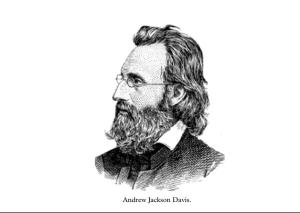
In reply to my question how he could account for the impartation of life to these temporary organisms, so that the heart can be felt to beat, and the other physical operations be carried on, he said he had no explanation to offer, and left the riddle for the disciples of Comte and Lyndall to solve. Varley, the English electrician, wrote him recently to ask where was the connecting link between maker and spirit.[10]
He replied that it was just upon the plane of these materializations, where spirit descended toward matter, and matter ascended toward spirit, the point of contact would be found. There are; 1. Solids; 2. Fluids; 3. Atmospheres; 4. Ethers; 5. Essences; the un-ponderables distilled out of the whole universe of matter. Matter is at its climax of progress there. Then takes place the alliance of spirit, and at this sensitive place occur all these apparitions. The spirit lifts matter up to this point, and by reducing its temperature and motion, he evolves the apparition. The reversal of this action produces the vanishment of the shape. All forms and potencies exist in the atmosphere, and by the action of the spirit upon them, all these and any other desired results are attained.
The conversation thus meagerly reported occurred sometime before the account of Prof. Tyndall’s Belfast address before the British Association was received in this country; and being read in connection with that, it possesses a definite value as suggesting a possible solution of the enigma propounded by that eminent man, of “the issue of consciousness from the clash of atoms.” One of these Chittenden ghosts told me that there are three qualities of electricity, of which our present scientific tests take cognizance of only the coarsest. Let us hope that by the time we catch the other two, we may be far on our road toward an explanation of the marvels that I have herein imperfectly described.







 Ad-Free & Subscriber Log-In