

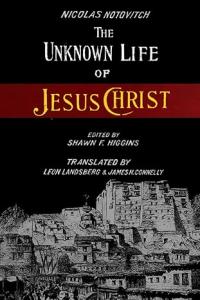
Was Jesus a student of Eastern wisdom? Did the teachings of Buddha and the Vedas leave their mark on the Gospel? In 1894, Russian explorer Nicolas Notovitch stunned the world with a revelation made at the Hemis Monastery in Ladakh, India—ancient scrolls describing the “lost years” of Jesus, known in the East as Saint Issa. These chronicles told of a young seeker who journeyed through India and Tibet, studying with Brahmins and Buddhists, preaching love and equality, and defying the rigid laws of caste. That same year, two members of the New York Theosophical Society, James H. Connelly and Leon Landsberg, produced the first English translation, The Unknown Life Of Jesus Christ, unveiling a vision of Christ deeply shaped by the wisdom of the East.
I recently published a new edition (The Unknown Life Of Jesus Christ,) reviving this historic work with expanded biographical essays on Notovitch, Connelly, and Landsberg, modernized spelling, and supplementary commentary illuminating the text’s esoteric meaning. The following are biographies of Notovitch, Connelly, and Landsberg, showing, perhaps, that more was at play with publishing this book than it appears.
NOTOVITCH ALEKSANDROVICH NOTOVITCH
Nicolas Aleksandrovich Notovitch (1858-1916) was a Jewish explorer from Crimea. He held a Lieutenancy in the Terek Cossacks, with whom he served during the Russo-Turkish War and was twice wounded. He was present at the battle of Plevna, and on more than one occasion acted as orderly officer to General Mikhail Skobelev. In 1882, after the war, Notovitch became a journalist for Novoe Vremya, adopting the nom-de-plume, “Dervish Nix” (the latter word being a diminutive of Nicholas, while the prefix ‘Dervish’ owed its application to his travels in the borderlands around Caucasus and Persia in “Oriental guise.”) In 1885 he went to Dagestan as a special correspondent to witness the suppression of a little uprising by Russian troops from the Caucasus. He was captured by some rebels and his career narrowly missed coming to an end, but after some weeks in captivity, he was ransomed and reached Russian lines again in safety.
In 1886 went to Tehran and was well-received by the Russian Legation of Persia. The Russian Minister, M. Melnikov, even took him to a reception of the Corp. Diplomatique hosted by the Shah on Nowruz (Persian New Year.) Some petty jealousies were aroused, and Notovitch made his way further east. He stayed some weeks in Egypt, surveying how the country fared under English protection. In August 1887, he arrived in India and stayed for nearly a year, but an untimely injury compelled him to leave the sub-continent. He left India for England in 1888, stopping in Persia along the way, where he was calling himself Captain Notovitch. The people of Bushehr noticed that he carried with him a small-scale map of Persia and India on which certain lines were drawn. Witnesses surmised that this map alluded to the future designs of the Russian Empire. He eventually arrived in London in December 1887.
According to Theosophist, Edmund Russell, Notovitch, “the strange Russian” with a “face like an icon,” visited the occultist Madame Helena Petrovna Blavatsky at Lansdowne Road on several occasions. One of the founders of the Theosophical Society, Blavatsky was, like Notovitch, a child of Russia. Notovitch and Blavatsky, no doubt, discussed the tension between Britain and Russia in the final days of the Anglo-Tibetan War (March-September 1888,) a conflict in which the British invaded Sikkim to expel the Tibetans. The conflict elicited interest from the Theosophists. Letters sent back to England from British soldiers on the front were published in the newspapers. Some stated that A. P. Sinnett’s book, The Occult World, was found in the library of Ládang Monastery, the residence of the Kubgen Lama of Sikkim. (Evidently, the monks were delighted by Blavatsky’s message and beautified the text with their own illustrations.) It was announced that summer that Russian General Nikolai Mikhailovich Przhevalsky would soon lead his fifth expedition to Tibet. This did little to quell the British fear of Russia encroaching on India.
Russian political interest in Tibet was to a large extent generated by what they regarded as “sinister designs” on the country by its British adversary. The Indo-Tibetan border clashes clearly attested to British encroachments upon the neighboring country. Thwarting this British aggression seemed just from the Russian point of view. Curiously, around 1886, the Theosophist, Mohini Chatterji, told Zenaida Smirnova (wife of Rev. Evgeny Konstantinovich Smirnov of the Russian Embassy Church) that the Russians should go to Lhasa, “where the spark of the [Indian] uprising should flare up.” In great secrecy, he reported that the English cannot pass through their because there were “mines detonated by electric batteries.” This information was, presumably, relayed to him by Blavatsky, of whom he stated possessed supernatural powers. Back in 1855, when Blavatsky was traveling in India, she never told anyone that she was Russian—letting them assume what they liked in this regard. The Crimean War was drawing to a close, and it unwise to reveal her Russian roots. “No Englishman ever believes any good of a Russian. They think we are all liars,” she stated. “I don’t understand how these Englishmen can be so very sure of their superiority, and at the same time in such terror of our invading India.” Like Notovitch, Blavatsky went to Ladakh en route to Tibet and Nepal where she intended on meeting with her guru, the mystical Master Morya. According to Blavatsky, Master Morya was a member of a brotherhood of advanced spiritual adepts who lived in seclusion in the Himalayas. All of this was public knowledge, as it was published in Isis Unveiled. Notovitch planned on leaving England to join General Przhevalsky’s expedition and “explore the road from Lhasa to Sikkim and onward through the Mussulman part of the Chinese Empire.” General Przhevalsky, however, died in Central Asia on November 1, 1888. A “curious rumor” was circulating that Przhevalsky’s death was simply misinformation spread by the Russians “to hide his operation from prying British eyes.”
Vera Johnston, Blavatsky’s niece, did not meet Notovitch when she stayed with her aunt from June-October 1888. Russell himself returned to New York in April 1889. This means that Notovitch was with Blavatsky prior to the summer of 1888, or after October 1888. “W. Q. Judge,” Russell adds, “of course, [was] there.” William Quan Judge, along with Colonel Henry Steel Olcott, one-third of the triumvirate of Theosophical founders, having been with the movement since its beginning in 1875. Judge, the General Secretary of the American Section of the Theosophical Society, was also President of the New York Branch (also known as the Aryan Branch,) which he established in the final days of 1883. His journal, The Path, served as the literary organ of the American Theosophists since its creation in 1886. (The other main Theosophical journals were The Theosophist, and Blavatsky’s own Lucifer, published in London.) Most recently, in the autumn of 1888, Judge opened a “little toy” Buddhist temple near his office in downtown Manhattan. (At the same time, Judge contributed an article to the Japanese Buddhist journal, The Bijou Of Asia, in which he gave a “gloomy sketch of Western morality in justification of his opinion that ‘the religion of Buddha [was] much needed.’”) He was in Britain from November 19 until the end of December 1888, and he may have been in contact with Notovich.
Colonel Olcott was also in London in the autumn of 1888, though he left before Judge arrived. That October, Olcott spent an afternoon in Oxford with the eminent Sanskritist, Max Müller, and was introduced to the anthropologist, E. B. Tylor, and the Indologist, Sir William W. Hunter. The conversation, naturally, centered on religion, and the study of religion. The newspapers at the time stated that despite the “aid given to the Buddhistic faith by the prevalence of Theosophy in England,” the growth of Buddhism was “so slight that it [could] scarcely be taken into account.” Despite these reports, Hunter was of a different mind regarding the future religiosity of the Empire—particularly India. “There are new forces at work in India shaping the religious conceptions of the people,” said Hunter. “I venture to say that a new religion will soon arise in India. The Christian Missions, admittedly, are among the most powerful factors in India, however, I do not think this ‘new religion’ will be like our modern Christianity.” “It would be interesting,” stated The Pall Mall Gazette, “if our prophet would condescend upon particulars, and tell us what now religion is likely to be. Are we to regard […] Madame Blavatsky […] as the John Baptist of new faith, must we look for one who is still to come?” Müller praised Olcott for his noble effort in reviving the love for Sanskrit but implored him to “pivot from this evil course of Theosophy.” Müller added: “We know all about Sanskrit and Sanskrit literature and have found no evidence anywhere of the pretended esoteric meaning which your Theosophists profess to have discovered in the Vedas, the Upanishads, and other Indian Scriptures.” In the autumn of 1888, Müller would state in his Gifford Lectures at the University of Edinburgh:
No question has excited so much interest, and has produced much heat and passion, as that of the universality of religion…If religion were defined as a modus cognoscendi et colendi Deum, even Buddhism would not be a religion. If it is defined as a surrender of the finite will to the Infinite, even Judaism would hardly deserve the name of religion…There was a very ancient word for faith, which must have existed before the Aryan nations separated.
It was, indeed, a topic much discussed at the time, and works like Arthur Lillie’s 1887 work, Buddhism In Christendom, were still discussed in the papers in the autumn of 1888. In January 1889, shortly before Notovitch went to Paris to prepare his manuscript, La Vie Inconnue de Jesus Christ (1894,) Rabbi Louis Grossman published a work on the history of Judaism, Some Chapters On Judaism And The Science Of Religion. In this work, Grossman addressed the foreign elements that may have shaped early Christianity. “The threads of mystic influence can be pursued farther, and we shall not go amiss if from Semitic Judaism we go in our investigation to Aryan Buddhism, for there has been more of miscegenation in religion than is apparent,” Grossman writes. “The assertion that an influence was exerted by Buddhistic esoterism upon the early Jewish Christian Church is not easily disposed of.”
JAMES HENDERSON CONNELLY.
James “Jim” Henderson Connelly (1840-1903,) the managing-Editor of The New York Herald, was born in Pittsburg, Pennsylvania, becoming a reporter for The Pittsburg Chronicle while still a youth. In 1857 he went West to be a reporter for The Cincinnati Columbian, and Chicago Tribune, and in 1858 returned East to report in New York where he worked on nearly every leading paper, taking a hiatus only during the Civil War, during which time he served in the 145th New York Volunteers. In 1872 he married Celia Logan, an author who studied under Charles Reade. His first recorded encounter with the Theosophists occurred on March 20, 1878, during the “Old Shep” investigation. Connelly writes:
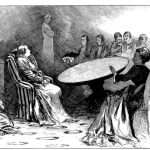
[W.Q. Judge and I] first met upon an occasion when H. P. Blavatsky was induced to try, in the presence of some reporters, if she could open up communication with the diaphanous remainder of a night watchman who had been drowned in an East River dock. Olcott was present, in command, prominent and authoritative, and Judge, in attendance, reserved and quiet. The spook was shy and the reporters sarcastic. The only one apparently annoyed by their humor was the Colonel. Mr. Judge’s placidity and good nature commended him to the liking of the reporters, and made a particularly favorable impression upon me, which was deepened by the experiences of an acquaintance that continued while he lived. In all that time, though I have seen him upon a good many occasions when he would have had excellent excuse for wrath, his demeanor was uniformly the same–kindly, considerate, and self-restrained, not merely in such measure of self-control as might be expected of a gentleman, but as if inspired by much higher regards than mere respect for the convenances of good society. He always seemed to look for mitigating circumstances in even the pure cussedness of others, seeking to credit them with , at least, honesty of purpose and good intentions, however treacherous and malicious their acts toward him might have been. He did not appear willing to believe that people did evil through preference for it, but only because they were ignorant of the good, and its superior advantages; consequently, he was very tolerant.
Connelly then tells us that he met Judge again in the 1880s while working as a correspondent in Venezuela: “I was not a little astonished when one day he appeared in La Guayra Venezuela where I happened to be as the attorney representing a mining company holding certain valuable concessions from the Venezuelan government […]He had come to straighten out some snarl the company had got itself into or secure it in some jeopardized rights.” It is likely that Judge is the “company’s agent” referred to in Connelly’s article, “A Land Of Follies And Sin,” from the August 30, 1881, issue of The New York Times.
Connelly and fellow (Theosophical journalist) David A. Curtis left their careers at newspapermen to join the Austin Corbin’s Arrow Steamship Company. It was a scheme in which Corbin planned on connecting the Long Island Railroad with a fleet of swift ocean steamers that would cut a day off the transatlantic trip. The company was going on with “small capital and large prospects.” Connelly joining the Executive Committee, while Curtis taking the position of Corresponding Secretary. They were in the business “up to their eyes,” but “were enthusiastic to a most enjoyable degree.” The New York Herald (the former employer of Connelly and Curtis,) soon made a tremendous attack on Arrow Steamship Co. with a series of damning articles which charged the company’s officers with being “conspirators,” “confidence operators,” and “swindlers.” This was a “very black eye for the company.” The company went under, and the former reporters found it difficult to go back into their former profession. In late 1888, they decided to take the Herald to court for libel, Curtis, and Connelly each sued for $50,000, while the company itself sued for a million. In the meantime, both men took work writing freelance articles for other publications like The Sun.
An article written by Connelly titled “Among The Dead” appeared in the December 1888 issue of The Path, marking one of his first overt Theosophical appearances. This was later republished in the February 1889 issue of Current Literature (along with Cincinnati Theosophist, Dr. Jirah Dewy Buck’s “The Planes Of Consciousness.) Weeks later, on January 14, 1889, Connelly joined the Aryan Branch of New York. In his capacity as a newspaperman, Connelly did much to promote Theosophical awareness in the media. He openly lauded Judge and the Theosophists in his June 1889 article announcing the arrival of the Swami Bhaskara Nand Saraswati (who later joined the Philadelphia Branch.) A month later, when Judge filed for incorporation for the Theosophical Society in New York, Connelly was named one of the fives trustees for its first year. Shortly after joining he engaged in was a joint-project with W. Q. Judge, a translation of Tukaram Tatya’s The Yoga Philosophy Of Patanjali (1885,) titled The Yoga Aphorisms Of Patanjali (1889.) Connelly and Judge were among the first in the West to make the connection between “Self-Culture” (“Physical Culture”) and the praxis of Yoga. To Judge, Self-Culture was really the “Culture of Concentration.” Connelly expressed a similar view: “Our very understanding of the significance of the words employed in conveying that knowledge must be remodeled. ‘Concentration’ does not at all mean, to us, what it does to the Hindu philosophers.” In his own words: “I say Theosophy taught me; but to be explicit, the exponent was William Q. Judge, which is, after all, the same thing to me, since the philosophy and he—the wisest and best teacher we have since H. P. B. is gone—are inseparable in my mind.”
Connelly’s works of fiction, meanwhile, infused with Theosophical themes, were popular within the movement and in the secular world alike. Stories like “Calling Araminta Back,” were published in The Path, and re-published in The World (New York.) Connelly would contribute over dozens of articles to The Path, Theosophy, and Universal Brotherhood (“A Dream Of Gold,” “Means To The End,” “What Is Electricity?” “Mahatmas,” “Supersensuous Planes And Mind,” “The Fourfold Lower Man,” and “Dangers Of The Psychical Plane,” to names a few.) He also delivered lectures on Theosophy as a member of the Theosophical Lecture Bureau. It was during this period that Connelly met Leon Landsberg, his co-translator of The Unknown Life Of Jesus Christ. Connelly leaves little record of his connection to Notovitch’s work, except a reply to, “G. H. S.,” who sharply criticized La Vie Inconnue De Jesus Christ in the July 2, 1894, issue of The Sun. Connelly writes:
To The Editor Of The Sun—Sir: Until further researches in Ladak and Thibet shall have determined the validity of M. Notovitch’s claim to discovery of an ancient Buddhistic memoir of Jesus Christ from his thirteenth year the genuineness of his work is, of course, open to discussion. It is foregone conclusion, owing to the magnitude of the trade interests involved, that The Unknown Life Of Jesus Christ will be venomously antagonized and denounced by those whose business it is to exploit the immaculate conception, the miraculous resurrection, and the vicarious atonement. Those for whom “ignorance is the mother of devotion” will be quite satisfied with the meagre information attributed to Luke, that Christ “was in the deserts until the day of His showing unto Israel.” But there is no good reason why faith sufficiently robust to go untrammeled by reason should assume a license for employment of misrepresentation and untruth to prejudice judgment. This is done by one “G. H. S.,” whose communication to The Sun concerning M. Notovitch’s discovery appeared in the issue of July 2. Professing, to be so informed by Mr. N.’s narrative, he says that Renan “advised him not to publish the work.” Such an inference cannot honestly be drawn from the author’s relation, which is as follows:
“M. Renan proposed that I should confide to him the memoirs in question, so that he might make to the Academy a report upon the discovery. This proposition, as may be easily understood, was very alluring and flattering to my amour propre. I, however, took away with me the manuscript, under the pretext of further revising it. I foresaw that if I accepted the proposed combination, I would only have the honor of having found the chronicles, while the illustrious author of the Life Of Jesus would have the glory of the publication and the commenting upon it. I thought myself sufficiently prepared to publish the translation of the chronicles, accompanying them with my notes, and, therefore, did not accept the very gracious offer he made to me.”
Again; “G. H. S.” represents that the author of the book (meaning the unknown Buddhistic compilers of the original manuscript) “claims to have written it on the basis of information furnished by Jewish merchants.” That which the manuscript itself is: “The merchants coming from Israel have given the following account of what has occurred.” This may at first glance seen small quibble, but is not so, for the difference involved is precisely that which might be expected between the interested and garbled reports of a race supposedly inimical to Christ and the impartially truthful account given by men of another race who were, by their religious belief, predisposed to a reverential and keenly sympathetic view of the “great and just Issa, in whom was manifested the Soul of the Universe.” M. Notovitch says upon this subject, in his résumé:
“In antiquity, as in our own days, the whole public life of the Orient was concentrated in the bazaars. There the news of foreign events was brought by the merchant-caravans and sought by the dervishes, who found, in their recitals in the temples and public places, a means of subsistence. When the merchants returned home from a journey, they generally related fully during the first days after their arrival, all they had seen or heard abroad. Such have been the customs of the Orient, from time immemorial, and are today. The commerce of India with Egypt and, later, with Europe, was carried on by way of Jerusalem, where, as far back as the time of King Solomon, the Hindu caravans brought precious metals and other materials for the construction of the temple. From Europe, merchandise was brought to Jerusalem by sea, and there unloaded in a port, which is now occupied by the city of Jaffa. The chronicles in question were compiled before, during and after the time of Jesus Christ. During his sojourn in India, in the quality of a simple student come to learn the Brahminical and Buddhistic laws, no special attention whatever was paid to his life. When, however, a little later, the first accounts of the events in Israel reached India, the chroniclers, after committing to writing that which they were told about the prophet, Issa,—viz., that he had for his following a whole people, weary of the yoke of their masters, and that he was crucified by order of Pilate, remembered that this same Issa had only recently sojourned in their midst, and that, an Israelite by birth, he had come to study among them, after which he had returned to his country. They conceived a lively interest for the man who had grown so rapidly under their eyes, and began to investigate his birth, his past and all the details concerning his existence.”
“G. H. S.” demonstrates a disingenuous purpose of conveying the false impression that these memoirs of “Saint Issa” belittle the character of Christ. This is shown most by the suppressions in what he pretends to offer as a condensation of the narrative. Christ’s tender and profound love for humanity and his devotion to truth and justice were first manifested when he was with the Brahmins, by his heroic and eloquent defense of that downtrodden and most miserable caste, the Sudras, over whom the Brahmins and Kshatriyas exercised merciless tyranny, for which they falsely professed to find justification in the Vedas. His six years’ study of the Vedas enabled him to disprove that claim, and, in contempt for their prejudices and defiance of their power, he preached words of comfort and hope of immortal life to the Sudras, teaching them that they, too, were children of and dear to the Heavenly Father. For that rebellion the Brahmins and sought to slay him, and to save his life he fled to the Buddhists. This magnificent and characteristic episode in his career “G. H. S.” hides beneath the misrepresentation—“he is not satisfied with cloister life, and he devotes himself to the Buddha Sakya-Muni. But as the people at preaching of Issa canst aside their idols, the priests became angry at him. However, the people cling to him and the priests compelled to flee. After this Issa goes to Persia,” &c.
Now that representation of concatenated events can hardly be regarded otherwise than as intentionally mendacious. It assigns a false reason for his leaving the Brahmins and it conveys by clumsy implication a slander upon the Buddhist priests. The chronicle relates:
“When the just Issa had acquired the Pali language, he applied himself to the study of the sacred scrolls of the Sutras. After six years of study, Issa, whom the Buddha had elected to spread his holy word, could perfectly expound the sacred scrolls. He then left Nepaul and the Himalaya mountains, descended into the valley of Radjipoutan and directed his steps toward the West, everywhere preaching to the people the supreme perfection attainable by man […] When the divine Issa traversed the territories of the Pagans, he taught that the adoration of visible gods was contrary to natural law.”
More evidences of the dishonesty of this correspondent could be cited were they needed, but enough has surely been shown to disqualify him from sitting in judgment upon the good faith of M. Notovitch.
A religious journal in St. Louis hotly gasps that this hook (The Unknown Life Of Jesus Christ) will feed the fires of atheism and infidelity, which is bigoted nonsense. It may be bad for the quality of faith that has been defined “a faculty of the mind which enables us to believe that which we know not true,” but it will be welcomed by those capable of seeing the gold of truth, even under the mire creed. The Buddhistic life of Saint Issa (Jesus Christ) in no degree detracts from the most exalted idea any one can rationally form of the character of the sublime Jewish reformer in whom the chroniclers of these memoirs saw as an incarnation of the divine spirit. That it does not support dogmas invented as pillars of a faith long after it was written may perhaps sadden or enrage the dogmatists, but, unhappily for them, history deals with facts that have been, not fancies which are yet to be.
J. H. Connelly.
New York, July 6, 1894.
LEON LANDSBERG
Leon Landsberg was born in the Russian Empire in 1853. Of Jewish birth, it was said that he was a “staunch supporter of the Hebrew religion.” A linguist of unusual attainments, he attended university in Paris and Leipzig and could translate from seven languages. He arrived in America in 1882, and lived for some time in Cleveland, Ohio. In July 1884, Landsberg went to Memphis, Tennessee, “with the best of recommendations,” to work as a language instructor teaching German and French using the Toussaint-Langenscheidt method. He was already acquainted with the leading members of the Jewish community here, and was well-known to Dr. Max Samfield, a forty year old German Rabbi. Samfield came to America in 1867 at the invitation of Congregation Bnai Zion in Shreveport, Louisiana, where he played a key role in the construction of a new synagogue for the community. In 1871 he was elected Rabbi of Congregation Bnai Israel of Memphis where, in 1884, he was also privileged to dedicate a new house of worship. Although small in numbers, the Jews of Memphis were highly visible, and played an important role in the history of the city. Samfield and his congregation were community activists who were honored by fellow Memphians for their “eleemosynary, cultural, and literary contributions.” In 1885 Samfield established The Jewish Spectator, one of only two Jewish publications in the South. That same year, Landsberg tried his hand at writing for the local papers. (One of his first articles, which appeared in a December 1885 issue of The Memphis Daily Appeal, was about the Laotian girl, Krao Farini, a side-show performer who was born with hypertrichosis.)
In March 1887, Landsberg moved to Atlanta, Georgia, where he continued teaching German and French. That summer, he relocated to Nashville, Tennessee, accepting a position at the Woolwine High School. He was compelled to give up his position early in 1888, “because of his anarchistic expressions.” He then moved to Birmingham, Alabama, where he taught German at a public high school. He also took up the job as the editor of the Birmingham branch of Anzeiger Des Sudens (“Advertiser Of The South,”) a German weekly based in Nashville. Not long after he arrived, his anarchist sympathies landed him in another controversy. A meeting was held by the German Society of Birmingham, after Kaiser Wilhelm I of Germany died on March 9, 1888. Landsberg, and the society’s President, E. Lesser (both ex-subjects of the Tsar,) denounced the late Kaiser “as an enemy of the Socialists of Germany.” Lesser was made to resign, and both men were labeled as being Anarchists. The Board Of Education subsequently put Landsberg on leave as they investigated the matter. The Germans of the city wanted it to be known that they did “not endorse any of the Socialistic utterances of the two men.” Landsberg resigned from his post in April to avoid expulsion.
He continued his work as editor of various German newspapers in the South. (During this time, he was an advocate of the “Elixir Of Life,” a concoction developed by Dr. Charles-Édouard Brown-Séquard which promised restored vitality and sexual prowess.) In March 1890, Landsberg joined the Theosophical Society as a member-at-large. The movement had yet to make any considerable inroads in the South, and there was no local Branch to join. That would begin to change, however, later that summer. At the end of May, Landsberg traveled to Memphis, where he was warmly greeted by Max Samfield and his old friends. Around the same time, Carl F. Redwitz, the former President of the Krishna T. S. (Philadelphia) moved to New Orleans. In the summer of 1890, Redwitz sent an application to charter a new Branch, the Vyasa T. S. It would be the first Branch of the Theosophical Society in the South. A charter for the second Branch of the South, the Siddhartha T. S. of Vicksburg, Mississippi, was issued on November 15, 1890. On December 10, 1890, a Branch charter was issued for the Memphis T. S., the third Branch of the South. Samfield, who joined the Theosophical Society on December 12, was the President, and William H. Hotchkiss was the Secretary.
In February 1891, F. Schrank, manager of the Deutscher Zeitung, filed an affidavit charging Landsberg with mail fraud, with designs on stealing his paper’s secrets. The matter was soon dropped, however, as there was not enough evidence to pursue the case. Weeks later, Landsberg was arrested for his alleged involvement with a New York firm, E. H. Horner & Co., who ran an illegal lottery scheme through the mail. That August, he returned to Nashville, where he secured a position as teacher of modern languages at Belmont College. It was here that Lansberg published his piece, “What Theosophy Is,” in the October 5, 1891, issue of The Nashville American. This may have been connected with the Theosophical Society’s “Press Scheme” of the American Section. The November 1891 issue of The Path states, it was “devised and carried on single-handed by a most devoted Theosophist, ‘F. T. S.,’ whereby short articles on Theosophy and Theosophical news are secured publication in a large number of newspapers all over the country.” Landsberg then contributed a series of Theosophical articles, “The Soul, Immortality, And Reincarnation,” for The Nashville American beginning December 1891. W. Q. Judge states, it “produced such sensation through Tennessee.” (One local commenter noted, however, that Landsberg was an “intelligent crank.”) Days after the conclusion of Landsberg’s series, a series of articles appeared in The Nashville American titled: “Jesus And The Christ.” The author only gave the name “Fellow Theosophical Society,” and stated he belonged to New York’s Aryan Branch. Perhaps it was just Landsberg adopting that moniker, and aligning himself with the Aryan Branch which, in a few months later, he would join. In July 1892, Landsberg left the South and moved to New York. Here his Theosophical articles were published in New York’s great German daily, the Staats Zetung. They also appeared in other German American papers, like Die Westliche Post (St. Louis, Missouri.) “Another main tenet of Theosophy is so-called karma,” Landsberg writes, “a moral expression for which we have no equivalent in German, and which can be best be understood as ethical causal law.”
An active member, he presented a collection of fourteen occult books to the Reference Library of Aryan Hall, the New York Headquarters at 144 Madison. As a lecturer, he spoke on Theosophical topics at the Aryan Branch, Brooklyn Branch, and Harlem Branch. This is where he likely met James H. Connelly, as they were both involved in the Theosophical Lecture Bureau in early 1893. Before long, Landsberg was on the staff of The New York Tribune, working as both a special writer and librarian.
In February 1893, Alexander Russell Webb, an old member of the Theosophical Society the Pioneer T. S. (St. Louis,) arrived in New York after to establish a journal called The Moslem World and make the first attempt to “convert America to Islam.” In 1885 was sent by President Grover Cleveland as Consul to Manila, Philippines. While there, Webb, his wife Ella (a fellow Theosophist,) and their children, converted to Islam. He subsequently resigned from his post to take up missionary work for his new religion. Before returning to America, Webb paid a visit to Olcott in India and told him about his plans. Judge invited Webb to give a public address on “Theosophy In Islam” at Aryan Hall on March 7, 1893. It was the first talk was on Islam hosted by the Society in New York. That autumn, when Webb established his “Muslim Headquarters” at 458 W. 20 Street, Lansberg was among those who lectured there. During his talk in October 1893, Lansberg “spoke of the morality, the honesty, and sobriety illustrated in the everyday life of the Mussulman.” It is likely that Webb developed his interest in Islam when a circular for the book Barahin-e-Ahmadiyya by Mirza Gulam Ahmad (founder of Ahmadiyya Islam,) was published in the September 1886 issue of The Theosophist. Though Webb did not meet Mirza Gulam Ahmad in India, they corresponded on matters of faith in letters for many years. Mirza Gulam Ahmad was aware of Notovitch’s works and believed that Jesus spent his early years in Ladakh, as indicated in his articles in the Ahmadiyya journal, Review Of Religions. This notion would be expanded in Ahmadiyya theology, as Mirza Gulam Ahmad would teach that Jesus (Īsā) survived the crucifixion, returned to India, lived a long life in Kashmir, and was buried in in Srinagar.
In June 1894, Landsberg and Connelly’s edition of The Unknown Life Of Jesus Christ was published by G. W. Dillingham. The Sun dedicated four columns to work. As The Path noted in its review of the work, Landsberg and Connelly were “both New York F. T. S.” It added, with pride: “That this remarkable work, possibly destined to create a great change in theological thought, should have been first brought within English reach by Theosophists, is pleasant to their brethren.”
In 1895, E. T. Sturdy, a former member of the Esoteric Section of Theosophy, helped facilitate the arrival Swami Vivekananda in America. Judge noted in a letter from that time, that “the sly fellow [Vivekananda] is now smashing at Theosophy.” As Vivekananda himself stated: “Any suspicion of my connection with the Theosophists will spoil my work both in America and England, and well it may.” He added. “[Theosophists] are thought by all people of sound mind to be wrong, and true it is that they are held so, and you know it full well […] I do not want to quarrel with the Theosophists, but my position is entirely ignoring them.” Landsberg, however, became a disciple of Vivekananda, and was compelled to change his name to “Swami Kripananda.” Needless to say, Judge was not pleased with this turn of events.





 Ad-Free & Subscriber Log-In