

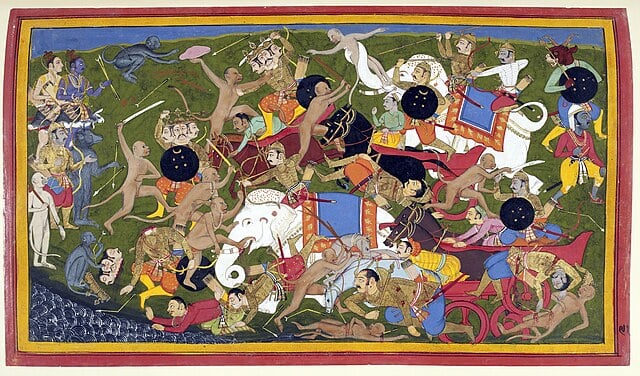
from the Ramayana
Sahib Din
1649-1653
(At the recent Empty Moon Zen Saturday Zazenkai, Dharma Holder Mo Myokan Weinhardt gave the dharma talk on the koan “Stop the war.” I asked her if I could reprint it at my Monkey Mind column, hoping to see it get the wider readership it deserves. She graciously consented. )
Once, many years ago when Tom and I were living in the Bay Area, we went to sit one evening with David Weinstein Roshi’s Rockridge Meditation Community. After getting reasonably far into one or two periods of zazen together, David’s voice rolled quite suddenly through the zendo and into the depths of my mind:
“Stop the War. Stop the War,” he repeated slowly.
At the time, I was deeply upset that he’d dropped something into my zazen like that. To be honest, it felt invasive and inappropriate. It was my first time with that community, and the experience caught me completely by surprise.
And, to this day, I have to admit that it’s one of the most profound koan I’ve ever encountered.
I invite you to take a moment to turn this over in your heart-mind — to soak in its meaning from different angles and perspectives:
Stop the War.
Consider, what could this mean for how you engage with yourself? …for how you engage with others? How you engage with ideas, beliefs, or situations that you find ignorant? …or worse yet, abhorrent? What might it mean for how you’re encountering this very moment?
Given the deeply divided, chaotic state of our world — which weighs heavily on me, as well as every single person I’ve spoken with recently — I’ve been reflecting a great deal on what this koan means; and to go a step further, what it means to walk a path of peace.
This has challenged me for a long time, much longer than I care to admit — and I know I’m not alone.
This isn’t actually what I set out to discuss in this dharma talk, but in trying to write something coherent and meaningful, this is what emerged. To be clear, whatever I say here is not coming from place of having sorted this conundrum out; this is more of a “sharing where I am in this endless fucking struggle” sort of talk. The “wiping mud and blood off my face and just trying to take another step, thanks for helping me up” sort of talk.
I may have managed to duct-tape all of this together okay enough for today’s zazenkai, but let there be no question — I am still deep in trying to figure this out for myself. It’s a moving target, and I have no answers. All I can say is that I’m committed to holding and exploring all sides of this koan. How to stop the war; how to remain endlessly curious as I continue to discover the shape and meaning of my own path of peace; and I’m committed to sharing what I learn as I stumble along, in the hope that with each other’s help and support, we may all grow in wisdom together.
But no promises 😉
***
So, what exactly is a ‘path of peace’?
So, what exactly is a ‘path of peace’?
The first thing that came to my mind is that any path of peace must be firmly rooted in love and compassion. And while I do believe that’s true, upon further reflection, it felt incomplete.
“Love and compassion” are nice, flowery words. But it’s easy to hear them as cliche sentiments; to roll our eyes and judge folks who talk like that as kumbaya, flower-twirling hippies who naively believe that “All we need is love.”
And in some ways, there’s truth to that cynicism. In this often harsh, unrelenting, batshit crazy world of form, love and compassion as mere sentiments — as warm, fuzzy feelings — are entirely useless. They’re not enough. Walking a path of peace doesn’t rely on “good vibes.” In fact, it has nothing to do with the substance of our feelings at all.
But… Love as a verb? Love as an intentional practice of ‘not one, not two’? As the very fabric of emptiness itself, permeating every iota of this madly interdependent world? That’s a different proposition altogether.
Walking a path of peace through these dark and broken roads requires much more of us than warm, fuzzy feelings. To walk such a path through a world that is anything but peaceful, means prioritizing how each of us cultivates our internal landscape first and foremost. It all starts and ends with this <point to heart>. And it requires grit. Awareness. Resilience.
Thankfully, we don’t have to completely reinvent the wheel here. There are many people who’ve modeled different versions of living this path; but first, I want to offer a different koan from The Blue Cliff Record I’ve been sitting with — one that goes right to the marrow of this entire struggle.
Case 43: “Tozan’s No Cold or Heat”A monk asked Tozan, “When cold and heat come, how can we avoid them?”Tozan said, “Why don’t you go to the place where there is no cold or heat?”The monk asked, “What is the place where there is no cold or heat?”Tozan said, “When it’s cold, the cold kills you; when it’s hot, the heat kills you.”
You can almost hear the astonishment in the monk’s voice here. What is this magical place you speak of, where there is no cold or heat? Beyond our constant picking and choosing? Where can we go to escape these difficulties? How do I get there?!?
This monk is speaking directly to the heart of the human condition.
And in our batshit crazy world, this monk’s question is also our question: How can I avoid the things I don’t want to experience? The things I don’t want to be true? How can I avoid all of this heartbreak, injustice, fear, and suffering?
But Master Tozan suggests a radically different path. He says if it’s cold, let the cold kill us. If it’s hot, let the heat kill us. But don’t be fooled — he’s not talking about physical death here.
What is it exactly that’s being killed?Over the years, we’ve each developed countless ways to strengthen our defenses, guard ourselves from perceived threats, and insulate our hearts from fear and suffering. But instead of thrashing against the things we don’t want to experience — instead of raging and protecting ourselves from whatever we’re clinging to or trying to push away — Master Tozan is inviting us to lay down our armor completely, and be intimate.
Intimate with our thoughts, fears, and feelings. Intimate with our suffering, with our own tender hearts. Intimate, and curious, with all that we’d rather avoid.
Stop the War.
This reminds me of Pema Chödrön, who teaches a concept called “Maitri.” A Sanskrit word, Maitri is literally translated as a kindness or benevolence toward all beings that is free from attachment — also known as ‘loving-kindness.’
Now on the surface, this might sound like yet another flowery sentiment. According to Pema however, who defines Maitri as ‘unconditional friendliness with oneself’, it means having an unbiased relationship with all the parts of your being — creating intimacy with all those parts of ourselves, (and thus those parts of others), that we generally don’t want to touch.
In a brief excerpt from her article, Turn Your Thinking Upside Down, Pema says:
“Becoming intimate with pain is the key to changing at the core of our being — staying open to everything we experience, letting the sharpness of difficult times pierce us to the heart, letting these times open us, humble us, and make us wiser and more brave. Let difficulty transform you. And it will. In my experience, we just need help in learning how not to run away.”
When it’s cold, let the cold kill you; when it’s hot, let the heat kill you.
The circumstances causing you pain may not be your fault, and you don’t have to like or condone it. But — we do have to take responsibility for how we respond to the cold, to the heat, and to everything in between.
You see, fault and blame are just other forms of armor. I’ve heard it said — most famously by the actor Will Smith — that fault and responsibility don’t actually go together. It sucks, but they don’t. For example, it’s not somebody’s fault if their parents were abusive, or if their partner cheated and ruined the relationship; but it is their responsibility to figure out how to face that pain so it doesn’t spread, or create rot; how to compost those traumas into some kind of fertilizer that can cultivate healing and compassion.
When we focus on whose fault the “heat or cold” is — whether it’s our corrupt government, a stranger who causes harm, an awful boss, our parents, our past — we’re just trying to build a wall between ourselves and the anger, the discomfort, or whatever it is we’d rather avoid. And as long as we’re pointing a finger of fault, we remain stuck in some kind of righteous victim mode.
Like I said, fault and responsibility don’t actually go together. Not when it comes to our hearts; not when it comes to our actions.
Responsibility is the act of dropping the blame; facing the heat fully, just as it is; and then, to the best of our ability, responding with intention — instead of reacting unskillfully.
Stop the War.
It may not be our fault that the world is on fire, but it’s for damn sure our responsibility to decide how we’re going to inhabit that heat. This is what moves us out of victim mode — out of our narratives and armor and reactivity — and back into presence, choicefulness, and agency.
Peace is a skill that we develop across our lifetime. It’s a commitment to discerning what uprightness and ethical conduct mean in the context of our messy lives, moment by moment; and — spoiler alert — we are sure to fall short again and again. But, just as we return to our breath in zazen, we return to this commitment to Love and Compassion as verbs — living this commitment for ourselves, and living it for all beings. No separation.
This is how Buddha carries out Buddha’s practice through us.
***
But this path isn’t just about our individual practice and resilience. It’s about how we inhabit the fire together.
One example of this is the recent Buddhist Walk for Peace — a 2,300-mile pilgrimage across the United States. Organized by 24 monks from the Theravada tradition, they walked for 108 days (the same number of beads found on our malas) from Fort Worth, Texas to Washington DC, accompanied by a rescue dog from India named Aloka.
Importantly, the monks emphasized that this was not a protest; not a parade; this was not some ceremony of faith. In their own words, it was “…a journey to bring blessings to countless lives in a world filled with uncertainty and restlessness.”
They intended this pilgrimage to demonstrate that true peace arises when the mind is free from the three poisons of greed, hatred, and delusion — a truth that transcends religious boundaries. As Bhikkhu Paññakāra took care to remind participants: “Peace is not a trophy we find at the end of 2,300 miles; it is the path we cultivate under our feet with every breath and every step.”
***
But this type of collective, upright action is not limited to religious devotees. Far from it.
Just a couple of weeks ago on March 24th, Palestinian and Israeli mothers joined their hands, voices, and hearts in an event called the Barefoot Walk: Mothers’ Call for Peace — a powerful, intimate demonstration of unity and urgency; part of a larger global initiative demanding that the voices of those who give life be heard by those who are taking it.
In an ongoing conflict where ‘fault’ and ‘blame’ are a thousand-year-old language, these women instead are choosing love and responsibility — walking barefoot together through the streets of Rome, calling for peace, an end to violence, and protection for all children, who deserve safety, dignity, and a future free from fear.
These mothers laid down all of their armor. Holding hands, they let the heat of their shared grief over the war, violence, and murder taking place in Iran, Palestine, Lebanon, Israel, and throughout the Middle East — they let the heat of their shared grief melt away all imagined barriers of nationality and religion. By refusing to indulge in the three poisons, and instead committing to unity and discerning uprightness for themselves, these women demonstrated the absolute verb of Love. And in so doing, they became a sanctuary for one another — and a sanctuary for us all.
***
So, again, what exactly is a ‘path of peace’? It seems to take many shapes and sizes.
I have profound respect for the monks and the mothers who made their calls for peace in community, with utter sincerity, and by literally walking together in highly public and heartfelt ways. They’re inspiring.
And, if I’m honest, big examples like these bring up my own judgements and criticisms about myself — thoughts that anything that I do isn’t good enough. Isn’t big enough, or important enough. But these are common delusions. I try not to take thoughts like these seriously. They’re just the off-gassing of my fragile ego, and entirely miss the point.
We cannot possibly fathom how much the work we do to practice peace within can shine light and heal those around us. This is Buddha carrying out Buddha’s practice through us.
Like I said at the beginning, walking this path doesn’t rely on “good vibes.” It has nothing to do with the substance of our feelings at all. Just another opportunity to Stop the War.
We each must continually discern for ourselves how best to cultivate love and compassion as verbs. With every breath, and every step, an endless ocean of opportunity.
Walking such a path through a world that is anything but peaceful, starts and ends with this — and we must not allow external forces — all of the batshit crazy we encounter — to define our internal landscape.
This requires grit. Awareness. Resilience. And intimacy.
We cannot do this alone, and no one else can do it for us.
As you practice, I encourage you to awaken to the self that is part of all things, and realize that a part of all things is also your very self. The best of us, the worst of us, and everything in between. Our great invitation is to embrace this ‘not one, not two.’ Nothing is left out.
Because we share these broken roads; these bright and unblemished roads; I encourage us all to continue discovering and practicing the skill of peace — aiming to temper our reactivity with presence, choicefulness, and agency.
The more armor we lay down, the more capable we are of letting these times open us, humble us, and help us become wiser and more brave.
I’m still very much stumbling my way through all of this. But one thing I can say is that my path of peace begins with intimacy.
This is the ground on which I choose to stand.
Our great invitation is to let difficulty transform us.
May we help each other learn not to run away, and have the courage to walk this path together — upright, barefoot, and open-hearted.
Thank you, Bodhisattvas.











 Ad-Free & Subscriber Log-In