

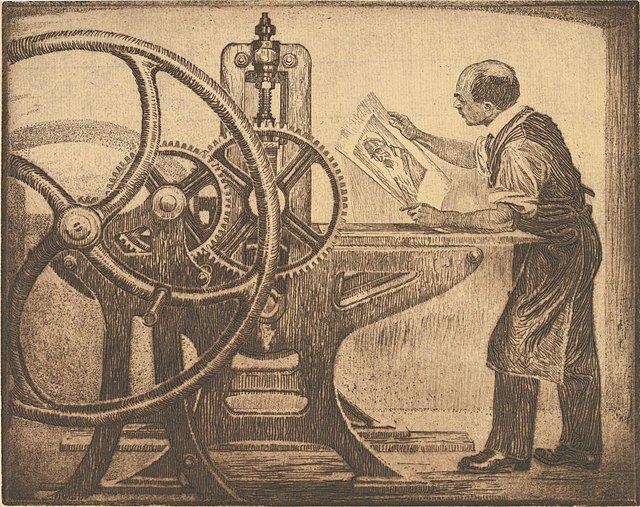
Ephraim Moses Lilien
early twentieth century
Nineteen years ago on the 5th of September, 2006, at 12:53pm (Eastern time), I posted my very first Monkey Mind blog post.
It was a Gary Snyder poem.
Lew Welch jut turned up one day,
live as you and me. “Damn, Lew” I said,
“you didn’t shoot yourself after all.”
“Yes I did” he said,
and even then I felt the tingling down my back.
“Yes you did, too” I said — “I can feel it now.”
“Yeah” he said,
“There’s a basic fear between your world and
mine. I don’t know why.
What I came to say was,
teach the children about the cycle.
The life cycles. All the other cycles.
That’s what it’s all about, and it’s all forgot.”
Gary Snyder Axe Handles
(San Francisco, North Point Press, 1983: p 7)
I was still in the parish ministry, serving the First Unitarian Society of Newton (in Massachusetts) and I was about to begin a sabbatical. I didn’t know it at the time, but it would be the only sabbatical of my ministerial career. Colleagues told me that it would be nice to keep in touch with the congregation, the people who were footing the bill. Most of whom would never see a sabbatical themselves. It seemed a reasonable idea at the time.
Another colleague suggested perhaps trying to start up a blog. It was becoming a thing in that moment.
I liked the idea. There were even free sites that one could use. I checked out several and settled on Blogger. For a name I decided to use the title for my church newsletter column. Itself chosen way back in 1989 when I was doing my parish internship at the First Unitarian Church of San Jose. They informed me I was writing a column and they wanted the title right then.
Monkey Mind immediately came to mind. It’s a Buddhist term for the mind that jumps around like a monkey.
It has stuck all these years…
My first impulse was sort of a day book. The same day I offered a second post. At 3:25pm I added a poem from the Unitarian minister and poet Lynn Ungar.
When Moses met God on the mountain
the first thing the Divine spoke of
was shoes. How are we to interpret this?
Where do you find God when
you have no mountains? Some say just
stand in the lowlands and call,
but you must be willing to take
whichever god might answer.
“Whoever would save his life
will lose it,” said the prophet,
who was harsh, but never cold.
Once, driving across the steaming
lake, something beckoned, but I
was too impressed by the possible
to follow. Sometimes, in the
low light it haunts me. It will
share neither face nor direction.
It mutters through its hot breath
something that sounds like “shoes.”
When I gave up high heels I heard
it fluttering around the window
for a month. Some nights I think
I will live into this obsession. Go
barefoot long before spring.
Some nights the voice blows in
from the Sound:
“Take off what binds you.
You are standing on holy ground.”
Lynn Ungar Blessing the Bread: Meditations
(Boston, Skinner House Books, 1996: pp 41-2
The next morning I kicked off with a quote from Joan Halifax.
Spirituality is difficult for us to touch because it flows to and from the invisible, fromlove and the mystery of death. It comes out of the “meltdown” that we know as love and compassion and the surrender that we know as death. It flows from the ground of our relationship, not only between human beings, but also between all beings, including mountains and rivers. It is often born from suffering, and it evokes within us compassion, which allows us to see through the eyes of innumerable beings.
Joan Halifax A Buddhist Life in America: Simplicity in the Complex
(New York, Paulist Press, 1998: pp 44-5)
I suspect this foreshadowed that while the old monkey mind would bounce around, it would also usually return to the issues of spirituality and religious life from a somewhat eclectic, broadly Unitarian Unitarian but also deeply informed by a Zen Buddhist perspective.
 Just before 10am I wrote my first original posting. In it I outlined the upcoming sabbatical and how I’d been offered a minister-in-residence fellowship at Meadville Lombard, our Unitarian Universalist seminary in Chicago. It came with an apartment and a very modest stipend.









 Ad-Free & Subscriber Log-In