

Lately, I’ve been particularly pissed off about my chronic pain. I’m still working to even understand myself as disabled and have realistic expectations of my daily energy. My field isn’t littered with job openings, and promising interviews haven’t turned into paid bills, but I’m terrified of having an offer. The wall of undeniable rest has hit, and capitalism demands I find a way through.
But it’s hard not to be mad. Another day of pain feels like another reminder of the things I try not to ruminate on—problems mainly grounded in capitalism, even more so than some of the foundational limitations of my disabilities. Recently, I’m feeling like I learn a new way my hypermobility is screwing with me (most recently, that the cold weather is medically making everything worse even more than I already assumed!)
When I hit the impossible, I find the impossible: religion, the spiritual, the divine. The Catholic in me craves the specificity of a saint, intercession based in dedication of specific care, someone who bridges the spaces between my human specifics and dedication to Christ, who knows human embodiment.
So, with the power of Google, I looked for patron saints related to my disabilities. I found multiple, but one has spoken to me as I consider the seasonality of my body. She is a 15th-century sufferer of chronic pain named St. Lidwina.
St. Lidwina’s Early Life
St. Lidwina was born in Schiedam, Holland, to a poor nobleman married to her poor commoner mother. She was already living a life of devotion from a young age, before the moment that would later color her lifelong dedication to Christ. St. Lidwina was particularly drawn to Mary. She prayed frequently, slipping into the church to pray a Hail Mary when sent on errands by her mother. She was also said to pray whole nights over the miraculous image of Our Lady of Schiedam.
By the age of twelve, despite her father’s desires to eventually marry her off, she made a vow of virginity. By age fifteen, she would suffer the beginning of the health problems that would characterize the rest of her life. According to legends, Mary revealed to St. Lidwina the suffering that she would experience due to the coming misfortune and promised to sustain her through the pain.
St. Lidwina’s Chronic Pain and Illness
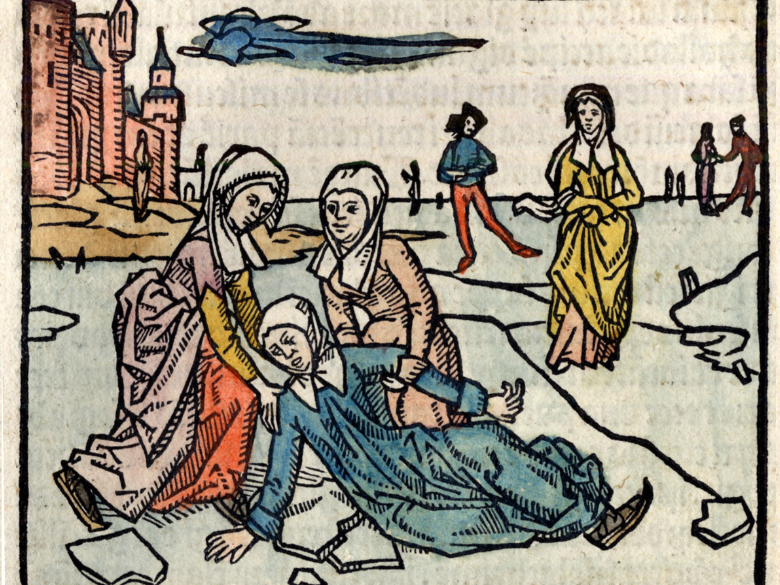
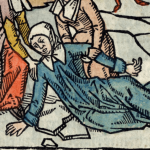
After recovering from a period of sickness in her youth, St. Lidwina went ice-skating with friends. During this outing, St. Lidwina suffered a fall that would catalyze multiple painful lifelong conditions. She broke a rib that would not heal, developed an internal abscess, and developed gangrene that would spread through her body. She became bedridden for most of her life.
Additionally, St. Lidwina developed blindness in one eye and sensitivity to light in the other. She experienced extreme pain in her right shoulder when she would attempt to lift her left arm, so much so that it rendered the arm immobile. She would also develop difficulty swallowing solid foods and later liquids.
St. Lidwina is sometimes considered the earliest case of multiple sclerosis, though the nature of hagiography and history in general complicates any evidence regarding this theory. Despite these difficulties, aspects of her life may indicate she suffered MS symptoms alongside the complications related to her fall.
It is possible that the reason she fell and suffered her abscess was weakness caused by the first development of MS symptoms. The pains she experienced upon her fall could be trigeminal neuralgia, a chronic pain condition that causes intense, shocking pain on one side of the face, often caused by the damage MS does to nerves.
Miracles and Sainthood
St. Lidwina’s miracles involved healing the sick who visited. She also experienced ecstatic vision, encountering Heaven and Purgatory, participating in the Passion, and being visited by saints.
Hagiographies reported that the only food that sustained her in her last 19 years of life was the Eucharist. An official document dated 12 years before her death stated that at that time, she had not had anything to drink for seven years.
St. Lidwina would have her final vision on Easter Sunday, 1433, in which she received the Last Rites directly from Jesus before her death. Pilgrimages began almost immediately. In 1890, St. Lidwina was canonized by Pope Leo XII, in confirmation of the already existing devotion.
Alongside her role as a patroness to those experiencing chronic pain, chronic illness, and all sick persons, St. Lidwina is invoked as a patroness of ice skaters and skating.
Disability, Faith and Chronic Pain
St. Lidwina found comfort in accepting her pain as Mary accepted God’s will, understanding herself to submit to it willingly for love of God. In this way, she reclaimed her pain as a voluntary act and offering—she rejected the idea of even being healed miraculously. She chose to make the pain something that she would not rid herself of if she could, an integral part of her experience, and took control over it.
In understanding her pain as voluntary, taken on as a kind of alms for others who suffered, to relieve them of their suffering, she chose to make her life more difficult, such as by sleeping on a bare straw mat. For all the discomfort of ye olde Catholic disability porn, St. Lidwina also represents radical acceptance of her circumstances, and the ability to find meaning and comfort through the exercise of autonomy.
The Incarnation, Pain and Humanity
St. Lidwina spent a great deal of her life meditating on the Passion, and in remembering this, I remember that the pain is integral, but not good. It is precisely for the alleviation of suffering that Christ must undergo it, and it is precisely because suffering is foundational to the human experience.
For St. Lidwina, imitation of Christ in a voluntary taking on of this pain, an unavoidable reality, unevenly allotted, she mirrored an act of divine empathy. Humanity is saved through not only the omniscient understanding and all present love of God, but in finding dignity within a visceral, lived, undignified experience of life on earth.
In turning to her, that’s what I try to remember in the face of the truth that I will just hurt, a lot, for the rest of my life. And that that is part of life, even if we don’t all get a fair allotment, and our world makes it hurt more than it needs to. That I can be angry and move beyond the moments of bitterness rather than live in them. That Jesus knows my hurt not in omniscience, but in body, somatic reality. He knows the pain, and doesn’t ask us to pretend it doesn’t hurt.



 Ad-Free & Subscriber Log-In