

Poland’s most visited shrine houses Poland’s most revered icon, a Byzantine-style image of the Mother Mary known as Our Lady of Częstochowa. Oft called the Black Madonna of Poland, she is an example of an entire genre of images known as Black Madonnas. She is housed in the Jasna Góra Monastery in Częstochowa under the care of the Paulite community.
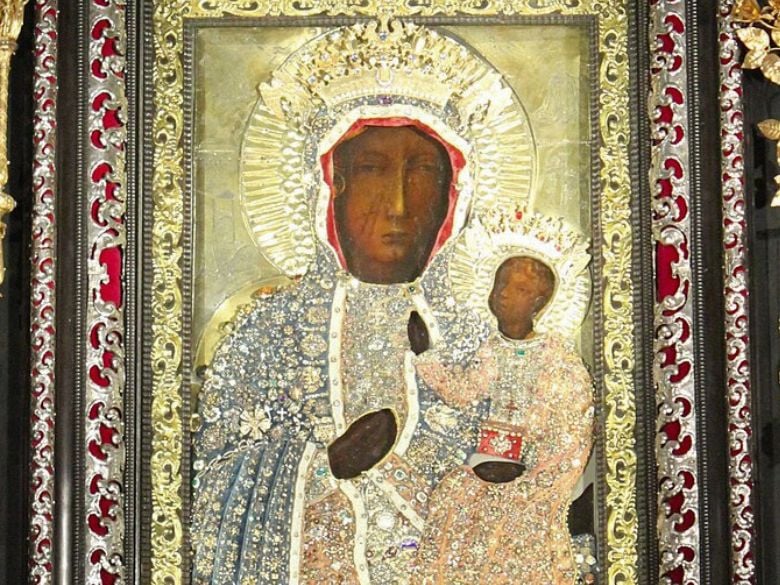
She is not the only Black Madonna of Europe whose skin tone has caught popular and academic interest. Throughout southwest Europe, dark-skinned depictions of the Mother Mary are found.
In recent years scholars and the public alike have been reexamining the presence and role of Black and brown people in European history. Modern encounters with European Black Madonnas prompt us to consider what skin tone means to Christian worshipers in the past and present.
What is a Black Madonna?
When discussing Our Lady of Częstochowa, we are discussing a historic tradition of dark-skinned icons. Simply, a Black Madonna image is a statue or painting of Mary and the Christ child in which both are depicted with dark skin. In discussing Black Madonna images, we must be aware that Capital “B” Black and black are not necessarily the same.
Throughout the world, there are dark-skinned depictions of the Black Madonna to be found. Recent depictions who are Black in a modern sense include Larry Scully’s Madonna and Child of Soweto, Our Lady of Austin sculpted by Jim Thomas, and the works of Boston artist Allan Rohan Crite.
Madonna and Child of Soweto
Soweto’s Mary represents her own community. Even in Africa, this can’t be taken for granted. Immaculée Ilibagiza describes the images of Jesus that accompanied Kinyarwanda-language Bibles as, “a white man with beautiful blue eyes and long, blond hair”. *Immaculée Ilibagiza with Steve Erwin, “Led by Faith: Rising from the Ashes of the Rwandan Genocide”, Hay House, Carlsbad: 2008, p.113
The depiction, titled by the artist “The Madonna and Child of Soweto” was dubbed “Black Madonna” by her community. Commissioned by anti-apartheid newspaper The Star in 1973 Johannesburg for a fundraising effort, it was purchased by Harry Oppenheimer then donated to the Regina Mundi Church where she is housed. The church hosted much anti-apartheid activity until apartheid’s official end in the 90s.
She bears the marks of the battle against apartheid in scars on her face given by police who stormed the church during the 1976 student uprising; several occupants of the church at the time were killed. Despite ultimately being of a different category of “Black Madonna” than the European counterparts we will discuss, this piece of her history is particularly reminiscent of Our Lady of Częstochowa.
Black Madonna, Our Lady of Austin
Our Lady of Austin, titled Black Madonna, was created much more recently in 2005. Thomas, with the bronze statue, created a Madonna the represents the primarily Black congregation of Holy Cross Catholic Church. Holy Cross, like the congregation in Soweto, has a history of challenging deeply rooted racism and promoting “Social Justice Ministry”.
Thomas, a white man, was commissioned to create a Black Madonna for the church based on photographs provided by the church. The omission inspired him, according to an article on his website, to research the historical tradition of Black Madonnas for himself and makes specific reference to Our Lady of Częstochowa. The article also notes the widespread interest in the Black Madonna, stating “Thomas was surprised to find 26,000+ Internet sites on The Black Madonna”.
The Black Madonnas of Allen Rohan Crite
Devout Episcopalian and artist, Allan Rohan Crite, created dozens of images of a Black Madonna that exalted in particular Black mothers in his community in Boston. An exhibition titled Visions of Black Madonnas held at the Gardner Museum paired these works with their artistic inspiration Black Glass Madonna, a lampworked Black Madonna from the 1500s that Crite visited frequently at the Gardner.
The older piece was made by Venetian glass-makers in Innsbrucker Hofglashütte of Archduke Ferdinand II of Austria and likely modeled off the older Our Lady of Loreto. Our Lady of Loreto is a traditional Black Madonna that shares a historical legend that closely resembles that of Our Lady of Częstochowa.
These Black Madonnas are examples of inculturated Madonnas, artwork made by (often) Black artists for Black people. These images highlight the universality of the salvatory miracle and challenge understandings of race that would reject the commingling of divinity and Blackness. And, of course, it can’t be lost that these dark-skinned depictions are close in complexion to what we might expect of the historical Mary and her son.
The Black Madonna Tradition
When discussing Our Lady of Częstochowa and the tradition she belongs to, we are discussing a historic artistic tradition of dark-skinned icons. Black Madonnas in this traditional sense are images of a certain prominence that have dark-skinned or darkened complexion. These images are of mainly medieval origin and frequently in a Byzantine-style; in some cases their legends date them as Byzantine era icons in contrast to the medieval dates provided by art historians.
The reasons for their complexion have been a matter of scholarly debate. The images are found across Europe, with a concentration in southern Europe and especially France. France, in fact, has 180 of the over 500 European examples.
These Black Madonnas are the target of attention and speculation. Three major categories of Black Madonna are outlined by a 1953 study: first, Black Madonnas who, like those we discussed above, fall into the artistic type and era described above but that do represent the surrounding population; second, art forms that have been darkened over time by simple age, accumulated smoke, or other forms of damage; and third, a “residual” category that is not well explained.
The Origins of the Black Madonna
Speculations around the European Black Madonnas sometimes suggest that the images were brought by Crusaders to their current homes. In this case, the images are of the first category, in a sense; they represent the community of origin, if not that where they reside. Sometimes, this connection to the Crusades is itself a connection to the pagan explanation, in which the Crusaders brought images home from the local cults of the lands they invaded. In this way, the modern scholar blames the foreigner for the pagan influence on the Madonna icons, an unsubtle but probably unintentional smuggling of Orientalism into the conversation. *Begg, Ean. 1985. The Cult of the Black Virgin.
Another explanation, similar to the “damage” explanation, is that the original materials are themselves dark, carved into dark wood. In this explanation, the darkness of the Madonnas’ skin is a consequence of material and not about representing any particular skin tone. These woods are connected to age and to legends of origin in Gaza or surrounding regions, the authenticity tied to material and a supposed Byzantine origin rather than skin tone.
The Black Madonna and the Song of Solomon
Yet another theory connects Mary’s dark skin to a passage in the Song of Solomon, “I am black and beautiful” (1:5). This explanation mirrors powerful language from medieval homilies on that connect the icon to this passage. Further lines indicate that this blackness comes from laboring in the sun (1:6). These homilies follow the tradition that connects Mary with the church as the bride of Christ, with her blackness representing both Mary’s grief, and the sun that darkens her skin to powerful love. This connection to skin color is, however, an interpretation that postdates the origin of the images.
In my next post, we will discuss these multiple theories in more detail as we trace the Black Madonna tradition in preparation for our exploration of Our Lady of Częstochowa.






 Ad-Free & Subscriber Log-In