

From the beginning God, the Creator, walked and talked in a tangible form with Adam and Eve. Genesis 3:8 says, “And they heard the sound of the LORD God walking in the garden in the cool of the day.” As the world became more populated is it possible God also appeared and spoke to other peoples throughout the world? I think it is very reasonable to assume that a loving God has always been involved in the affairs of man since he created them and I believe that also includes humans other than those in the Middle East. The Bible focuses mainly on Israel and its history and the revealing of Christ to the world as Lord and Savior. There is no way that it could contain everything that was happening in the entire world. In John 21:25, the Apostle John states that if every one of Jesus’s acts were written down, the world itself could not contain the books that would be written.
There are many accounts of Christ appearing in some form even throughout the Old Testament. Here are a few examples in the chart below:
| Person/Event | Scripture Reference | Context |
| Hagar | Genesis 16:7-13 | The Angel of the LORD appeared to Hagar in the wilderness. |
| Abraham | Genesis 12:7-8 | Appeared in the plain of Moreh after leaving Haran. |
| Abraham | Genesis 18 | One of the three men who spoke about Sodom and Gomorrah. |
| Jacob | Genesis 32:24-32 | Wrestled with Jacob at Peniel. |
| Joshua | Joshua 5:13-15 | Appeared as the Commander of the Army of the LORD. |
| Gideon | Judges 6:11-14 | Appeared to Gideon under the oak in Ophrah. |
| Three Hebrew Children | Daniel 3:24-25 | The fourth man in the fiery furnace. |
I could go on and on with these accounts in the Old Testament that are generally considered pre-incarnate appearances of Christ, but my point is, if Christ revealed himself so many times to his people, could he not also have appeared to other people and cultures besides the Jews? I believe he did. In this article, I wish to consider the possibility that he visited the Native Americans in North America.
There is a very cruel assumption among some churches in America that believe all Native Americans went to hell prior to the European missionary coming to North America. You should keep in mind that there were also the missionaries that raped and killed Native American men, women and children; who made them cut their hair, forbade them to use their Native names or dress in their native clothing and forbade them to even speak in their native tongue; sold them into slavery and stole their land and their gold.
There are several references in the Bible talking about Abraham’s faith was counted as righteousness (Genesis 15:6, Romans 4, Hebrews 11:8-19). If Abraham’s faith was counted as righteousness and he lived before Christ came to Earth why could there have not been others from other cultures this could apply to? After all, God is no respecter of persons (Romans 2:11). And what about Romans 2:14-15 “For when the Gentiles, which have not the law, do by nature the things contained in the law, these, having not the law, are a law unto themselves: Which shew the work of the law written in their hearts, their conscience also bearing witness, and their thoughts the mean while accusing or else excusing one another.”
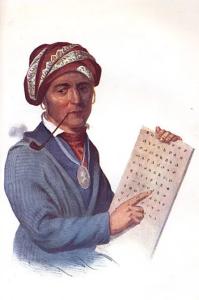
Native Americans generally had no written language until Sequoyah of the Cherokee devised a written language but that was not widely adopted, so the history of First Nations people or the Native Americans is largely based on oral traditions and storytelling and some pictographs painted on animal hides or painted and etched in stone in caves and such.
This is really true for all of humankind.
“For 99 percent of the tenure of man on earth, nobody could read or write. The great invention had not yet been made. Except for firsthand experience, almost everything we knew was passed on by word of mouth. As in the children’s game “Telephone,” over tens and hundreds of generations, information would slowly be distorted and lost.”
—Carl Sagan
The Great Peacemaker
One story among the five nations of the Iroquois that stands out to me is the story of the Great Peacemaker. There are different versions of this story so forgive me if you have heard a different version of it. But generally, it goes like this:
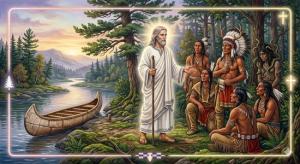
Long ago, the five nations of the Iroquoian-speaking nations: Mohawk, Oneida, Onondaga, Cayuga, and Seneca were at war with one another, constantly fighting, scalping and there were even reports of cannibalism. From among the Mohawk came Hiawatha, praying one day by a river when he saw a man coming toward him in a white stone canoe. He wondered at how a stone canoe could float. The man landed his canoe on the bank where Hiawatha was standing and told Hiawatha he had come as an answer to his prayers to the Creator. The man said his name was Deganawida, which meant ‘Great Peacemaker’. It was the Peacemaker who called a great council of the five tribes and it was at this great council that he caused a white pine tree to be uprooted before their eyes. He told them all to throw all their weapons in the hole and to fight no more and to form a confederacy. When all the weapons were thrown into the hole, it is said the pine tree miraculously stood back up, burying the weapons forever. All were willing except the medicine chief of the Seneca, Tadodaho. Tadodaho was a wicked man who cast spells and even had snakes intertwined in his hair to make himself appear more fierce. To this, the Peacemaker picked a small girl who was standing nearby and told her to go and lay hands on him. The little girl did what the Peacemaker said, unafraid and the snakes fell from his hair and upon his knees, he complied and gave in to the Peacemaker and the five nations became one from that day on.
Now, some would say this was only a legend but it has been verified historically that the people named did indeed exist and that this Deganawida went around uniting the tribes. It is said that the principles of the Iroquoian Confederacy were greatly respected by Ben Franklin and that the Constitution of the United States is founded upon the same principles of that confederacy. There are also stories of the Peacemaker walking on water and even flying in his white stone canoe. Some stories even say that, though the Peacemaker was Mohawk, he was born of a virgin. Also, as a matter of interest, when all the natives threw their weapons in the hole formed by the uprooted pine tree, is where the expression ‘bury the hatchet’ came from.
Table of Nations
According to the story of the worldwide flood of Noah and his ark all living things were drowned except those on the ark. Of those that were on the ark were the three sons of Noah: Shem, Ham and Japheth and their wives. So, all future inhabitants of the Earth had to have descended from Noah’s three sons. Once the flood subsided, it is believed the continents were all one continent, often called Pangea, that later broke apart over thousands of years, often called continental drift. This made it possible for the people of this planet to walk all over the Earth. There is archaeological evidence of man on every continent except Antarctica and there is no evidence of the Native Americans or Australian Aborigines being seafarers so it makes sense that people dispersed throughout the world chiefly by walking and that the continents would have had to have been connected in some way in order for them to do so. Some believe there were also land bridges in some cases like the Bering Strait linking Asia and North America.
According to the Bible, at first, people were all staying in one place and speaking the same language and it took the events of the Tower of Babel (Genesis 10) where they were all made to speak different languages before they began splitting up and going different directions. In what is known as the Table of Nations in Genesis 10 and comparing secular histories and genealogies, it is possible to trace the descendants of the sons of Noah.
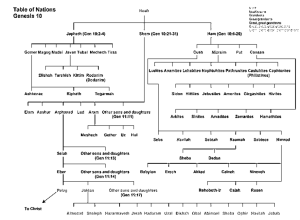
It is generally accepted that the children of Ham settled in portions of Africa, the Middle East, and India. Likewise, the sons of Shem settled in the Middle East and in western Europe. The sons of Japheth can be traced to Eurasia. Japheth had a son named Tiras, who is lost track of for he seems to have scattered beyond the customary boundaries of civilization and then we lose track of him in antiquity. Could the children of Tiras possibly be the origins of the Native Americans? It is hard to say for sure. Interesting though, ethnologists can now trace the Native American DNA and language similarities to those of Japheth and the people of Northeast Asia so it is likely. There are even some names among the Native Americans like Tauri, Taras, Turas, Dures, and Atures (The American Race by Daniel G. Brinton), very similar to the name Tiras.
Now it makes sense to me that all these people had a knowledge of God as passed down through Noah and his sons, but as happens to human nations man began to forget and distort their knowledge of God and I am sure demon spirits were more than willing to oblige them and create all the distortions and aberrations of God that became the religions of the world.
What other references are there to God among the Native Americans?
The Manahoac, also recorded as Mahock, were a small group of Siouan-language Native Americans (Indigenous people) in northern Virginia who were known to have what was basically a bucket with a stick standing up in it in their villages and when missionaries enquired what the meaning of it was they were told it was ‘the man in the boat’. Could it have been a reference to Noah and the ark?
The Cherokee generally believe in one supreme being known as Unetlanvhi or the Great Spirit, believed to have created the universe and all life within it. They believed that he maintained balance and harmony in the world. They also believe that the Great Spirit is present in all things and that all things are connected. Very similar to Colossians 1:16-17 “For by him were all things created, that are in heaven, and that are in earth, visible and invisible, whether they be thrones, or dominions, or principalities, or powers: all things were created by him, and for him: And he is before all things, and by him all things consist.”
They also believe in two people from whom all other people derived, Kanati and Selu are the names of the first man and woman. Kanati is also known as the “Lucky Hunter” providing food for the people. Selu is known as the “Corn Mother” and provides the people with corn, which is a staple food. According to the Cherokee, Kanati and Selu had two sons, who went on to create the rest of humankind. Could this story be their version of the story of Adam and Eve?
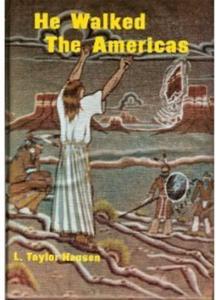
There are many recorded accounts of a lighter-skinned man walking the Americas that spoke a thousand languages, healed the sick and even raised the dead. He spoke like a prophet and revealed many things. Some of these accounts go back 2000 years, according to those who speak of him. Beware, though, of any of these accounts by any Mormon resources. The Smithsonian Institution even made a statement that they were unreliable, especially the Book of Mormon, citing there was no archaeological evidence to back up their claims. The book I recommend for reliable eyewitness accounts is a book by L. Taylor Hansen that records these accounts in his book ‘He Walked The Americas’. I give a few accounts from his book below. I encourage you to read his book though. He tells the stories below better than I and there are many more stories in his book. Numbers in parentheses below reference page numbers from this book.
In Hansen’s book, there are over 60 accounts that agree that there was indeed a pale-skinned person who usually had on white robes with black crosses embroidered all about the hem of his garment. It is said he wore golden sandals and his hair was either white or light brown and he always had a beard. Beards were not common and almost unheard of among native American people. His eyes are described as pale gray. He performed miracles. He healed. He deflected arrows shot at him. He sometimes walked on water. Wild animals did not fear him and seemed to love him and follow him. He was seen with a silver wolf and a black wolf and on a couple of occasions with a tiger that followed him. He would not give a name saying he wanted to be called whatever people wanted to call him. He is called Lord of the Wind and Water, Tah-Co-Mah, Kate-Zahl, and The Prophet. When pressed what his childhood name was he gave a name that sounded to the people like he was saying Chee-zoos (Sounds like he could have been saying Jesus.). It is said he spoke a thousand languages and had no trouble adapting to the language of any people he spoke to. Hansen documents his sources well in this book and notes that these stories are “still whispered by the storytellers of a hundred nations…and form a curious pattern…His symbol is woven into blankets, carved on the walls of canyons, burned into pottery, danced in dances. His name is given to rushing rivers, tall white mountains, sacred forests and springs of never-ending water.” Dr. Buck, Director of Bishop Museum says he verified this person existed from the Tahitians who spoke of “Wakea the Healer who lived in the first century of the Christian Era or generally speaking, in the time of Jesus. It seems he came in the early dawning of our history to those tribes who were fighting in the outlying island.” (21)

I know some of you reading this may consider this all speculation, and that’s OK, but the evidence I have presented, I think, is worth considering. It isn’t essential to salvation that you believe these accounts but I hope you will find it interesting and let it inspire you to consider that God is bigger than any human could comprehend and his ways are far above our ways (Isaiah 55:9). Jesus died for all of mankind (John 3:16-17), therefore I think it is plausible that he also appeared to many people besides those recorded in the Bible. Ultimately, the stories of the ‘Pale Prophet’ and the ‘Great Peacemaker’ do not compete with the Biblical narrative; rather, they serve as a profound echo of it. If we believe in a God who loves all people, it is only natural to find His fingerprints in the canyons of the West and the forests of the East, just as we find them in the plains of Mamre. Whether he was called Deganawida, Wakea, or the Commander of the Lord’s Army, the message remains the same: a call to peace, and a reminder that the Creator has always walked among His people. As we reflect on these accounts, let us find comfort in a God who is larger than our maps and more present than our histories. Just a thought. Be blessed and as many Native Americans say, A’ho (A term of agreement similar to Amen).
Thanks for reading this week’s blog. Please share with your friends and social media and be sure to sign up for notifications so you don’t miss a single blog.













 Ad-Free & Subscriber Log-In