

Some rivalries make sense when you look back on them. Others feel destined. The conflict between Aleister Crowley and W. B. Yeats falls into that second category. It wasn’t just a disagreement over personality or ideas. There was more behind it—a real divide over what the unseen world was, and what you were supposed to do with it once you touched it. A divide that may have felt at home in the worlds of The Lord of the Rings or Harry Potter.
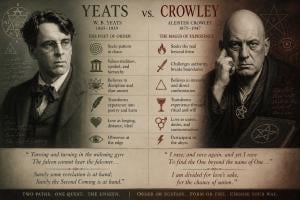
They crossed paths inside the Hermetic Order of the Golden Dawn, a strange meeting ground for poets, mystics, and people convinced there was something just out of reach. Yeats had already found his footing there. He took the system seriously—the symbols, the rituals, the slow progression through its structure. For him, magic wasn’t something you rushed. It was something you learned to hear, the way a poem changes the longer you sit with it.
Crowley arrived with a very different instinct. He wasn’t there to inherit anything. He wanted to push at it, test it, see where it broke. Where Yeats leaned toward refinement, Crowley leaned toward intensity. At first it sat in the background. It didn’t stay there.
By 1900, the order was already coming apart, and that tension gave Crowley an opening. Backed by Samuel Liddell MacGregor Mathers, he tried to assert authority over the London temple. The story has been told so often it feels half-real, half-performed: Crowley arriving in ceremonial dress, expecting to be recognized, only to be met at the door.
Yeats refused to let him in.
However it unfolded in detail, the moment stuck. Crowley turned away. Yeats holding his ground. One man trying to force his way forward, the other insisting there were still lines that couldn’t be crossed.
It wasn’t really about control of the order. It was about what the work itself demanded.
You can hear it in their writing. In The Second Coming, Yeats stands back just far enough to shape what he sees:
“Turning and turning in the widening gyre
The falcon cannot hear the falconer…”
Even as things fall apart, he’s looking for pattern. There’s distance in it, and a kind of restraint. The world may be breaking, but he refuses to let it dissolve completely.
Crowley doesn’t hold that distance. He moves straight into the experience:
“I rave; and rave again, and yet I rave
To find the One beyond the name of One…”
There’s no effort to contain it. He isn’t observing the edge—he’s trying to push through it.
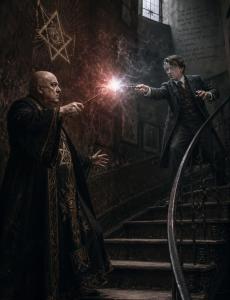
The same split shows up in how they lived. Crowley chased altered states wherever he could find them—ritual, sex, drugs. Heroin and cocaine became part of that pursuit. He believed if you went far enough, something would give, something real would break through. Sometimes it seemed like it did. Other times, the cost was obvious.
Yeats didn’t trust that path. He wasn’t less interested in transcendence, but he approached it differently. Discipline, for him, wasn’t a barrier. It was the method. You didn’t tear yourself open to reach something higher. You built toward it, carefully, piece by piece.
Their relationships followed the same pattern. Yeats’s connection to Maud Gonne carried a kind of distance, a sense that the feeling itself mattered more than its outcome. Love, in his world, often stayed just out of reach, shaped into something that could live inside language.
Crowley closed that distance. He moved directly into experience, folding desire into his philosophy and his practice. They moved through overlapping circles where attention and admiration carried weight, and it’s not hard to imagine how that difference added another layer to the tension between them.
Even with all that, their stories stay tied together. Yeats became a central literary figure, eventually winning the Nobel Prize and helping shape a cultural identity through his work. Crowley moved in a different direction, becoming a figure people either followed or warned against, depending on where they stood. Still, each reflects something the other refused to become. Yeats holds the line, giving form to something that might otherwise scatter. Crowley keeps pressing against it, unwilling to accept that any boundary is final.
What sits underneath their rivalry hasn’t really gone away. Both were trying to reach beyond ordinary experience, to touch something they believed was real. They just couldn’t agree on how far you were supposed to go.
Yeats, still searching for order even at the edge of collapse, writes:
“Surely some revelation is at hand;
Surely the Second Coming is at hand.”
There’s patience in that voice, a sense that meaning arrives when it’s ready.
Crowley answers in a different tone:
“I am divided for love’s sake, for the chance of union.”
He doesn’t wait for anything to arrive. He moves toward it, even if it means breaking himself along the way.
Put them next to each other and their epic difference is hard to miss. Yeats keeps his distance, waiting for meaning to take shape while standing in the light. Crowley doesn’t wait. He steps straight into darkness, convinced that whatever matters is on the other side.







 Ad-Free & Subscriber Log-In