

Singer-songwriter Regie Hamm said his new album, “Time Machine,” was born of play, memory and a desire to escape the commercial pressures that often accompany a life in music.
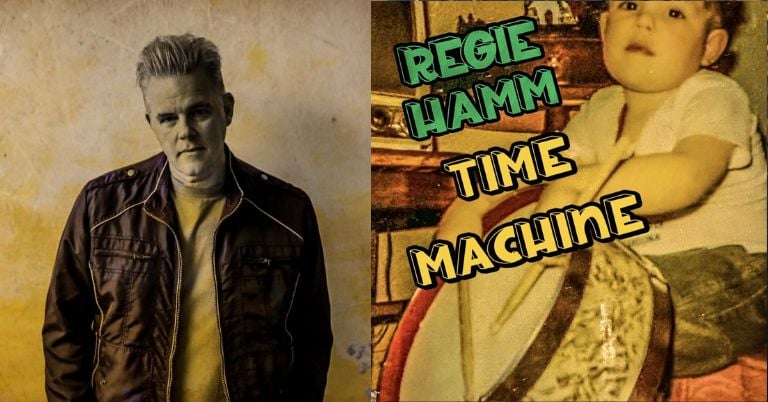
“Time Machine,” released this year, a project he produced mostly on his own when “I didn’t have a budget, so I just decided, ‘I’m just going to have fun with it’.” The result, he said, is “the most fun I’ve ever had making a record,” a collection that leans on the pop sensibilities of the 1990s, the rock of the 1980s and the funk of the 1970s.
Hamm, who wrote the winning song for “American Idol” when David Cook triumphed in 2008, said he approached “Time Machine” as a return to the creative freedom of childhood. He used a photo of himself “when I’m two years old playing a little drum” as the album cover to underscore that mindset. “I really just made an effort to kind of stay in that mindset, just like be a kid,” he said. “Play in the sandbox, do it the way you would do it when you were a kid.”
Work on the album began after a listener repeatedly urged Hamm to record one specific song “Beautiful Tragedy” that he had posted online. The persistent fan ended up becoming a really good friend of his. That springboarded into a whiteboard full of ideas.
“Before I knew it, I had a whiteboard of 15, maybe 17 songs, and so I just started, I just kept recording,” he said. He ultimately pared the collection down to a tight sequence “to create a really good top to bottom listening experience.”
Hamm recorded and mixed most of the record himself in a home studio, playing many of the instruments.
“I played it all, I sang it all, mixed it all, and not really because I wanted to, but I just didn’t have a budget,” he said. The self-contained process allowed him to experiment—mandolin, banjo, accordion and keyboards appear across the album, sometimes from instruments with sentimental value.
“I’ve got my mother’s old accordion from the 1950s,” he said. “I love playing it. For no, I just felt like I was like to smell it, because it reminds me when I was a kid.”
Hamm framed the album as a deliberate reaction to an industry that has shifted under artists’ feet. “There’s no real formula anymore for quote unquote success,” he said, noting that streaming has fundamentally altered how songwriters are compensated. “If I had a song on a record that sold a million copies, I would make $90,000 on that song. If I had a song today that was streamed a million times, I would make about 34 cents,” he said, using the striking contrast to illustrate the challenge facing many creators.
The album also marks a creative restitching of identity for a songwriter who has worked across the commercial and faith-based music worlds. Hamm traced the arc from his early band days to writing for national acts and maintaining a solo artistic life on his own terms.
“I gave myself permission every month,” he added. “I can write a song that I just want to write, and I don’t even want it to get recorded, and I don’t want it to get on the radio. I just want to do it for me.”
Hamm said he values intimate performance settings in theaters, clubs and churches and has embraced house concerts and living-room broadcasts as a way to sustain connection with listeners. He described a 2017 “Pass the Hat Tour,” offering house shows in exchange for donations from audiences, an experiment that grew beyond its initial plan.
“I love them because it’s real intimate. It’s like you’re playing songs for somebody in their house,” he said.
Among Hamm’s well-known catalog is a song that altered his family’s fortunes.
“I’m glad I wrote ‘Time of My Life,’” he said, reflecting on the song’s financial and professional impact. “It provided a stable income for my family while my kids were young,” he said, even as he noted the song is not necessarily his personal favorite composition. “It is the most important song for me. It’s that solid ‘C student song’ that I just love.”
“Time Machine,” Hamm said, is less about chasing commercial success and more about artistic truth.
Since the rules are kind of being thrown out anyway, why don’t we just have fun,” he said. The album’s sonic nostalgia and personal honesty aim to capture the joy of making music without overthinking outcomes. It’s a reminder that, for some artists, creative renewal arrives when constraints fall away.
“If nothing happens, well, we’ve had a good time,” he said. “We’ve said our piece the way we want to say it.”
“Time Machine” by Regie Hamm is now available on digital outlets. Regie also has a Patreon site where he frequently shares commentary on his career and current events. Watch Regie and DeWayne Hamby discuss the record on the “Reel Faith” podcast below.













 Ad-Free & Subscriber Log-In