

In talking with someone over the past few days about my efforts to develop a “Choose Your Own Adventure” textbook, I realized that the Bible itself can be viewed as a “Choose Your Own Adventure” book.
Think about it. No one gives equal attention to all of its contents, and so you get people following very different reading pathways through the Bible. Some devotional materials actually do something quite literally like the CYOA books. “If you want comfort while sick turn to… If you are angry, turn to…” But even without such add-ons, people make choices about what to read, how often to read various parts if at all, and how to interpret what they read and how it fits together.
And so the Bible, in that sense, is a book with many possible paths that one can take through it, leading to many different sorts of belief systems and ways of life at the other end.
Thinking about the Bible as a “Choose Your Own Adventure” book may be a helpful analogy for people trying to understand how it can be that people with very different beliefs and practices claim the Bible as their authority or influence. And it may also helpfully raise the question of who has actually really read the Bible: someone who has followed it through one particular pathway, or someone who has gone back and read all of the alternatives, and who therefore, although they may have a favorite path through the book, recognizes that there is also much else in there besides that.
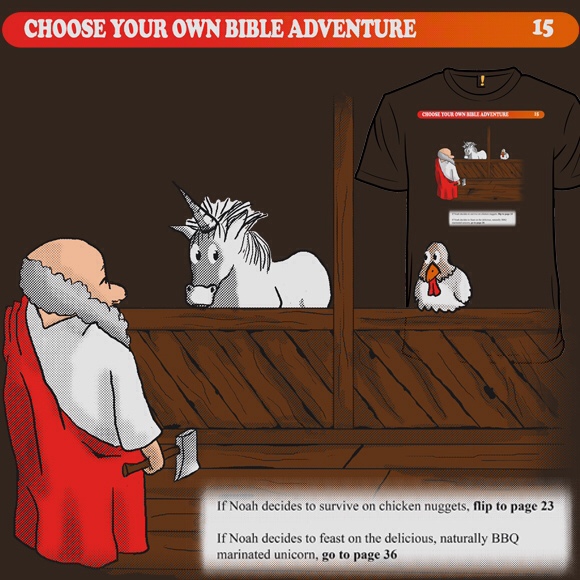
On a more humorous note, I found the following image when searching for possible illustrations for this post:












 Ad-Free & Subscriber Log-In