

David Fitzgerald posted this on Facebook:
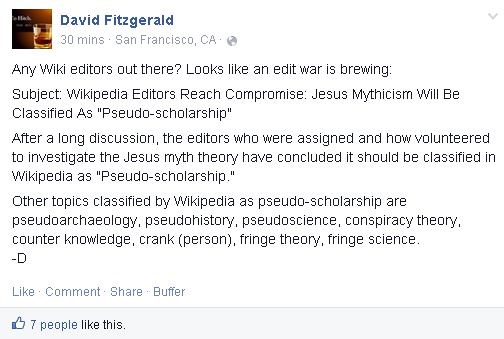
If a “war is brewing,” are you involved in Wikipedia enough, or invested enough in the subject, to get involved?
It was interesting to see the comments on Fitzgerald’s post. Some mythicists suggested that Richard Carrier having a peer-reviewed book published somehow proves that mythicism does not deserve this label. One can certainly make that case – if one is willing to grant that Intelligent Design, with its qualified supporters in the form of Michael Behe and others like him, is not pseudoscience. I wonder how many mythicists are willing to do that? If they are, I will admire their consistency.
I also appreciated this response to a mythicist’s comment in the Talk: Christ myth theory section on Wikipedia:
Wikipedia does not give equal validity to positions that receive less academic support, which is determined by due weight from sources, rather than choosing one source and rejecting others. In other words, the conclusions of the majority trump the claims of the minority. This is parallel to our article on Evolution: the majority in the field hold a particular position which we repeat, while we shuffle off the “alternative” to an article that’s mostly criticism. To date, Carrier’s work is the only peer-reviewed Mythicist work from an academic publisher, while there are plenty that (regardless of whether individual editors disagree or want to argue against it) take a Historicist position.













 Ad-Free & Subscriber Log-In