



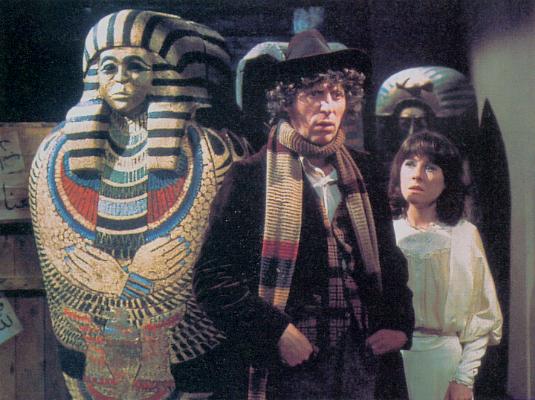
There is also an interesting time-travel trope as the Doctor shows Sarah what 1980 will look like if they leave now without stopping Sutekh. The Doctor identifies Sutekh with Satan, and also says that 740 gods combined forces to defeat Sutekh, whom he describes as “all-powerful.” And so when the Doctor manages to trap and kill Sutekh, that would seem to implicitly make him greater than the Osirans – an even more powerful god. And so this episode is a good starting point for discussion of natural gods and the Doctor’s quasi-divinity as well.
The episode also has connections with earlier episodes, as the Doctor notices that Sarah has put on something that Victoria used to wear when she traveled with him. He also mentions being middle-aged at 750 years old. And he says that he walks in eternity.
There is (for those who may be interested) a Pyramids of Mars Playset













 Ad-Free & Subscriber Log-In