

Clay tablets, copper plates, and stone inscriptions—thousands of strange relics pulled from Michigan’s burial mounds more than a century ago. To scholars they remain a riddle, and to many a hoax. To my family, they are a legacy.
The story of the Michigan Relics is woven directly into my family’s history. For more than a century, these controversial artifacts have stirred debate—captivating some, frustrating others, and dividing scholars into camps of believers and skeptics. At the center of this storm was my grandfather, Milton R. Hunter, who once held them in his care. To him, the relics were never just curiosities; they carried the weight of something sacred, something worth preserving.

ChatGPT
A Family Legacy
My grandfather was no ordinary collector. He earned a Ph.D. in history from the University of California, Berkeley, where he immersed himself in the study of early civilizations. His academic training was matched by his lifelong service in the Church of Jesus Christ of Latter-day Saints, where in 1945 he was called as a member of the First Quorum of the Seventy, one of the Church’s highest governing bodies. In that role he became widely respected as both a religious leader and an authority on the ancient Americas.
He was a prolific writer, publishing more than a dozen books and numerous articles that explored the spiritual and cultural histories of the Western Hemisphere. Works like Archaeology and the Book of Mormon and Christ in Ancient America reflected his conviction that the peoples of the Americas were part of a sacred history stretching back to biblical times. His writings left a lasting mark on generations of Latter-day Saint readers, myself included. As a child I would pore over his books, entranced by the idea that the lands around me carried echoes of prophets, builders, and forgotten civilizations.
Although he never published directly on the Michigan Relics, my grandfather spoke of them as potentially genuine. To him, the relics—etched with Jewish, Coptic, and Gnostic symbols—hinted at lost connections between the Old World and the New, and possibly at the very civilizations described in the Book of Mormon. Even if he entertained doubts about individual pieces, he believed the collection as a whole could not be so easily dismissed. That conviction, rooted in both scholarship and faith, shaped my own curiosity from a young age. For me, the relics were not just objects in a museum case—they were part of my grandfather’s legacy, and by extension, part of my own story.
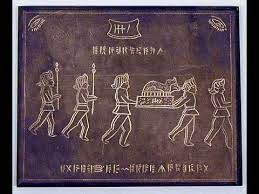
The relics themselves are a sprawling collection: thousands of clay, slate, and copper items etched with unusual symbols—Jewish, Coptic, and Gnostic motifs—uncovered from burial mounds across Michigan between 1890 and 1920. Among them is the so-called Mystic Symbol, a repeating image with striking similarities to iconography from ancient Israel. For my grandfather, these artifacts offered a potential link to the mysterious mound-building cultures of North America.
Hope and Disappointment
At first, the relics sparked excitement. They seemed to suggest a tangible bridge between the Old World and the New, perhaps even evidence of the Book of Mormon’s claims about Christ’s presence in the Americas. When my grandfather passed away in 1975, he arranged for the collection to be given to the LDS Church for study and research.
But enthusiasm soon gave way to skepticism. Scholars like Richard B. Stamps, himself an LDS member, dismissed the artifacts as frauds. His condemnation gave permission for many others to set the relics aside without serious attention. Eventually, the Church—keen to avoid controversy—donated the entire Soper-Savage Collection to the Michigan History Museum. My family only agreed on the condition that the artifacts would be examined with academic rigor. Instead, they were displayed as fakes.
For us, it was a betrayal. My grandfather had worked tirelessly to protect these objects from ridicule, only to see them mocked in public. The sting of that dismissal lingered for decades.
Broken Promises
In 2015, I decided to take action. I visited the Michigan History Museum myself, this time accompanied by Ryan Fisher, a documentary filmmaker, who captured the artifacts on video. The staff welcomed me warmly, and the archaeologists I spoke with were professional, kind, and generous with their time. They patiently answered questions and explained the museum’s stance. Yet despite their courtesy, it was clear that they did not see the relics as genuine. To them, the collection was a curiosity at best—a reminder of a past controversy long since settled in the eyes of the academic establishment.
Their politeness could not soften the sting of hearing my grandfather’s life’s work treated so lightly. For me, the relics carried a sense of wonder, a possibility of hidden connections across history. For the museum, they were artifacts of a hoax, destined to remain in the shadows of disbelief. Standing there, I felt the weight of generations pressing down—the trust my grandfather had placed in the Church, the conditions under which the collection was donated, and the hope that honest study might one day redeem them.
That hope had been betrayed long before my visit. The LDS Church, which I grew up in and loved deeply, had promised to safeguard and study the relics. Instead, they quietly handed them over to the museum, knowing full well that they would be branded as frauds. As a child of that faith, I was taught to trust my leaders, to believe that truth would always triumph, and to honor the heritage of the past. To discover that the institution I cherished had chosen expedience over integrity was a wound far deeper than any scholarly dismissal.
What I felt in that moment was more than disappointment. It was the disorienting realization that the Church of my upbringing—the very community that nurtured my faith—had treated my grandfather’s legacy as an inconvenience to be put away, rather than a mystery worthy of pursuit. The betrayal lingered like a shadow, entwined with my family’s story of the relics.
The Debate
Skeptics argue that the relics’ unusual blend of styles—symbols from the Near East, Europe, and Christianity jumbled together—is a strong sign of forgery. To them, the mixture looks less like the organic development of an ancient culture and more like the patchwork imagination of a 19th-century mind drawing loosely on Bible stories and popular histories. The fact that the artifacts surfaced during the late 1800s, a time when pseudo-archaeological discoveries were especially fashionable, makes their timing all the more suspect.
The circumstances of discovery add further doubt. Many of the relics were unearthed not by trained archaeologists, but by individuals such as James O. Scotford and Daniel E. Soper, whose reputations themselves were questioned. These items often appeared in isolation, without reliable excavation records or the kind of supporting material—bones, pottery shards, settlement layers—that normally anchors an artifact to a specific culture and period. In the absence of such context, scholars argue that the relics cannot be trusted as authentic.
Modern scientific tools have also weighed against the relics. Metallurgical tests on some of the copper pieces, for example, suggest they were worked with techniques consistent with the 19th century rather than antiquity. Clay tablets show signs of being baked in modern kilns, not the open-pit firing methods used by ancient cultures. Microscopic analysis of inscriptions has revealed tool marks consistent with steel chisels, which would not have been available to supposed mound-building peoples. Radiocarbon dating of organic material found with some items has also pointed to relatively recent origins.
Yet for every scientific test and skeptical conclusion, defenders point to anomalies that resist easy dismissal. Henriette Mertz, a respected cryptographer, noted that the scripts vary widely, suggesting multiple authors working with different tools—not the handiwork of a single forger. Some inscriptions use boustrophedon script, an obscure style rarely understood in 19th-century America, making it unlikely for a local fraudster to imitate convincingly.
The Mystic Symbol
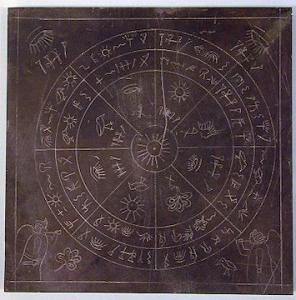
Part of Mertz’s argument is the Mystic Symbol, a recurring design that appears across many of the artifacts. The symbol often takes the form of a circle enclosing a series of intersecting lines, shapes, and characters that resemble a fusion of ancient scripts. To some researchers, its composition recalls motifs found in Israelite and Near Eastern iconography, suggesting possible Old-World connections. Its repeated presence across tablets, copper plates, and stone pieces hints that it held deep spiritual or cultural meaning for those who created it—far more than mere decoration. For believers, the Mystic Symbol stands as a tantalizing clue that the relics may preserve fragments of a forgotten sacred tradition.
Other anomalies are even harder to dismiss. Researcher David Allen Deal identified astronomical data on one tablet that matched a solar eclipse visible from Michigan in AD 342. Calendar wheels found among the relics suggest observance of a Saturday Sabbath, reflecting early Christian practice before Constantine’s shift to Sunday worship. These details raise an uncomfortable question: could forgers of that era really have created such sophisticated and historically accurate material?
Redefining Our History
So where does that leave us? The Michigan Relics sit at a crossroads of faith, history, and controversy. Could they be genuine artifacts that challenge our understanding of America’s ancient past? Or are they clever fabrications, products of a bygone age hungry for mystery? Perhaps, as some suggest, the truth lies in between—authentic pieces intermingled with later fakes.
My grandfather believed they were worth more than dismissal. To him, they carried the possibility of reshaping history, of opening a dialogue between the known and the unknown. Whether or not his faith in them proves justified, I share his conviction that the relics deserve honest consideration.
Because sometimes, the real story isn’t just about the objects themselves—it’s about how we choose to handle the mysteries of the past. My grandfather believed they were mysteries worth protecting, and I carry that belief still.












 Ad-Free & Subscriber Log-In