

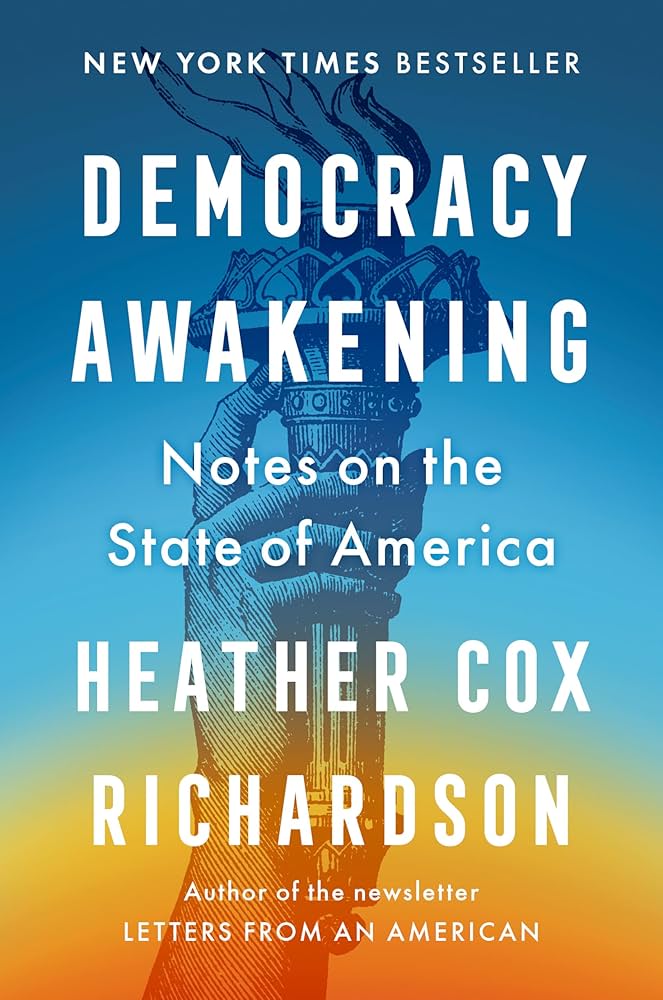
It’s been sitting on my shelf for two years now (sorry Penguin!), but I’ve finally got around to reading Heather Cox Richardson’s book on democracy and authoritarianism, Democracy Awakening: Notes on the State of America. It is well-written and not good.
As for well-written, I’m sure we’ve all seen her writings floating around the internet space (at least on Facebook, Twitter, Bluesky, and a couple of others–but I’m not on everything so take that with a grain of salt). She is a gifted writer and can pack a heck of a lot into a few words. This book is a straight-forward read.
And yet, I don’t recommend it as anything other than a glimpse into the mind of one side of the American political spectrum. Specifically, the American left opposed to Donald Trump.
And hey, power to her. We live in a free country wherein one is free to criticize the President all one wants. But I’m also free to point out a few of the problems with this book. (Briefly, because this is just a blog.)
First, Richardson throughout assumes that deference to state and local governments is “authoritarian”, while the federal government is not. There is of course truth to this if we look at American history through the lens of, say, Jim Crow Laws or slavery. That said, the first government in the modern world to outlaw slavery was the state of Vermont (in 1777–90 years before the Federal government got around to it), so even that example isn’t perfect. And if you want more on this specific topic (of states vs the feds, not slavery), see my review of How Democracies Die.
Second, Richardson never really defines “authoritarian” or “authoritarianism.” But we can see what she means by it in the first few pages of the book and then throughout. Namely, in her view an “authoritarian” is someone who seizes political power by painting “their team” as always good and virtuous and the “other team” as always evil and to be opposed–often in defiance of the truth. The problem with this approach is that by her own standard Democracy Awakening is an authoritarian text. One side is always good and the other (Trump, the MAGA movement, and traditionalist conservatives) are always bad. Even when the history presented is… incomplete. To say the least.
Finally, and most importantly, Richardson never defines “democracy.” This is important because the second democracy is defined, we see that it’s not really the alternative to authoritarianism that Richardson would like it to be. (As a side note, and along with the first point above–state and local governments are far more democratic than the federal government, since many of them allow for direct participation by the people in the initiative or referendum process. Many of the authoritarian examples in the book–legitimate or otherwise–from the states are examples that were put in place by democratic processes.)
So what is democracy? It’s a structure of government that directly involves the people. The more people involved, the more democratic. The fewer people involved, the less democratic. So ancient Athens or a New England town meeting are examples of “pure democracy” where the people directly run the government. Elected legislatures such as Congress or Parliament are examples of “indirect democracy” where we are involved (through elections) but do not directly decide on laws. What we should notice here is that whatever form, democracy is very compatible with authoritarianism (all forms of government are, if put to it). The people, directly or indirectly, can vote an authoritarian into power or put authoritarian laws in place just as easily as a dictator or tyrant. More easily in some ways–as Machiavelli points out a tyrant can be dealt with by a lone crackpot with a weapon. A democracy that supports authoritarianism, on the other hand…
Okay, enough of the political stuff. What does this mean for Christians? Well, this is a book to read if you want to know what’s going on with the left and its view of Donald Trump (and you should want to know that–it makes up 40% of our country). But more importantly it’s a reminder that we need to be willing to tell the truth in all circumstances as believers. If Trump does good things, we need to say that. If Trump does bad things, we need to say that too. If there are things to be proud of in our past (and there are) we need to admit those, just as we need to confess the very real wrongs. What we should not do is follow the authoritarian impulse to declare our side the right one in all times and all circumstances. That way lies tyranny and the destruction of the nation and our souls alike.
Dr. Coyle Neal co-hosts the City of Man Podcast and is an Amazon Associate (which is linked in this blog). He teaches Political Science, Philosophy, and History in Southwest Missouri.













 Ad-Free & Subscriber Log-In