


Apocalypse stories don’t fail because they lack imagination.
They fail because they lose interest in people.
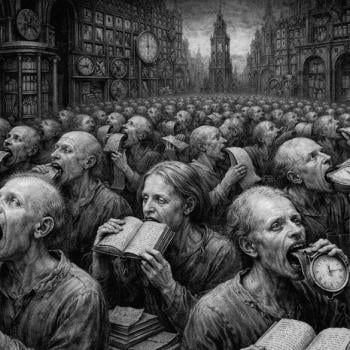
The monsters get bigger. The symbols get louder. The stakes inflate until everything is cosmic and nothing is personal. Endings become indulgent—spectacle masquerading as meaning.
This is true of prestige television.
It’s also true of how Christians read the Book of Revelation.
And it’s painfully true of rapture culture.
The moment an apocalypse stops asking how humans live under pressure and starts obsessing over how everything finally burns, the story collapses. Not with a bang—but with fireworks that distract from the absence of courage.
Endings, Apocalypse, and the Lie of Spectacle
Endings don’t reveal what a story meant to say. They reveal what it actually loved.
When endings collapse, it’s rarely because of plot holes or unanswered questions. It’s because spectacle replaced people. Escalation replaced resolution. The story mistook noise for truth.
Apocalypse stories are especially vulnerable to this failure—because the temptation to go big is overwhelming, and the courage to stay human is rare.
Finale Energy and the Seduction of Scale
Consider Stranger Things. At its best, the show worked because it trusted its characters. The horror mattered because the people did. The supernatural was never the point—it was the pressure.
But as the series pushes toward its ending, something familiar happens. Mythology expands faster than character. Lore stacks higher than emotional resolution. Stakes inflate until the only way forward is bigger.
Characters don’t finish arcs so much as freeze inside them—reduced to symbols, callbacks, and poses. The finale energy becomes indulgent. Spectacle steps in to do the work intimacy once did.
This isn’t a fan complaint. It’s a structural failure. When creators stop trusting that small human conclusions are enough, they compensate with scale.
Spectacle feels like meaning. It just isn’t the same thing.
Revelation Wasn’t the Bible’s Finale—We Turned It Into One
This same failure shows up every time Christians treat the Book of Revelation as the ending of the Bible—the final answer, the cosmic summary, the theological mic-drop.
That framing alone distorts the text.
Revelation was never meant to function as Scripture’s franchise finale. It’s a resistance document. A symbolic protest written to oppressed communities under empire. A text about how to remain faithful when power claims total ownership of the future.
But modern Christianity demanded certainty instead of courage.
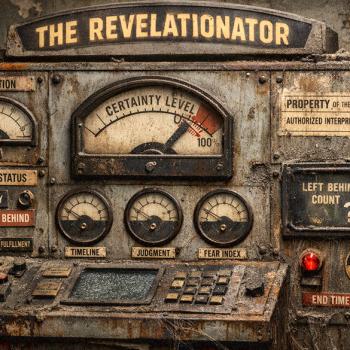
So Revelation became lore. Beasts turned into timelines. Symbols became spreadsheets. The story stopped being about people enduring empire and became a spectacle Christians could control.
That isn’t Revelation failing. That’s us refusing to let it stay human.
Mythic Overload Is What Happens When We Don’t Trust People
Across pop culture and theology, the pattern is the same. Apocalypse stories collapse when they no longer trust that:
• quiet faithfulness matters
• endurance without payoff counts
• love without vindication is meaningful
So they pile on monsters. Judgments. Cosmic sorting mechanisms. Final clarity.
Mythic overload isn’t about imagination—it’s about avoidance. It’s what happens when we don’t want to sit with ambiguity, suffering, or unresolved humanity.
And nowhere is that more obvious than rapture theology.
Rapture Culture and the Allergy to Humanity
Rapture culture doesn’t obsess over the end because it longs for justice. It obsesses because it can’t tolerate unresolved humanity.
The rapture promises escape, not transformation. Sorting, not reconciliation. Certainty, not courage.
It removes the burden of loving enemies. It sidesteps long obedience. It replaces ethical formation with a countdown clock.
The apocalypse becomes a theological eject button.
That’s why rapture narratives are obsessed with spectacle. Fireworks are easier than faithfulness. Watching the sky is easier than staying human when power tightens its grip.
This is the same failure pattern—just baptized.
Apocalypse Was Never the Point
Apocalyptic language was never meant to explain everything. It was meant to reveal something.
Who you were when the world burned.
What you loved when certainty vanished.
Whether you resisted empire—or joined it.
That’s what Revelation was doing.
That’s what good stories do.
That’s what indulgent finales forget.
When apocalypse remembers people, it forms ethics. When it forgets people, it becomes pornographic—power without responsibility, judgment without self-examination, certainty without compassion.
The Ending We Keep Getting Wrong
This is where The Tribulation Survival Guide sneaks in—not as a prophecy manual, but as a mirror.
The book exists because rapture culture treats apocalypse as spectacle instead of formation. It exposes what happens when faith becomes obsessed with being right at the end rather than being human in the meantime.
Rapture theology didn’t misunderstand the end of the world.
It misunderstood the point of the story.
Apocalypse was never about watching the sky.
It was about how you lived when empire claimed it owned tomorrow.
And any ending—biblical, cinematic, or theological—that forgets that will always collapse under its own spectacle.
Enjoy this article?
You might also enjoy
The Tribulation Survival Guide

More Snarky Faith
Join the newsletter
Snarky Faith Podcast
Instagram — @stuartdelony
YouTube — @snarkyfaith
Bluesky — @snarkyfaith.bsky.social
Facebook — facebook.com/snarkyfaith
Snarky Faith merch — available here














 Ad-Free & Subscriber Log-In