


In the original Transformers cartoon, Megatron transforms into a gun.
Not a tank.
Not a jet.
A gun.
A literal handheld weapon that requires someone else to pick him up and pull the trigger.
Once you notice it, you can’t unsee it. Megatron—the tyrannical, power-hungry leader of the Decepticons—temporarily turns himself into an object. He gives up agency. He becomes dependent. He becomes a tool.
Inside the logic of the Transformers universe, that should be a problem.
Why Megatron Being a Gun Breaks the Transformers Universe
Transformers don’t choose alt-forms randomly. Vehicles provide disguise, mobility, and autonomy. They allow sentient robots to move through the world unnoticed and under their own power.
A gun does none of that.
A gun can’t travel on its own.
A gun can’t disguise itself unless someone else already holds it.
A gun removes agency rather than enhancing it.
Megatron-as-gun violates the internal rules of his own universe. It’s not a nitpick—it’s a category error.
Which tells us something important: he isn’t a gun because it makes sense. He’s a gun because it solves a storytelling problem.
The Real Reason Megatron Is a Gun
Here’s the part lore nerds love to point out—and they’re right, but not in the way they think.
Megatron was a gun because the toy already existed.
Early Transformers weren’t story-first creations. They were repurposed Japanese toys (Micro Change, Diaclone) imported into the U.S. The designs came first. The narrative came later. Megatron was already a Walther P38 gun toy before anyone bothered to explain why a sentient robot would want to turn himself into a weapon.
The story didn’t discover a solution. It inherited one—and then had to justify it.
This is the key move: a solution imposed first, followed by a retroactive explanation to make it feel inevitable.
And that move shows up far beyond Saturday morning cartoons.
When Plot Devices Get Treated Like Physics
Stories rely on shortcuts—symbols, metaphors, narrative glue. They exist to communicate meaning efficiently, not to map the mechanics of the universe.
Trouble starts when those devices stop being treated as storytelling tools and start being treated as literal physics—when the metaphor hardens and questioning it becomes taboo.
That’s where theology enters the chat.
Christianity’s Version of the Gun Mode
The Bible does not present a clean, fully articulated doctrine of the Trinity.
What it gives us instead are tensions:
God is one.
Jesus speaks with God’s authority.
Jesus prays to God.
The Spirit shows up doing God-things.
These threads sit beside one another without explanation, systemization, or a divine footnote saying, “Here’s how this all works.”
The Trinity doesn’t appear in Scripture as a diagram. It emerges later as a way to hold those tensions together without letting the system collapse.
The Trinity as a Theological Patch
The Trinity functions. That’s not an insult—it’s an observation.
It preserves monotheism.
It protects authority.
It maintains continuity and hierarchy.
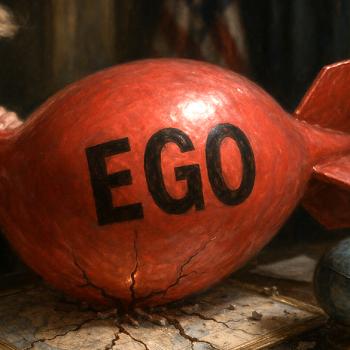
Like Megatron’s gun mode, it solves a problem. It keeps the story running. But it only works if you stop asking certain questions.
The Trinity isn’t dangerous because it’s mysterious. It becomes dangerous when it’s treated as divine math instead of theological scaffolding—when a conceptual solution hardens into unquestionable reality.
At that point, coherence becomes sacred. And when coherence is sacred, people become expendable.
What Happens When Metaphors Harden
Once doctrine shifts from meaning-making to boundary enforcement, curiosity becomes rebellion. Doubt becomes disobedience. Faith turns into a loyalty test rather than a way of life.
History is full of people punished not for causing harm, but for “breaking” theological logic. Not for cruelty, but for asking the wrong questions.
This is what happens when systems confuse their scaffolding for the building itself.
When the Plot Device Is No Longer Needed, the Theology Changes
Here’s the tell that gives everything away.
Once a plot device is no longer necessary, it quietly disappears.
Later versions of Megatron fix the problem. He becomes a tank. A jet. A Cybertronian weapon. The gun fades out. Writers stop explaining it. The universe works better. No one rushes to defend the old logic because the story no longer needs it.
Theology works the same way.
Doctrines evolve. Certainties soften. Explanations shift. Not because truth changed—but because the system did. What once protected power gets reinterpreted, rebranded, or quietly retired.
Despite the rhetoric, theology has never been static. It’s always been responsive.
Let Stories Be Stories Again
You don’t need Megatron to literally function as a gun to understand what he represents.
And you don’t need the Trinity to behave like a cosmic equation to follow the way of Jesus.
Faith was never meant to explain the universe. It was meant to orient us within it—with humility, curiosity, and a willingness to let mystery remain unresolved.
Sometimes the most faithful thing you can do is stop defending the gun mode—and let the story breathe again.
Enjoy this article?
You might also enjoy
The Tribulation Survival Guide

More Snarky Faith
Join the newsletter
Snarky Faith Podcast
Instagram — @stuartdelony
YouTube — @snarkyfaith
Bluesky — @snarkyfaith.bsky.social
Facebook — facebook.com/snarkyfaith
Snarky Faith merch — available here















 Ad-Free & Subscriber Log-In