

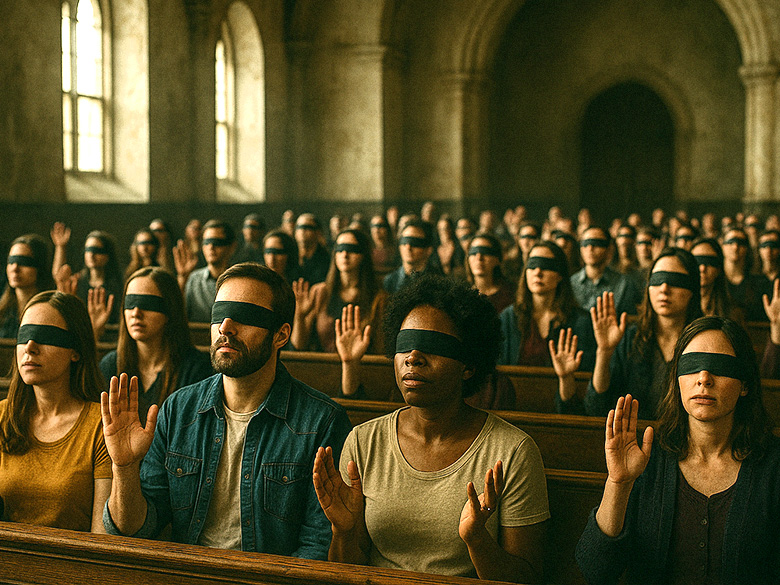
Sunday morning smells like coffee and false certainty. The lobby hums with “How are yous?” that mean “Don’t tell me,” and the band is tuning up for a setlist that promises transcendence in four chords or less. This is community—at least that’s what we call it. Strangers gather, eyes closed, arms raised, feeling connected because they’re singing the same song about the same invisible friend. It works. It really works. And it shouldn’t. None of this holds together without the story—true or not. Which begs the question: Why do we need to believe in something bigger, even when it’s bullshit?
The Power of the Lie
Belief is social superglue. Declare allegiance to the same myth, and you’re instantly part of the “we.” You’re not just Jane; you’re “Jane, beloved daughter of the King.” You’re not just Joe; you’re “Joe, brother in Christ.” Myth flattens complexity into belonging. It’s simple, comforting, and—most importantly—requires zero evidence.
The lie gives structure to chaos. Life is unpredictable, cruel, and wildly unfair. “God has a plan” is a tidy explanation that beats the cold honesty of “the universe doesn’t care.” It’s the emotional equivalent of bubble wrap—useless against real impact, but nice to hold.
And let’s not pretend the rituals don’t help. Shared actions—singing, kneeling, bread-breaking—bypass reason and wire connection straight into the limbic system. It’s not about thinking; it’s about feeling. Communion wine tastes better when you believe it’s blood.
Hypocrisy? That’s not a bug; it’s the feature that keeps the machine running. Religion lets you project virtue while outsourcing morality. As long as you’re part of the tribe, you’re good—even if you’re not good at all.
The Hole It Fills
Humans want more than survival; we want why. We want to believe our suffering matters, that love isn’t just a chemical reaction, that death isn’t the end of the story. Religion gives us that. Community, in its secular form, can provide support and solidarity, sure—but it rarely delivers transcendence.
“You die, and life goes on” is true. It’s also a marketing disaster. We like hope, even if it’s fabricated. We’ve always preferred bedtime stories to existential dread.
The Mythless Community – Dream or Mirage?
What if we stripped away the pageantry and kept the good stuff—connection, care, mutual aid—without the dogma? It’s not impossible. Secular humanist groups exist. Mutual aid networks thrive. Even fandoms and sports teams create bonds without demanding belief in the supernatural.
But most of these fade over time. Why? Because they lack the sacred anchor. No cosmic why to give the group a sense of permanence. No transcendent narrative to fuel loyalty when things get hard. When there’s nothing “eternal” at stake, people drift.
Which leaves us with the uncomfortable question: Do we really want community without myth—or just a better myth?
The Myth We’re Living Now
We haven’t abandoned myth. We’ve just rebranded it. The nation-state is a myth we pledge allegiance to. Capitalism promises salvation if you believe hard enough. “Progress” is a secular eschatology; “science will save us” is its gospel. Even the cult of individualism—the idea that you alone can define yourself—is just another story we tell to make the void palatable.
We didn’t stop needing the lie. We just swapped God for gods with better PR.
The Hard Truth
Maybe maturity isn’t killing myth; maybe it’s admitting we can’t live without one. Maybe the real question isn’t whether we need the lie, but whether we can choose one that doesn’t exploit, exclude, or demand our ignorance.
Or maybe we’ll keep lying to ourselves because the truth—that we’re all we’ve got—is too heavy to hold alone.
For more Snarky Faith, check out the podcast and more:
- Snarky Faith website
- Snarky Faith on Instagram: @stuartdelony
- Snarky Faith on YouTube: @snarkyfaith
- Snarky Faith on Bluesky: @snarkyfaith.bsky.social
- Snarky Faith Group on Facebook: www.facebook.com/snarkyfaith
- Snarky Faith t-shirts and mugs available here.












 Ad-Free & Subscriber Log-In