

Our reading this week is from the gospel of John.
Now a man named Lazarus was sick. He was from Bethany, the village of Mary and her sister Martha. (This Mary, whose brother Lazarus now lay sick, was the same one who poured perfume on the Lord and wiped his feet with her hair.) So the sisters sent word to Jesus, “Lord, the one you love is sick.”
Welcome Readers! Please subscribe to Social Jesus Here.
This is Part 1 of the series A Story of Hope for our Present Moment
When he heard this, Jesus said, “This sickness will not end in death. No, it is for God’s glory so that God’s Son may be glorified through it.” Now Jesus loved Martha and her sister and Lazarus. So when he heard that Lazarus was sick, he stayed where he was two more days, and then he said to his disciples, “Let us go back to Judea.”
“But Rabbi,” they said, “a short while ago the Jews there tried to stone you, and yet you are going back?”
Jesus answered, “Are there not twelve hours of daylight? Anyone who walks in the daytime will not stumble, for they see by this world’s light. It is when a person walks at night that they stumble, for they have no light.”
After he had said this, he went on to tell them, “Our friend Lazarus has fallen asleep; but I am going there to wake him up . . . ” (John 11:1-45)
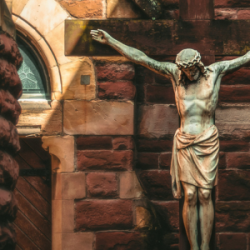
Let’s begin this week with the overall context of our story. In the Gospel of John, the narrative reason for Jesus’ crucifixion differs drastically from the reasons in the Synoptic Gospels. This shift has significant implications for how justice themes are framed today. In Matthew, Mark, and Luke, Jesus’ protest in the Jerusalem Temple is an embodied, public confrontation with economic exploitation and political-religious power and it’s the decisive catalyst for his arrest and execution. The cross is imperial pushback for Jesus’ Temple protest. John, however, relocates the Temple protest to the very beginning of Jesus’ ministry (John 2) and strips it of immediate political consequences. By doing so, the Gospel of John removes a concrete act of economic and social disruption as the closest cause of Jesus’ death.
In John’s narrative, the final trigger for the authorities’ decision to kill Jesus is not a protest against unjust systems but Jesus raising Lazarus from the dead. After Lazarus is restored to life, the political leaders gather and conclude that Jesus must die to prevent Roman intervention and protect the nation. The logic is explicit: the miracle is what makes Jesus too dangerous to live, not his challenge to Temple economics or priestly, political authority. This narrative move reframes the threat Jesus poses. He is not primarily a prophet exposing exploitation; he is a life-giving revealer whose power destabilizes even the cosmic order.
This shift dulls the Gospel’s social edge in at least two ways. We’ll pick up with each of them in Part 2.
Begin each day being inspired toward love, compassion, justice and action. Free.
Sign up at HERE.















 Ad-Free & Subscriber Log-In