

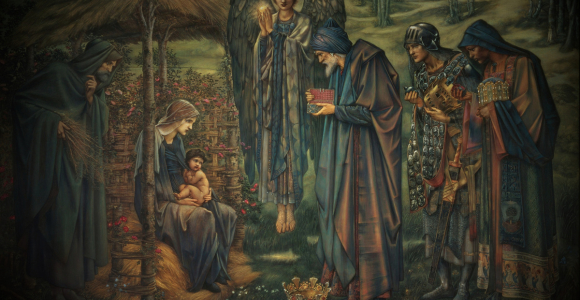
Our reading this week is from the gospel of Matthew:
Now the birth of Jesus the Messiah took place in this way. When his mother Mary had been engaged to Joseph, but before they lived together, she was found to be with child from the Holy Spirit. Her husband Joseph, being a righteous man and unwilling to expose her to public disgrace, planned to dismiss her quietly. But just when he had resolved to do this, an angel of the Lord appeared to him in a dream and said, “Joseph, son of David, do not be afraid to take Mary as your wife, for the child conceived in her is from the Holy Spirit. She will bear a son, and you are to name him Jesus, for he will save his people from their sins.” All this took place to fulfill what had been spoken by the Lord through the prophet:
Welcome Readers! Please subscribe to Social Jesus Here.
This is Part 1 of the series When Christianity Becomes Complicit with Societal Injustice
“Look, the virgin shall conceive and bear a son,
and they shall name him Emmanuel,”
which means, “God is with us.” When Joseph awoke from sleep, he did as the angel of the Lord commanded him; he took her as his wife, but had no marital relations with her until she had borne a son; and he named him Jesus. (Matthew 1:18-25)
The birth narratives of Jesus found in Matthew and Luke emerge in a world saturated with Roman imperial propaganda. We can read them as intentional counter-stories that rivaled prevailing narratives surrounding the birth of Caesar Augustus. In the early Roman Empire, Augustus’ rise was framed as a divinely orchestrated event. Imperial poets and historians portrayed him as born under auspicious signs, heralded by prophecies, and destined to bring a golden age of peace. They said his birth would fulfill cosmic expectations. Inscriptions such as the Priene Calendar Decree called him a “savior” whose arrival marked the beginning of “good news” (or gospel) for the world. These themes formed a powerful ideological backdrop that shaped public imagination.
In this context, early Christians crafted their own contrary birth narratives. These stories don’t simply tell of Jesus’ origins but also deliberately challenge Rome’s theological claims. Luke’s narrative in particular mirrors and subverts imperial motifs. While Augustus issues a decree that sets the story in motion, the real focus is on a child born not in a palace but among the poor. Angels proclaim “good news” of “peace on earth,” echoing Roman language but redirecting it toward a different kind of rule. Instead of imperial conquest, this peace is grounded in human compassion and justice. Matthew’s story likewise positions Jesus in a prophetic lineage superior to Rome and presents him as the true king threatened by unjust power.
By adopting forms familiar from imperial birth legends and filling them with radically different content, the gospel writers offer a theological critique of empire. We’ll explore this a bit further in Part 2.
Begin each day being inspired toward love, compassion, justice and action. Free.
Sign up at HERE.

















 Ad-Free & Subscriber Log-In