


Jesus continues with a promise to “prepare a place.” This promise is not about a distant future. It instead speaks to the active work of making space. His preparation implies intention. Cooperation or alignment with “preparing places” in the midst of a world of injustice looks like dismantling barriers, transgressing boundaries, redistributing resources, and cultivating communities where every person’s humanity is celebrated, embraced, and supported. It is the labor of making “many rooms” visible and accessible here and now.
Welcome Readers! Please subscribe to Social Jesus Here.
This is Part 2 of the series Justice Lessons from the Gospel of John
(Read this series from its beginning here.)
Then Thomas butts in with an honest, vulnerable, and unpolished question that resonates deeply with anyone engaged in this kind of change-making today: “We don’t know where you are going, so how can we know the way?” Our work is often marked by uncertainty about the way. We don’t know the way. The path forward is rarely clear. As the saying goes, we make the road by walking. And in that process, our strategies sometimes fail. Progress is uneven. As we learned two weeks ago from this same Thomas, doubt is not a sign of failure; it is part of honest engagement.
Jesus’ response to the question reframes “the way.” The way is not merely a roadmap or a set of steps. It is also relational, embodied, and lived. For justice practitioners, this means the path is not only about outcomes, but is also about how we walk, how we treat one another, how we center love, how we resist dehumanization even as we confront it.
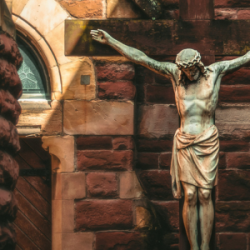
So “Do not let your hearts be troubled” is not a call to passive comfort. It’s an invitation to grounded courage. In the face of injustice, troubled hearts can either harden or deepen. Jesus calls us toward deepening: to trust that there is room enough, love enough, and future enough to sustain our long, uncertain, and necessary work of justice. We will have to endure crosses. Yet the resurrection calls us past those crosses to hope in what will follow next.
Next in our reading, we encounter the gospel of John’s famous declaration, “I am the way and the truth and the life.” These words of Jesus in John are often heard as a boundary marker. Yet in its original context, his statement functions less as exclusion and more as revelation. Jesus is pointing to a way of being in the world that embodies love, compassion and justice. When he tells Philip, “Anyone who has seen me has seen the Father,” Jesus grounds this way of being in his own practice. If we want to know what the Divine is like, what this way of love, compassion, and justice is like, we look at how Jesus himself lived. We stop and take note of the marginalized people who Jesus centered and stood in solidarity with and the systemic injustice that Jesus resisted.
This has direct implications for us, today. We’ll pick up here in Part 3.
Begin each day being inspired toward love, compassion, justice and action. Free.
Sign up at HERE.











 Ad-Free & Subscriber Log-In